


Best SSD for Gaming in South Africa - Updated July 2026
The best SSD for gaming is available at Evetech from R1,599 including VAT, with 58 drives in stock. A PCIe Gen4 NVMe drive at 500GB to 1TB is the recommended pick for most gamers.
Read moreA 1440p gaming monitor is available at Evetech from R3,299 including VAT, with 24 models in stock. QHD is the resolution that balances sharpness against frame rate.
The 1440p gaming monitor category is where most serious PC gamers in South Africa should be shopping in 2026, sitting squarely between the affordability of 1080p and the GPU demands of 4K. QHD resolution gives a real jump in sharpness over Full HD without requiring a flagship graphics card to drive it at high refresh rates. With 24 models in stock, the range runs from a solid 144Hz entry panel to a 260Hz screen built for serious competitive play.
A 1440p gaming monitor is available at Evetech from R3,299 including VAT, with 24 models currently in stock. The range spans 144Hz to 260Hz panels between 27 and 32 inches, all built around QHD resolution. For most gamers running a mid-to-upper-range graphics card, 1440p is the resolution that best balances visual sharpness against how many frames per second you can actually push.
Prices verified 16 July 2026. These are in-stock models at Evetech, cheapest first, and every price includes VAT.
The entry point here, the AOC Q27B36X, already covers the fundamentals: a 27-inch QHD IPS panel at 144Hz, a genuine step up from any 1080p screen. The most interesting decision on this list sits at R3,999, where two very different monitors carry exactly the same price. The Dahua LM32-E330CA gives you a 32-inch panel at 180Hz; the AOC Q27G4/D stays at 27 inches but pushes 200Hz. That is a straight choice between more screen and more refresh rate for the same money, and which one is right depends entirely on what you play. Full current stock is on the gaming monitor range.
Above R4,000 the picture is worth reading carefully. The AOC Q27G4Z at R4,699 is the genuine performance pick of the range, pairing 260Hz with HDR and a 0.3ms response time. The most expensive monitor here, the AOC Q27G4/WS at R4,899, is actually a slower panel at 200Hz; the premium buys the white colourway, not extra speed. If a white build is what you are after, that is a fair trade, but nobody should mistake it for the faster screen. Anything from 144Hz to 200Hz is genuinely competitive for most players, and few people can tell 200Hz from 260Hz without a frame counter on screen. If you already own or plan to buy an Alienware system, their own curated monitor range is worth comparing on the Alienware gaming monitors page.
QHD asks noticeably more of a graphics card than 1080p, roughly 80 percent more pixels per frame, so the monitor and GPU need to be matched. A current mid-range card, such as an RTX 4060 Ti or RTX 5060, will comfortably hit 100fps-plus at 1440p in most titles with settings turned down slightly, while an RTX 5070 or above is what actually lets you chase the 200Hz and 260Hz panels in this list. Pairing a 260Hz monitor with an entry-level GPU is the single most common mismatch buyers make at this price point; the screen will simply never be fed enough frames to use its full refresh rate.
27 inches is the standard size for 1440p and the safest choice for most desks, giving a sharp, detailed image at a normal 60 to 80cm viewing distance. Going to 32 inches, like the Dahua LM32-E330CA, spreads the same QHD pixel count over more screen, which softens perceived sharpness slightly but makes the monitor feel more immersive if you sit further back or want a bigger presence on the desk. Because that 32-inch Dahua and the 27-inch AOC Q27G4/D now sit at the same R3,999, the decision is unusually clean: take the 32-inch panel if you play story and open-world games and sit a little further back, or the 27-inch 200Hz panel if competitive shooters are your priority and you want every frame the screen can show.
A 1440p gaming monitor starts at R3,299 including VAT at Evetech, with 24 models in stock ranging up to R4,899. The fastest panel in the range, a 260Hz screen with HDR, sits at R4,699.
An RTX 4060 Ti or RTX 5060 handles 1440p well at settings that keep frame rates high, while an RTX 5070 or above is needed to properly drive the 200Hz and 260Hz panels in this range.
For most current GPUs, yes. 1440p gives a real jump in sharpness over 1080p without the heavy performance cost of 4K, which is why it has become the default resolution for serious PC gaming.
144Hz to 200Hz covers the vast majority of the real-world benefit; going higher mainly matters for competitive shooter players who can consistently hit those frame rates and want the lowest possible input lag.
27 inches is sharper at a normal desk distance, while 32 inches feels more immersive if you sit further back. Both use the same QHD resolution, so the choice comes down to desk space and seating distance.
Ready to move up to 1440p? Compare every in-stock 1440p gaming monitor with live South African pricing and match the refresh rate to the graphics card you already have.
A 1440p gaming monitor starts at R3,299 including VAT at Evetech, with 24 models in stock ranging up to R4,899. The fastest panel in the range, a 260Hz screen with HDR, sits at R4,699.
An RTX 4060 Ti or RTX 5060 handles 1440p well at settings that keep frame rates high, while an RTX 5070 or above is needed to properly drive the 200Hz and 260Hz panels in this range.
For most current GPUs, yes. 1440p gives a real jump in sharpness over 1080p without the heavy performance cost of 4K, which is why it has become the default resolution for serious PC gaming.
144Hz to 200Hz covers the vast majority of the real-world benefit; going higher mainly matters for competitive shooter players who can consistently hit those frame rates and want the lowest possible input lag.
27 inches is sharper at a normal desk distance, while 32 inches feels more immersive if you sit further back. Both use the same QHD resolution, so the choice comes down to desk space and seating distance.
The best SSD for gaming is available at Evetech from R1,599 including VAT, with 58 drives in stock. A PCIe Gen4 NVMe drive at 500GB to 1TB is the recommended pick for most gamers.
Read more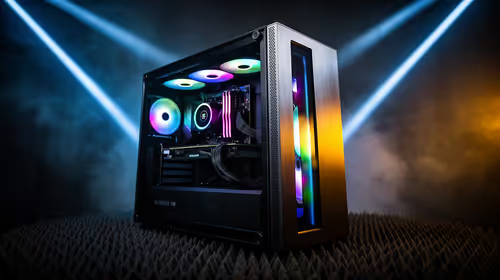
The best streaming PC range is available at Evetech from R20,684 including VAT, with 22 models in stock. Every build pairs a multi-core CPU with an NVENC or Quick Sync capable GPU, so streaming and gaming can run on one machine without stealing frame rate.
Read more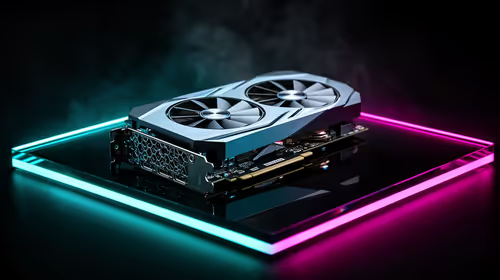
The RTX 5070 is available at Evetech from R11,899 including VAT, with 18 models in stock and most cards priced between R11,899 and R14,000. It is the current 1440p value pick in the NVIDIA 50-series.
Read more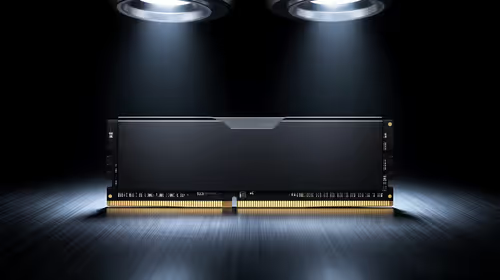
16GB DDR5 RAM is available at Evetech from R3,799 including VAT, with 22 modules in stock. It is the sensible baseline for budget and esports builds.
Read more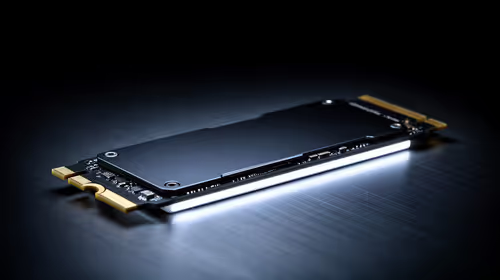
The cheapest 1TB NVMe SSD is available at Evetech from R2,599 including VAT, with 21 drives in stock. 1TB PCIe Gen4 is the current sensible default for a gaming or work PC.
Read more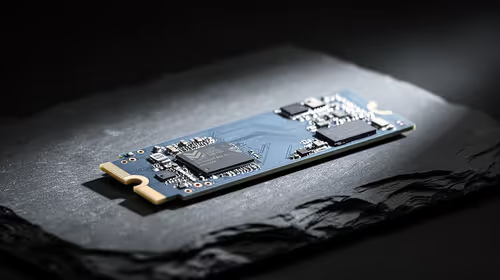
The cheapest 2TB NVMe SSD is available at Evetech from R4,999 including VAT, with 21 drives in stock. 2TB is now the comfortable capacity for a real gaming library.
Read more
Wi-Fi 7 vs Wi-Fi 6e for cinematic story games comes down to router support, latency goals, device compatibility, and coverage. SA buyers should match the choice to the real network setup.
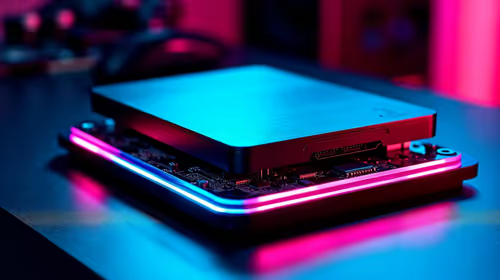
The real world difference between PCIe 5.0 and PCIe 4.0 for MMO and live-service games is usually about loading, patches, and headroom. SA players should weigh NVMe speed, GPU lanes, CPU limits, and platform cost.
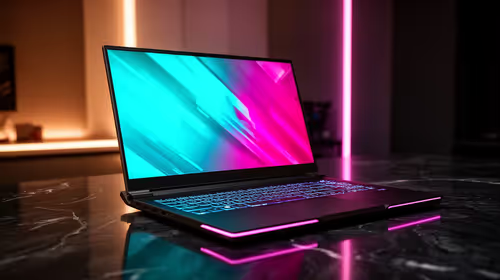
Windows 11 gaming laptop dead pixel checks begin with a full-screen colour test. This how to fix dead pixel windows 11 gaming laptop guide helps SA users compare settings, drivers, external screens, and warranty routes.
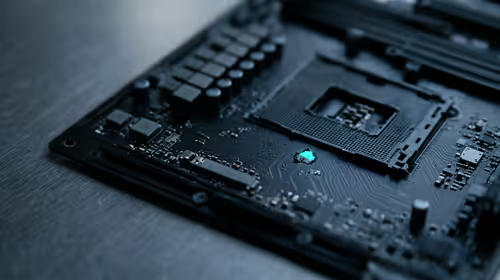
AM5 motherboard stuck pixel fixes in South Africa start with panel, cable, GPU output, and Windows checks. Use a clean test path before blaming the motherboard or replacing screen hardware.

FPS drops blamed on a wireless mouse often point to input, driver, USB, network, or system-load checks. Use a quick SA-friendly troubleshooting flow to isolate software, firmware, thermals, storage, and game settings before replacing hardware.

How to fix fps drops on steam deck starts with power profile, shader cache, storage health, and per-game settings. For South Africa, check charger quality, heat, and download stability before assuming the handheld needs repair. Retest after updates.
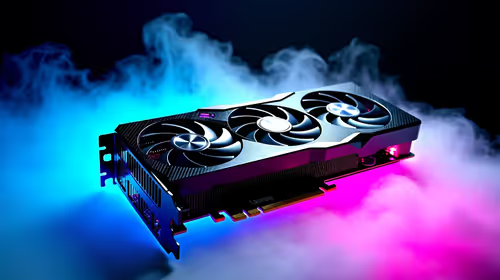
How to fix low FPS after an RTX 5080 build upgrade starts with driver cleanup, display settings, thermals, and power mode. For SA gamers, verify GPU usage, PCIe speed, RAM profile, and CPU limits before changing parts.
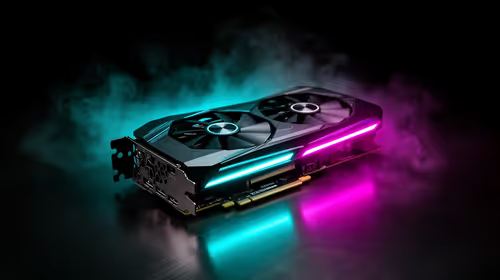
Hollow Knight Silksong at 4K needs a GPU matched to settings, VRAM, CPU balance, and monitor goals. Use this SA guide to compare tiers without treating FPS target or prices as fixed.
The best SSD for gaming is available at Evetech from R1,599 including VAT, with 58 drives in stock. A PCIe Gen4 NVMe drive at 500GB to 1TB is the recommended pick for most gamers.
The best streaming PC range is available at Evetech from R20,684 including VAT, with 22 models in stock. Every build pairs a multi-core CPU with an NVENC or Quick Sync capable GPU, so streaming and gaming can run on one machine without stealing frame rate.
The RTX 5070 is available at Evetech from R11,899 including VAT, with 18 models in stock and most cards priced between R11,899 and R14,000. It is the current 1440p value pick in the NVIDIA 50-series.
16GB DDR5 RAM is available at Evetech from R3,799 including VAT, with 22 modules in stock. It is the sensible baseline for budget and esports builds.