


Best SSD for Gaming in South Africa - Updated July 2026
The best SSD for gaming is available at Evetech from R1,599 including VAT, with 58 drives in stock. A PCIe Gen4 NVMe drive at 500GB to 1TB is the recommended pick for most gamers.
Read moreA 240Hz gaming monitor is available at Evetech from R2,199 including VAT, with 15 models in stock, every one pairing 240Hz with Full HD resolution.
A 240Hz gaming monitor exists for one reason: to shave every possible millisecond off the time between your mouse moving and the screen showing it. This is the category for players who take competitive shooters seriously, where the difference between 144Hz and 240Hz shows up as smoother tracking and a fractionally faster read on enemy movement. With 15 models in stock at Evetech, all built around Full HD for maximum frame rate, here is what the current range costs.
A 240Hz gaming monitor is available at Evetech from R2,199 including VAT, with 15 models currently in stock. Every panel on this list pairs 240Hz with Full HD resolution, which is a deliberate combination: keeping resolution low is what makes 240 frames per second achievable without needing a flagship graphics card. This is the monitor category built specifically for competitive online games, not general use.
Prices verified 16 July 2026. These are in-stock models at Evetech, cheapest first, and every price includes VAT.
Every model here hits the same headline number, 240Hz, so the price differences come down to screen size and panel quality rather than speed. The Dell SE2426HG opens the range at R2,199 on a 24-inch IPS panel, which is genuinely all most competitive players need. Stepping up to 27 inches, as with the ViewSonic VX2779A-HD-PRO and Dahua LM27-E241B, costs a few hundred Rand more for a larger field of view without sacrificing the 240Hz refresh. See the full range on the gaming monitor page.
Since every panel here is already 240Hz, the smarter question is what else matters: response time, panel type and port selection. IPS panels, like the Dell and both IPS-labelled ViewSonic models, give better colour and viewing angles than older TN technology while still hitting the same refresh rate, so there is little reason to choose a non-IPS 240Hz panel today. Check the full monitor range if you also want to compare against 1080p options at lower refresh rates for a cheaper alternative.
240Hz is a genuine, measurable upgrade over 144Hz for competitive shooters like Valorant and CS2, where fast, precise tracking is the whole game, but it is not a universal recommendation. To see real benefit you need a GPU capable of consistently hitting frame rates near 240fps, which at 1080p is achievable for most current mid-range cards in lighter competitive titles, but not in demanding AAA games. If you mostly play story-driven or graphically heavy games, a 144Hz 1440p monitor will look and feel better than a 240Hz 1080p one; 240Hz is a specialist tool for a specific kind of player.
Because every monitor in this list is Full HD, the GPU demand stays reasonable compared to chasing 240Hz at 1440p or 4K, which is a far heavier ask. A current mid-range card can hit close to 240fps in esports titles like Valorant, CS2 and Rocket League with settings tuned down, which is exactly the audience these monitors are built for. If you are aiming for 240fps in a heavier game, you will need a considerably stronger GPU, and the frame rate ceiling becomes the card, not the monitor.
A 240Hz gaming monitor starts at R2,199 including VAT at Evetech, with 15 models in stock, all pairing 240Hz with Full HD resolution.
For competitive shooters, yes, many players can feel the difference in tracking and responsiveness. For general and story-driven gaming, the difference is far less noticeable and a 144Hz 1440p monitor is usually the better all-round choice.
A current mid-range GPU can hit close to 240fps at 1080p in lighter esports titles like Valorant and CS2. Heavier games need a considerably stronger card to actually reach that frame rate.
Keeping resolution at 1080p is what makes 240fps achievable without extreme GPU power. 240Hz 1440p and 4K monitors exist, but they demand far more from your graphics card to hit their full refresh rate.
Ready to go 240Hz? Browse every in-stock 240Hz gaming monitor at Evetech with live South African pricing and find the panel size that fits your desk.
A 240Hz gaming monitor starts at R2,199 including VAT at Evetech, with 15 models in stock, all pairing 240Hz with Full HD resolution.
For competitive shooters, yes, many players can feel the difference in tracking and responsiveness. For general and story-driven gaming, the difference is far less noticeable and a 144Hz 1440p monitor is usually the better all-round choice.
A current mid-range GPU can hit close to 240fps at 1080p in lighter esports titles like Valorant and CS2. Heavier games need a considerably stronger card to actually reach that frame rate.
Keeping resolution at 1080p is what makes 240fps achievable without extreme GPU power. 240Hz 1440p and 4K monitors exist, but they demand far more from your graphics card to hit their full refresh rate.
The best SSD for gaming is available at Evetech from R1,599 including VAT, with 58 drives in stock. A PCIe Gen4 NVMe drive at 500GB to 1TB is the recommended pick for most gamers.
Read more
The best streaming PC range is available at Evetech from R20,684 including VAT, with 22 models in stock. Every build pairs a multi-core CPU with an NVENC or Quick Sync capable GPU, so streaming and gaming can run on one machine without stealing frame rate.
Read more
The RTX 5070 is available at Evetech from R11,899 including VAT, with 18 models in stock and most cards priced between R11,899 and R14,000. It is the current 1440p value pick in the NVIDIA 50-series.
Read more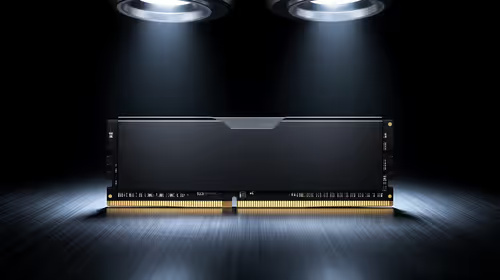
16GB DDR5 RAM is available at Evetech from R3,799 including VAT, with 22 modules in stock. It is the sensible baseline for budget and esports builds.
Read more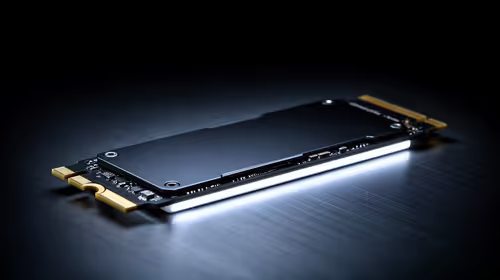
The cheapest 1TB NVMe SSD is available at Evetech from R2,599 including VAT, with 21 drives in stock. 1TB PCIe Gen4 is the current sensible default for a gaming or work PC.
Read more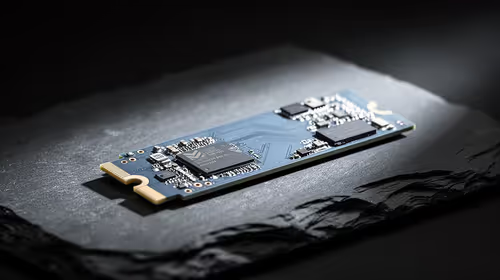
The cheapest 2TB NVMe SSD is available at Evetech from R4,999 including VAT, with 21 drives in stock. 2TB is now the comfortable capacity for a real gaming library.
Read more
Wi-Fi 7 vs Wi-Fi 6e for cinematic story games comes down to router support, latency goals, device compatibility, and coverage. SA buyers should match the choice to the real network setup.
The real world difference between PCIe 5.0 and PCIe 4.0 for MMO and live-service games is usually about loading, patches, and headroom. SA players should weigh NVMe speed, GPU lanes, CPU limits, and platform cost.
Windows 11 gaming laptop dead pixel checks begin with a full-screen colour test. This how to fix dead pixel windows 11 gaming laptop guide helps SA users compare settings, drivers, external screens, and warranty routes.
AM5 motherboard stuck pixel fixes in South Africa start with panel, cable, GPU output, and Windows checks. Use a clean test path before blaming the motherboard or replacing screen hardware.
FPS drops blamed on a wireless mouse often point to input, driver, USB, network, or system-load checks. Use a quick SA-friendly troubleshooting flow to isolate software, firmware, thermals, storage, and game settings before replacing hardware.

How to fix fps drops on steam deck starts with power profile, shader cache, storage health, and per-game settings. For South Africa, check charger quality, heat, and download stability before assuming the handheld needs repair. Retest after updates.
How to fix low FPS after an RTX 5080 build upgrade starts with driver cleanup, display settings, thermals, and power mode. For SA gamers, verify GPU usage, PCIe speed, RAM profile, and CPU limits before changing parts.
Hollow Knight Silksong at 4K needs a GPU matched to settings, VRAM, CPU balance, and monitor goals. Use this SA guide to compare tiers without treating FPS target or prices as fixed.
How to fix FPS drops after a Ryzen 9 9950X3D starts with BIOS, chipset, EXPO, power, and GPU driver checks. It helps isolate upgrade stutter on high-end SA gaming rigs before you change hardware, reinstall Windows, or retune cooling.
PCIe 5.0 and PCIe 4.0 differ most in lane support, compatibility, and upgrade value for cinematic story games. SA buyers should match the choice to their actual hardware and games.
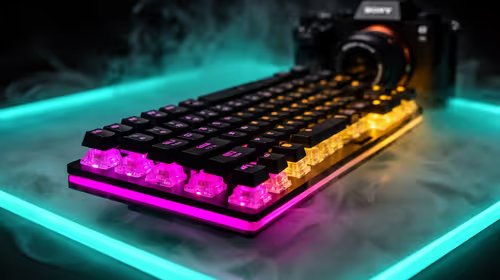
FPS drops Windows 11 mechanical keyboard issues can come from USB polling, keyboard utilities, power settings, or overlays. This gaming checklist helps test input-device causes before deeper GPU or CPU troubleshooting.
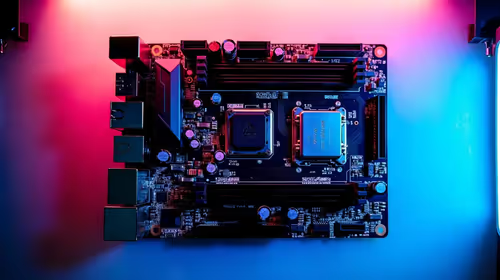
ATX 3.1 vs ATX 3.0 for streaming on Twitch and YouTube buyers - what changes is mostly about compatibility, budget, upgrade path, and setup fit. SA buyers should check device support and real needs before expecting a clear win from either option.