So, you’ve caught the AI bug. Maybe you’re a gamer using DLSS to boost frame rates, a creator using generative fill in Photoshop, or a student tinkering with local AI models. The world of Artificial Intelligence is no longer just for data scientists in labs… it’s right here on our desktops. 💻
But building a PC for AI can feel confusing. This isn't your average gaming rig build. This AI PC build guide is here to help you choose the right parts for your specific task.
First, What Is Your AI Task?
Before you even think about parts, you need to know what you'll be doing. AI workloads generally fall into two camps: training and inference.
- Training: This is teaching an AI model from scratch. It's incredibly demanding and needs top-tier hardware, something usually reserved for enterprise-level machines.
- Inference: This is using a pre-trained model to perform a task, like upscaling an image or generating text. This is what most of us will be doing, and it's much more achievable on a consumer PC.
Here are the most common AI tasks for a home build:
- AI-Enhanced Gaming & Streaming: Think NVIDIA DLSS, AMD FSR, and Intel XeSS for higher frame rates, or tools like NVIDIA Broadcast for cleaning up your mic audio. This is all about real-time inference.
- AI-Powered Content Creation: Software like Adobe Premiere Pro and DaVinci Resolve use AI for object tracking, scene detection, and transcription. This requires a balanced PC.
- Local AI Model Experimentation: Running models like Stable Diffusion to generate images or a local LLM (Large Language Model) to have a private chatbot. This is the most demanding consumer task and is all about GPU memory.
The Core Components for Your AI PC Build
Choosing parts for an AI PC involves prioritising differently than a pure gaming build. Let's break down the key components.
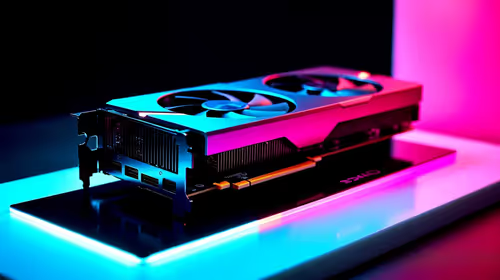
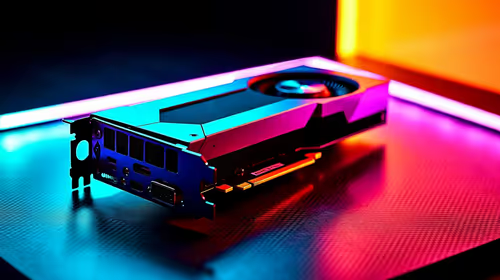
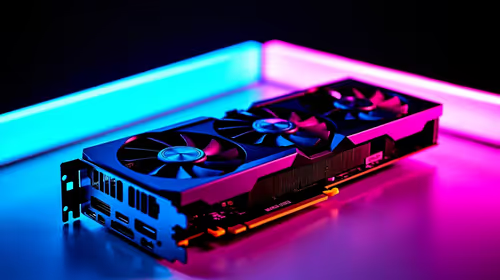
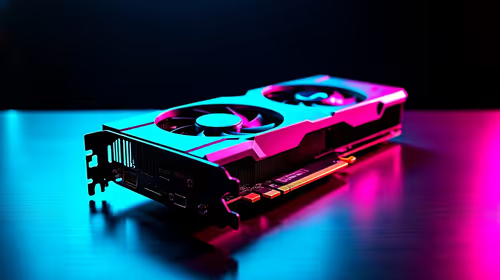
The GPU: The Heart of AI Performance 🚀
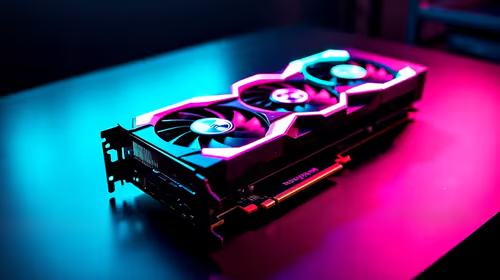
The Graphics Processing Unit (GPU) is, without a doubt, the most important component in your AI PC build. Its ability to perform thousands of calculations in parallel is exactly what AI models need to function efficiently.
When choosing a GPU, VRAM (video memory) is king. It determines the size and complexity of the AI models you can run locally. 8GB is the absolute minimum, 12GB is a good sweet spot for many tasks, and 16GB or more is ideal for serious experimentation.
- NVIDIA: With its CUDA platform and Tensor Cores, NVIDIA has long been the leader in the AI space. For anyone serious about AI, exploring the range of NVIDIA GeForce gaming PCs is the best place to start.
- AMD: Team Red offers fantastic value and performance. While their AI software support (ROCm) is still maturing compared to CUDA, their powerful hardware makes AMD Radeon gaming PCs a strong contender, especially for gaming and creative workloads.
- Intel: As the newest player, Intel is making waves. Their Arc GPUs offer impressive features for their price point, making Intel Arc gaming PCs an interesting option for those on a budget who want to explore AI-powered creation tools.
Check Your Software First! 🔧
Before buying a GPU for a specific creative app, check which hardware it supports best. Many professional programs are heavily optimised for NVIDIA's CUDA platform. A quick Google search for "[Your Software] + CUDA support" can save you a massive headache and ensure you get the performance you're paying for.
The CPU: The Brains of the Operation
While the GPU does the heavy lifting, the Central Processing Unit (CPU) is still vital. It manages the operating system, prepares data for the GPU, and handles tasks that can't be easily parallelised. For an AI PC, you don't need the absolute best CPU on the market, but a modern processor with a good core count is essential.
- Intel: With strong single-core performance and the introduction of NPUs (Neural Processing Units) in their latest chips to accelerate smaller AI tasks, Intel is a solid choice. Check out the latest Intel PC deals for a balanced build.
- AMD: Ryzen CPUs are famous for their excellent multi-core performance, which is brilliant for multitasking… like running an AI process in the background while you work on other things. The value offered by AMD Ryzen PC deals is hard to ignore.
RAM & Storage: Don't Skimp on Speed
RAM: For a modern AI and creative workflow, 16GB is the minimum, but 32GB of fast DDR4 or DDR5 RAM is the new sweet spot. It allows you to load larger datasets and models into memory, preventing system slowdowns.
Storage: A fast NVMe SSD is non-negotiable. AI models and datasets can be huge, and a slow drive will leave you staring at loading screens for ages. A 1TB drive is a good start, but 2TB will give you much more breathing room.
Putting It All Together: Sample AI Build Tiers
So, what does this look like in practice? This part of our AI PC build guide breaks it down into practical tiers.
The Entry-Level AI Explorer ✨
This build is for the gamer who wants to leverage AI features like DLSS and the budding creator using AI-assisted tools. The focus is on a great GPU with at least 8-12GB of VRAM and a capable modern CPU. Many of our budget gaming PCs fit this profile perfectly, offering a fantastic entry point into the world of AI.
The Prosumer & Creator Powerhouse
This is for the user who wants to run local AI models like Stable Diffusion, edit 4K video with AI tools, and enjoy high-end gaming. You're looking at a GPU with 16GB+ of VRAM, 32GB or more of system RAM, and a powerful multi-core CPU. These specifications are often found in high-end gaming rigs or dedicated workstation PCs, which are built for sustained, heavy workloads.
The "I Don't Want the Hassle" Solution
Let's be honest… not everyone has the time or desire to pick every part and assemble a PC from scratch. If you want a powerful, professionally built machine that's tested and ready to go, exploring Evetech's wide range of pre-built PC deals is the smartest move. You get all the performance without any of the stress.
Ready to Build Your AI Powerhouse? This AI PC build guide is your starting point. The perfect machine depends on your mission, whether it's gaming, creating, or experimenting. Don't want the hassle of building? Explore our best gaming PC deals and find a professionally assembled rig ready to crush any task you throw at it.