Building a new PC in South Africa? You’re probably focused on the GPU and CPU, but there’s a silent hero that deserves just as much attention: the cooler. With our warm climate, choosing between air cooling vs AIO (All-In-One) liquid cooling isn’t just about aesthetics… it’s about survival. Get this choice wrong, and you could be facing thermal throttling when you can least afford it. Let's break down which option is right for your rig.
The Great Debate: Air Cooling vs AIO Coolers
At its core, the job of a CPU cooler is simple: move heat away from your processor. But how they do it is where the air cooling vs AIO debate really heats up. Choosing the right one from the sea of available CPU coolers can feel overwhelming, but it boils down to two main philosophies.
Traditional Air Coolers: The Stalwart Guardian 🔧
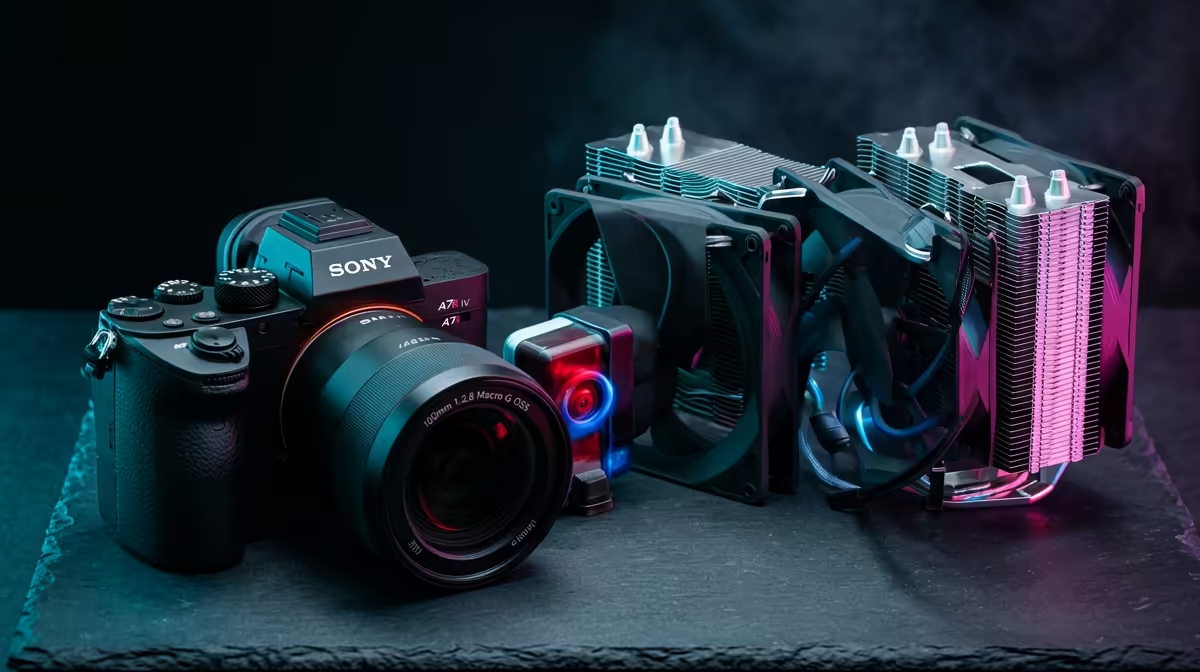
An air cooler is a classic for a reason. It uses a combination of a metal heatsink (usually aluminium and copper) and fans. Heat pipes draw thermal energy from the CPU into a large fin stack, and a fan blows cool air over the fins to dissipate it. Simple, effective, and reliable.
AIO Liquid Coolers: The High-Tech Solution ✨
An AIO is a sealed, pre-filled liquid cooling loop. It consists of a water block that sits on your CPU, tubes that carry liquid, a radiator, and fans. The liquid absorbs heat from the CPU, travels to the radiator, where fans cool it down, and then cycles back. It's a more complex system designed for maximum heat transfer.
Breaking Down the Air Cooler Advantage
Don't mistake simplicity for weakness. A high-end air cooler can easily compete with many AIOs, especially in the mid-range.
Their biggest advantage is reliability. With fewer moving parts (just the fan), there's less that can go wrong. There are no pumps to fail or liquids to worry about. For builders who want a "set it and forget it" solution, a quality air cooler is tough to beat. They are also often more budget-friendly, giving you excellent performance-per-Rand.
Why AIO Liquid Coolers Rule the Roost
So, why would anyone choose a more complex AIO? Three reasons: peak performance, aesthetics, and case airflow.
An AIO's main strength is its ability to handle high thermal loads and sudden temperature spikes. When your overclocked i9 or Ryzen 9 CPU is under full load, an AIO can move that intense heat away from the socket and directly out of your case more efficiently. This often results in lower peak temperatures.
Plus, they just look clean. A compact water block gives your build a modern, uncluttered look and provides excellent clearance for tall RAM modules. Brands like Corsair are famous for their sleek designs and RGB lighting that can become the centrepiece of your rig.
AIO Pro Tip ⚡
Always try to mount your AIO radiator higher than the pump (the part on the CPU). This ensures any tiny air bubbles in the loop get trapped in the radiator, not the pump. It keeps your AIO running quieter and extends its lifespan significantly!
Heat and Airflow Considerations
Here’s where the AIO vs air cooling discussion gets specific to us.
During a blistering Highveld summer, every degree counts. An AIO cooler excels here by exhausting the CPU's heat directly outside the case. A traditional air cooler, on the other hand, dissipates that heat inside the case, raising the ambient temperature for your other components like the GPU. In a hot room, a quality GAMDIAS AIO liquid cooler can make a real difference to your system's overall stability.
Dust is another enemy. While both types of coolers collect dust, the dense fin stacks on some large air coolers can be tricky to clean thoroughly. A radiator is often easier to access and clean with compressed air.
So, Which CPU Cooler is Right For Your Build? 🚀
The best choice in the air cooling vs AIO showdown depends entirely on you. Let’s make it simple.
You should probably choose an Air Cooler if:
- You prioritise reliability and simplicity.
- Your budget is a key consideration.
- You're not planning on extreme overclocking.
- You want a straightforward installation. You'll find excellent value with brands like GAMDIAS that offer fantastic air cooling solutions.
You should seriously consider an AIO Liquid Cooler if:
- You're running a high-end, high-heat CPU (e.g., Core i9, Ryzen 9).
- You want to push your system with heavy overclocking.
- A clean, minimalist aesthetic is important to your build.
- Your case has good radiator support. A 240mm AIO is often the sweet spot for performance and compatibility in most modern cases.
Ultimately, both are fantastic technologies. The decision isn't about which is better overall, but which is better for your specific PC build, right here in South Africa.
Ready to Tame Your Temps?
The air cooling vs AIO debate comes down to your build, budget, and performance goals. Whether you need a rock-solid air tower or a high-performance liquid cooler, the right choice is waiting. Explore our massive range of CPU coolers and give your PC the cooling it deserves.