Quick Answer
The best motherboards for a Ryzen 7 9800X3D gaming build in South Africa are the MSI MAG X670E Tomahawk WiFi and the ASUS ROG Strix B650E-F Gaming, both offering robust VRM delivery, PCIe 5.0 support, and good overclocking headroom. The B650E boards deliver excellent value for pure gaming builds while X670E adds connectivity flexibility for more demanding use cases.
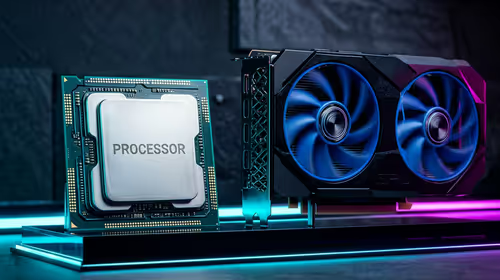
The Ryzen 7 9800X3D is the gaming CPU of the current generation - AMD's 3D V-Cache technology stacks cache directly on the processor die, dramatically reducing latency in game workloads and delivering frame rates that comfortably beat far more expensive chips in heavily threaded and cache-sensitive titles. Choosing the right AM5 motherboard for this chip in South Africa means balancing VRM quality, feature set, and price against a backdrop of rand-priced hardware that can range from R3,000 to R9,000 for an X670E flagship.
Understanding What the 9800X3D Needs from a Motherboard
The Ryzen 7 9800X3D has a 120W TDP under typical gaming loads, making VRM demands relatively modest compared to the 9950X or extreme workstation chips. However, sustained workloads like streaming while gaming, content creation, or heavy multitasking push power delivery requirements higher. A motherboard with a 12+2 or better power stage configuration handles the 9800X3D comfortably with headroom to spare. The other key consideration is memory support - the 9800X3D benefits strongly from fast DDR5 (6000MHz to 6400MHz) due to the memory subsystem's interaction with the V-Cache, so a board with a strong memory controller and broad QVL support matters for getting the most from your RAM.
B650E vs X670E: The SA Value Decision
For a pure gaming build in South Africa, a B650E motherboard is the sweet spot. B650E boards support PCIe 5.0 for the primary GPU slot, DDR5, and all the connectivity the 9800X3D needs, at R3,500 to R5,500 - typically R2,000 to R3,000 less than equivalent X670E boards. The ASUS ROG Strix B650E-F Gaming and MSI MAG B650 Tomahawk WiFi are both strong choices at this tier, offering solid VRMs, dual M.2 slots, PCIe 5.0 GPU support, and Wi-Fi 6E. X670E makes sense if you want two PCIe 5.0 M.2 slots for high-speed SSDs in addition to the GPU lane, need more USB 4 or Thunderbolt connectivity, or intend to run multiple graphics cards (though this is rarely relevant for gaming). The extra spend is justifiable for a content creation or streaming workstation, less so for a dedicated gaming rig.
Top Motherboard Recommendations for the 9800X3D in SA
The MSI MAG X670E Tomahawk WiFi is the recommendation for builders who want X670E at an accessible price point. It delivers a 14+2+1 power stage with 90A power stages, dual M.2 slots (one PCIe 5.0), HDMI and DisplayPort for iGPU output, Wi-Fi 6E, and a comprehensive rear IO. Local pricing typically sits between R4,500 and R5,500, making it the most affordable entry into X670E territory. For B650E, the ASUS ROG Strix B650E-F Gaming offers premium build quality, four M.2 slots, excellent BIOS with strong memory overclocking support, and an aesthetically clean design that suits mid-tower builds. It typically prices between R4,000 and R5,000 locally. Budget-conscious builders should consider the MSI B650 Gaming Plus WiFi at R3,000 to R3,500 - it sacrifices some premium features but its VRM is perfectly adequate for the 9800X3D under gaming conditions.
BIOS and Memory Tuning for Maximum 9800X3D Performance
One of the most impactful free performance upgrades for the 9800X3D is running memory at 6000MHz with AMD's EXPO profile. Most premium B650E and X670E boards support this out of the box with a single BIOS toggle. Beyond that, AMD's Precision Boost Overdrive (PBO) can be enabled to allow the CPU to pull more power and push clocks slightly higher in sustained workloads - it's fully supported on all mentioned boards. The 9800X3D benefits from keeping the CPU die temperature below 89 degrees Celsius, which is the thermal threshold where the V-Cache protection mechanism begins pulling back performance. Ensure your chosen board's power limits are set correctly in BIOS for efficient thermal behaviour.
Frequently Asked Questions
Q: Does the Ryzen 7 9800X3D work in B550 or X570 boards?
A: No. The 9800X3D uses the AM5 socket which is not backward compatible with AM4 boards. AM4 boards use DDR4 and have a different socket, making them physically and electrically incompatible.
Q: Is there a difference in gaming FPS between B650E and X670E boards with the 9800X3D?
A: In gaming specifically, there is no meaningful FPS difference between equivalent B650E and X670E boards running the same CPU and RAM configuration. The performance difference only emerges in connectivity-intensive workloads or when the X670E board's additional PCIe 5.0 lanes are actively used.
Q: What DDR5 speed is optimal for the Ryzen 7 9800X3D?
A: 6000MHz CL30 is the widely recommended sweet spot - it sits at a 1:1 memory fabric ratio which AMD's architecture prefers, and provides a significant cache latency reduction versus 4800MHz stock speeds. Pushing beyond 6400MHz yields diminishing returns for most gaming titles.
Q: Are AM5 boards future-proof for next-gen AMD CPUs?
A: AMD has committed to AM5 socket support through at least 2027 and potentially beyond. Ryzen 9000-series chips use AM5, and future generations are expected to maintain compatibility, making an AM5 board purchase today a reasonable long-term investment.