Budget Architecture: Building Your Production Foundation 🎵
A complete music production setup under R30,000 demands prioritisation: CPU/DAW (R8,000), Audio Interface (R5,000), Monitors (R6,000), Microphone (R4,000), Acoustic Treatment (R3,000), Peripherals (R4,000). This allocation ensures your productions achieve professional quality limited only by your mixing skill, not equipment inadequacy. Neglecting any category cripples the whole system; an excellent microphone paired with untreated room acoustics produces muddy recordings, making investment balanced across categories essential.
For SA producers with loadshedding concerns, prioritise equipment that functions without internet connectivity. Local DAWs running on your machine provide independence from cloud-based services that disconnect during power loss.
Computer and DAW Selection: The Production Engine 💻
Allocate R8,000 here. This funds either: a used gaming laptop (R7,000–8,000 with adequate CPU—8-core processor minimum) running a mid-tier DAW, or a budget desktop (R6,000 components + monitor) with identical specs. Specs matter: 16GB RAM minimum, SSD-only storage, i7/Ryzen 7-equivalent processor. These enable 20+ simultaneous VST plugin instances without CPU throttling.
DAW selection: Purchase Ableton Live Intro (R1,100 one-time licence, limited but functional), or use free alternatives like Reaper (R500 one-time donation). Avoid renting subscription DAWs (FL Studio subscription R200/month adds up); one-time purchase models preserve budget for other components. Ableton Live Intro or Reaper handles mixing, synthesis, and audio editing adequately for semi-professional production.
Audio Interface: Your DAW-to-Hardware Bridge 🔌
Allocate R5,000. Purchase an 8-channel audio interface like the Focusrite Scarlett 2i2 (3rd gen, approximately R2,500–3,000 locally) or Audient iO4 (R3,000–4,000). These provide audio I/O quality superior to onboard laptop audio, with low-latency drivers stable across Windows 11. Avoid ultra-budget interfaces (R600 noise floors undermine recording quality); equally, avoid flagship interfaces costing R10,000+ (marginal audio quality improvement doesn't justify 3x cost).
Multi-channel I/O (8 channels) enables simultaneous recording of multiple instruments (drums + bass + vocals simultaneously), critical for live band recording or podcast production. Loadshedding consideration: choose interfaces powered via USB (no external power supply required); this ensures operation via laptop/UPS power without dependency on wall outlets.
Studio Monitors: Hearing Accurate Truth 👂
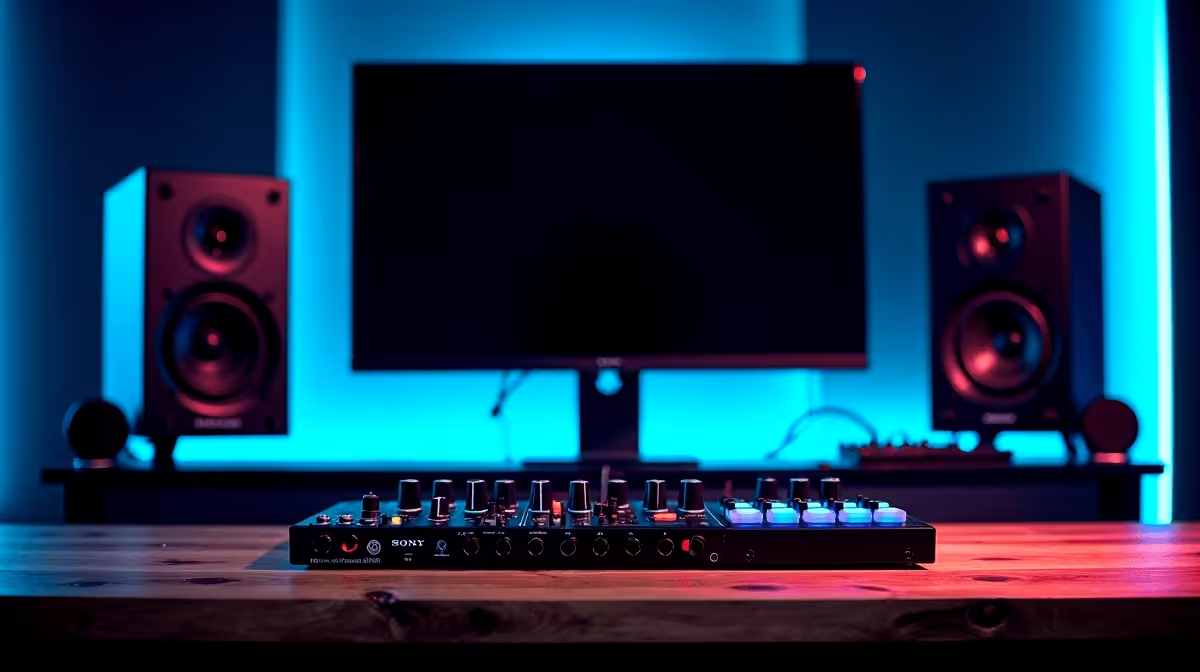
Allocate R6,000. Pair of nearfield studio monitors (5-inch woofer, 1-inch tweeter approximately) like KRK Rokit 5 G4 (R3,500–4,000 per pair locally) or Adam Audio T5V (R3,800–4,500). These deliver flat frequency response essential for mixing—consumer speakers emphasise bass/treble, deceiving you into mixing with incorrect balance. Studio monitors eliminate this deception.
Placement: position monitors at ear level, forming 60-degree triangle with your listening position (you at apex, monitors at base corners). This stereo sweet spot provides accurate imaging—critical for balancing vocals left-right in stereo mixes. South African humidity and temperature variation can stress cheap speaker components; invest in quality monitoring to ensure multi-year reliability.
Monitor stands (R800–1,200 per pair) prevent bass boom from speaker vibration coupling to your desk—essential acoustic treatment often overlooked by budget builders.
Microphone and Accessories: Capturing Performance 🎤
Allocate R4,000. Purchase a large-diaphragm condenser microphone like the Audio-Technica AT2035 (R2,200–2,800) or AKG P220 (R2,500–3,200). These excel at vocal recording, instrument mic'ing (acoustic guitar, trumpet, etc.), and podcast dialogue. Skip USB-only mics; this setup requires XLR connectivity via your audio interface.
Accessories: phantom power cable (R150, included with most interfaces), XLR mic cable 5m (R200), pop filter (R150–300), mic stand with boom arm (R400–600), shock mount (R300–500). These peripherals ensure your microphone captures clean signal without environmental noise or cable interference.
Music Production Pro Tip ⚡
Microphone placement impacts recording quality more than the microphone itself. Position the mic 20cm from source, at 45-degree angle to avoid plosives (harsh "P" sounds) and sibilance (exaggerated "S" sounds). A R2,500 microphone placed ideally outperforms a R8,000 mic placed carelessly. Treat placement as component you're purchasing, not afterthought.
Acoustic Treatment: Controlling Your Environment 🎙️
Allocate R3,000. Absorptive panels (bass traps, absorption blankets) address room reflections that corrupt recordings. Cheap bedsheet-based treatment proves ineffective; invest in actual acoustic foam (R80–150 per 30×30cm panel). Your bedroom or office requires 6–10 panels minimum: three behind listening position (rear wall), two on side walls, two at first-reflection points.
Bass traps (thicker 10cm foam) address low-frequency room resonance—essential in SA concrete homes where bass builds destructively. Position 5–8 bass traps in room corners; they're expensive (R500–800 each) but transform mixing accuracy by eliminating false bass emphasis your room creates.
Don't obsess over perfection; even partial acoustic treatment (6 panels, 2 bass traps) dramatically improves over untreated environments. Loadshedding planning: ensure treatment installation uses non-permanent mounting (adhesive strips, not wall anchors) to permit reconfiguration if you relocate during stage changes.
Peripherals and Connectivity 📦
Remaining R4,000 budget covers: MIDI keyboard (R1,500–2,000, essential for synth programming), studio headphones (R1,500–2,000, for detailed editing when monitors unavailable), monitor cables (R200), XLR cables (R300), USB cables (R150), power conditioning (R600–800 UPS). These items seem minor individually but collectively determine workflow smoothness.
MIDI keyboard: minimum 25-key, 49-key preferred. Provides intuitive instrument programming versus mouse-only composition. Brands like Akai, Novation, or M-Audio offer budget models (R1,500–2,200) sufficient for semi-professional production.
Software Plugins and Virtual Instruments 🎼
Within your DAW allocation, budget R1,000–2,000 for plugin bundles that expand production capabilities. iZotope RX Elements (noise reduction, audio repair, R400–600), Waves Bundle during sales (occasionally R1,000–1,500 discount sales), or Arturia V Collection Intro (synthesizers, R600–900). Build your plugin library incrementally—don't buy everything at once.
Many quality plugins offer free versions (limiting functionality but providing core tools): Voxengo, Fabfilter Trial, Neural DSP limited editions. Leverage free tools initially; invest in paid plugins once your production outgrows their limitations.
Loadshedding Resilience Considerations 🔋
SA power instability impacts production continuity. Invest R800–1,500 in a UPS system (uninterruptible power supply) providing 2–3 hours laptop operation. This permits graceful shutdown or continued mixing during load-shedding events. Position UPS near your desk, power both computer and audio interface through it.
Cloud backup (Dropbox, Google Drive, locally synchronising R200/year) ensures production files survive hardware failure. Pair cloud backup with external SSD (R800–1,200) local backup—loadshedding shutdowns can corrupt unsaved projects; redundant backup protects against this scenario.
Setup Validation and Mixing Checks 🧪
Once assembled, validate your setup by mixing a reference track (professionally mixed song you know well). Compare your mix against the reference using your monitors. If your mix diverges significantly, your monitoring chain needs calibration: adjust monitor levels, reposition speakers, or add acoustic treatment to address the discrepancy.
CalibrateHz tool (free software) measures monitor frequency response using your microphone; use this to identify room peaks/dips correctable via absorption placement. This scientific approach outperforms guesswork.
Quality Expectations and Advancement 📈
Productions from this R30,000 setup achieve professional quality—comparable to paid studios charging R500–1,000/hour. Your limitations become your mixing skill and artistic vision, not equipment inadequacy. Many SA producers earning full-time income produce from setups identical to this spec.
Advancement path: once generating income, upgrade monitor calibration (add subwoofer for R3,000–4,000), add mastering-grade headphones (Sennheiser HD800S, R8,000+), or invest in room treatment refinement. Don't upgrade prematurely; this foundation supports career growth through years of projects.
Ready to produce professional-quality music in South Africa? Assemble your production setup and transform creative ideas into polished tracks. Explore Audio Interfaces and Streaming Equipment.