


Best SSD for Gaming in South Africa - Updated July 2026
The best SSD for gaming is available at Evetech from R1,599 including VAT, with 58 drives in stock. A PCIe Gen4 NVMe drive at 500GB to 1TB is the recommended pick for most gamers.
Read moreProgramming laptops are available at Evetech from R13,299 including VAT, with 1,405 models in stock. The ASUS Vivobook X1504ZA stands out with 40GB of memory at R13,499.
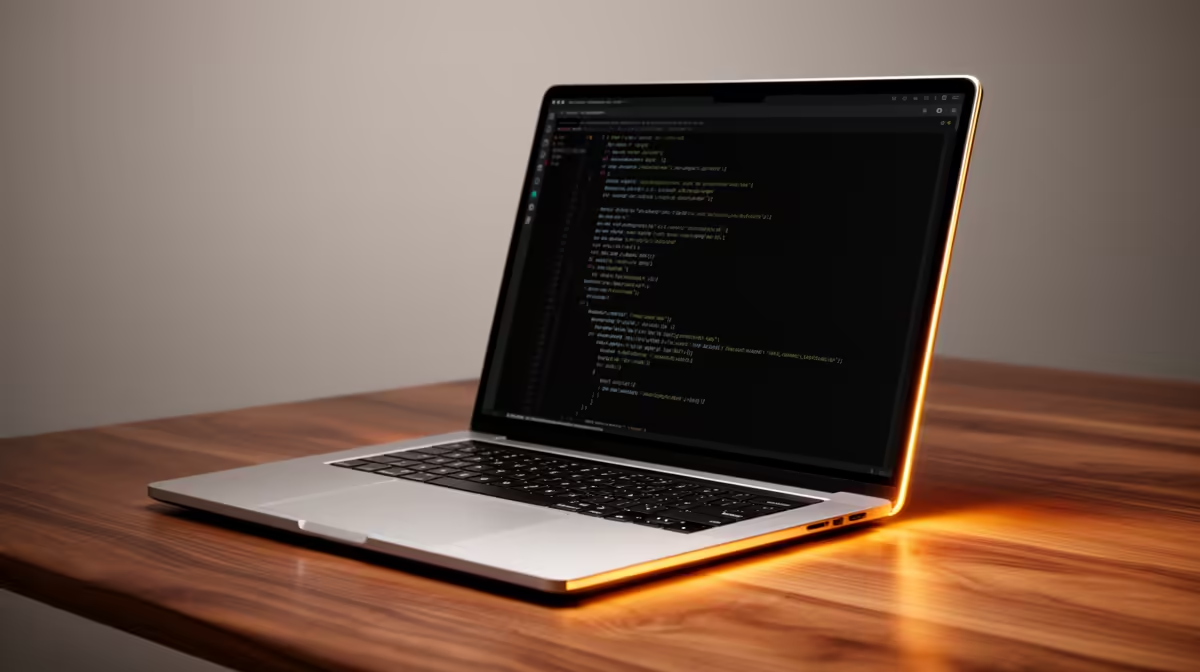
Ask ten developers what makes the best laptop for programming and you will get ten opinions on operating systems, but almost all of them agree on one thing: memory decides how the machine feels once a real project is open. An editor, a running dev server, a browser full of documentation and a container or two will eat RAM fast, long before the processor becomes the bottleneck. What makes the current lineup interesting is that R13,499 buys three completely different machines, and only one of them is built for that reality.
Programming laptops are available at Evetech from R13,299 including VAT, with 1,405 models in stock. Three machines share that entry price with 16GB of memory each, but the standout sits R200 higher: the ASUS Vivobook X1504ZA at R13,499 ships with 40GB, a figure you almost never see below R20,000 and a genuine advantage when several development tools are running at once.
Prices verified 16 July 2026. These are in-stock models at Evetech, cheapest first, and every price includes VAT.
The bottom three lines are the ones worth staring at, because they cost exactly the same and agree on almost nothing. For R13,499 you can have 2TB of storage, or a Core i5 processor, or 40GB of memory. Three machines, one price, three incompatible bets on what you need most. For development work the answer is not close: take the memory. The R13,299 tier is more coherent, with the Lenovo IdeaPad Slim 3, the Dell Pro 15 PV15250 and the HP Notebook 255R G10 all pairing 16GB with different processors, and the HP throwing in a 1TB drive that the other two do not match.
Unless you compile large codebases daily, train models locally or run several virtual machines at once, the processor in any of these laptops is fast enough. What actually causes the lag developers complain about is an IDE, a local server, a browser with a dozen documentation tabs and a chat app running together, and that is a memory problem wearing a performance costume. This is why the ASUS Vivobook X1504ZA's 40GB deserves a serious look even against the Core i5 sitting at the same price: it will keep far more processes comfortably resident than a quicker chip starved of RAM. It is also why the 8GB Dell 15 DC15250 is the one machine here I would steer a developer away from, however appealing its processor looks on paper.
512GB covers most stacks, repositories and toolchains without drama, so storage is rarely the spec that decides a purchase. It matters if you keep large datasets locally, run multiple virtual machine images, or install several language toolchains side by side, in which case the HP Notebook 255R G10 at R13,299 is the smart pick because it is the only machine offering 1TB without asking you to give up memory to get it. The 2TB ASUS Vivobook Go 15 is a lot of space at R13,499, but 8GB behind it makes it a better media machine than a development one.
You will type on this laptop for hours a day, so keyboard feel and screen comfort matter more than any benchmark, and neither appears in a spec list. A matte, non-glossy panel is easier on the eyes across a long session under office lighting than a glossy one tuned for media. None of these machines is marketed at developers specifically, which means none of these qualities are guaranteed, so try one in person if you can rather than choosing on memory alone.
If your work touches machine learning, local model inference, game development or GPU-accelerated compute, nothing above will serve you, because all six run integrated graphics only. Those workloads need a dedicated NVIDIA GPU for CUDA, and you will find machines carrying one across the Intel gaming laptop range, with Ryzen equivalents listed on the AMD Ryzen 5 laptops page. That is meaningfully more money for a different class of machine, and it is only worth it if your actual work demands it rather than your curiosity.
Programming laptops start at R13,299 including VAT at Evetech, a price shared by three machines that each offer 16GB of memory: the HP Notebook 255R G10, the Lenovo IdeaPad Slim 3 and the Dell Pro 15 PV15250.
16GB is a comfortable baseline for most development work. If you regularly run multiple tools, containers or virtual machines together, the ASUS Vivobook X1504ZA's 40GB at R13,499 is a large upgrade for R200.
Only for specific workloads like machine learning, local model inference or game development. For web, mobile and most backend work, the integrated graphics on these laptops are sufficient.
Yes, for most day-to-day development. Memory affects how smooth the experience feels far more than processor speed, so a Core i3 with generous RAM often outperforms a quicker chip with less.
The HP Notebook 255R G10 at R13,299 balances 16GB of memory with a 1TB drive, which comfortably covers coursework, IDEs and university projects without forcing a trade between the two.
Ready to find your programming laptop? Browse every in-stock laptop with live South African pricing and compare memory configurations built for real development work.
Programming laptops start at R13,299 including VAT at Evetech, a price shared by three machines that each offer 16GB of memory: the HP Notebook 255R G10, the Lenovo IdeaPad Slim 3 and the Dell Pro 15 PV15250.
16GB is a comfortable baseline for most development work. If you regularly run multiple tools, containers or virtual machines together, the ASUS Vivobook X1504ZA's 40GB at R13,499 is a large upgrade for R200.
Only for specific workloads like machine learning, local model inference or game development. For web, mobile and most backend work, the integrated graphics on these laptops are sufficient.
Yes, for most day-to-day development. Memory affects how smooth the experience feels far more than processor speed, so a Core i3 with generous RAM often outperforms a quicker chip with less.
The HP Notebook 255R G10 at R13,299 balances 16GB of memory with a 1TB drive, which comfortably covers coursework, IDEs and university projects without forcing a trade between the two.
The best SSD for gaming is available at Evetech from R1,599 including VAT, with 58 drives in stock. A PCIe Gen4 NVMe drive at 500GB to 1TB is the recommended pick for most gamers.
Read more
The best streaming PC range is available at Evetech from R20,684 including VAT, with 22 models in stock. Every build pairs a multi-core CPU with an NVENC or Quick Sync capable GPU, so streaming and gaming can run on one machine without stealing frame rate.
Read more
The RTX 5070 is available at Evetech from R11,899 including VAT, with 18 models in stock and most cards priced between R11,899 and R14,000. It is the current 1440p value pick in the NVIDIA 50-series.
Read more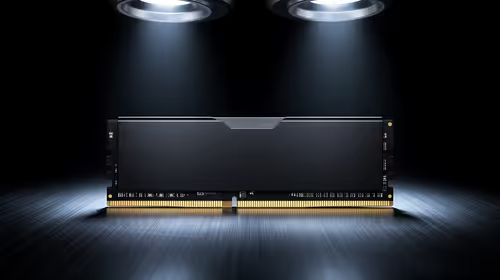
16GB DDR5 RAM is available at Evetech from R3,799 including VAT, with 22 modules in stock. It is the sensible baseline for budget and esports builds.
Read more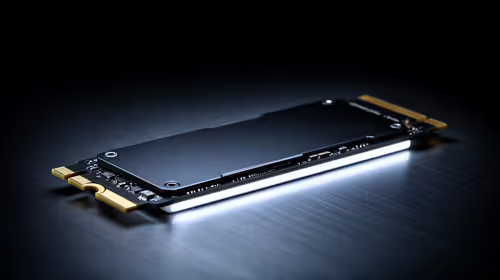
The cheapest 1TB NVMe SSD is available at Evetech from R2,599 including VAT, with 21 drives in stock. 1TB PCIe Gen4 is the current sensible default for a gaming or work PC.
Read more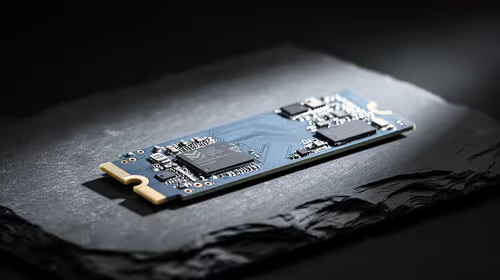
The cheapest 2TB NVMe SSD is available at Evetech from R4,999 including VAT, with 21 drives in stock. 2TB is now the comfortable capacity for a real gaming library.
Read more
Wi-Fi 7 vs Wi-Fi 6e for cinematic story games comes down to router support, latency goals, device compatibility, and coverage. SA buyers should match the choice to the real network setup.
The real world difference between PCIe 5.0 and PCIe 4.0 for MMO and live-service games is usually about loading, patches, and headroom. SA players should weigh NVMe speed, GPU lanes, CPU limits, and platform cost.
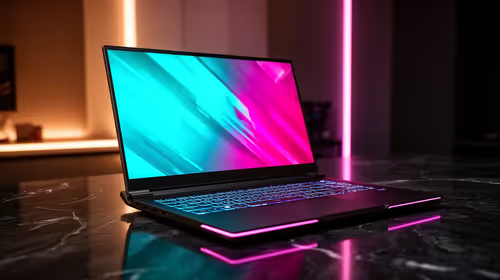
Windows 11 gaming laptop dead pixel checks begin with a full-screen colour test. This how to fix dead pixel windows 11 gaming laptop guide helps SA users compare settings, drivers, external screens, and warranty routes.
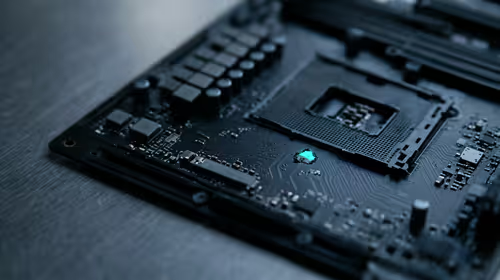
AM5 motherboard stuck pixel fixes in South Africa start with panel, cable, GPU output, and Windows checks. Use a clean test path before blaming the motherboard or replacing screen hardware.

FPS drops blamed on a wireless mouse often point to input, driver, USB, network, or system-load checks. Use a quick SA-friendly troubleshooting flow to isolate software, firmware, thermals, storage, and game settings before replacing hardware.

How to fix fps drops on steam deck starts with power profile, shader cache, storage health, and per-game settings. For South Africa, check charger quality, heat, and download stability before assuming the handheld needs repair. Retest after updates.
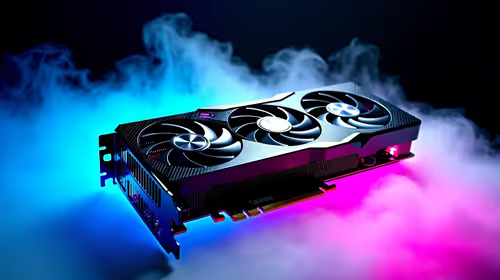
How to fix low FPS after an RTX 5080 build upgrade starts with driver cleanup, display settings, thermals, and power mode. For SA gamers, verify GPU usage, PCIe speed, RAM profile, and CPU limits before changing parts.
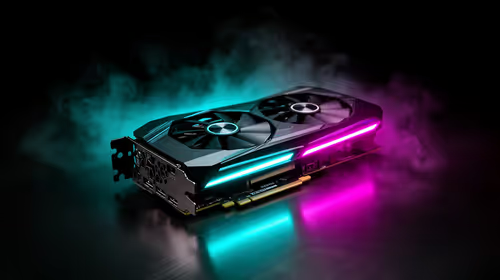
Hollow Knight Silksong at 4K needs a GPU matched to settings, VRAM, CPU balance, and monitor goals. Use this SA guide to compare tiers without treating FPS target or prices as fixed.
The best SSD for gaming is available at Evetech from R1,599 including VAT, with 58 drives in stock. A PCIe Gen4 NVMe drive at 500GB to 1TB is the recommended pick for most gamers.
The best streaming PC range is available at Evetech from R20,684 including VAT, with 22 models in stock. Every build pairs a multi-core CPU with an NVENC or Quick Sync capable GPU, so streaming and gaming can run on one machine without stealing frame rate.
The RTX 5070 is available at Evetech from R11,899 including VAT, with 18 models in stock and most cards priced between R11,899 and R14,000. It is the current 1440p value pick in the NVIDIA 50-series.
16GB DDR5 RAM is available at Evetech from R3,799 including VAT, with 22 modules in stock. It is the sensible baseline for budget and esports builds.