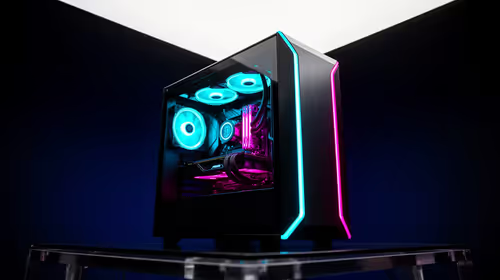
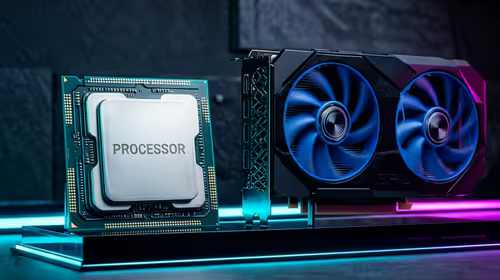
You’ve done it. You’ve finally assembled your dream rig—a monster PC with a power-hungry PCIe 5.0 GPU and a top-tier CPU. The RGBs are synced, the drivers are installed, and you’re dropping into your favourite game. Then, the lights flicker. ⚡ In that heart-stopping moment, an Uninterruptible Power Supply (UPS) is the only thing standing between you and potential data loss or component damage. Finding the best UPS for a high-end PC isn't a luxury; it's essential.
Why Your New Rig Draws Power Differently
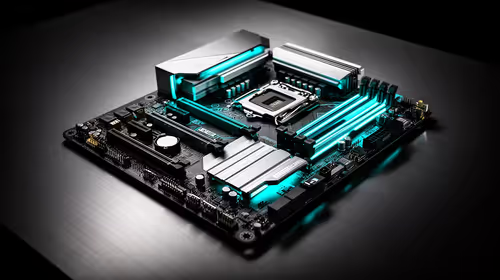
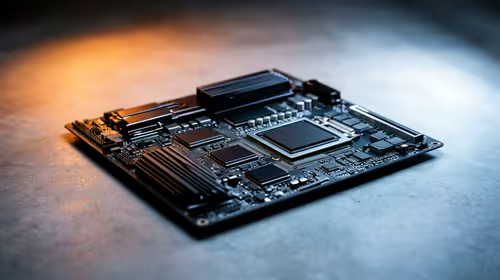
Modern high-end PCs, especially those built around PCIe 5.0, are a different breed of beast. Your new graphics card can have massive, split-second power spikes called 'transient loads' that far exceed its average wattage. A cheap, older UPS might see this spike as a fault and cut power, crashing your system even when the mains are on. Protecting the heart of your machine, whether it's one of the latest Intel motherboards, is crucial for stability.
Finding the Best UPS for a High-End PC
Choosing the right power backup isn't just about grabbing the biggest box off the shelf. You need to match the technology to your high-performance components. Getting it wrong can be a costly mistake. For a serious gaming PC, there are two key specs you absolutely must understand: the power rating and the waveform type.
Watts vs. VA: Don't Get Confused
You'll see two numbers on a UPS box: Watts (W) and Volt-Amperes (VA). Your PC's power supply (PSU) is rated in Watts, which is the actual power it uses. VA is the 'apparent' power the UPS can deliver. Because of how power supplies work, the VA number will always be higher than the Watt rating. A good rule of thumb is to choose a UPS where the Watt rating is at least 20-25% higher than your PSU's maximum output.
Quick VA Calculation 💡
To be safe, find your PSU's wattage and multiply it by 1.6 to get a target VA rating. If you have a 1000W PSU, you should be looking for a UPS with a rating of at least 1600VA. This buffer handles those crazy GPU power spikes and gives your components room to breathe.
The Sine Wave Showdown: Pure vs. Simulated
This is the most important part! High-end PC power supplies use a technology called Active Power Factor Correction (Active PFC). These PSUs require a Pure Sine Wave output from a UPS to function correctly and efficiently. A cheaper 'Simulated' or 'Stepped' sine wave UPS can make your PSU buzz, run hot, or even refuse to switch to battery power. For a premium rig built on powerful AMD motherboards, insisting on a Pure Sine Wave UPS is the only way to guarantee stability and protect your hardware's lifespan. 🛡️
Practical Reliability Considerations
A quality UPS does more than just keep the lights on. It's also a power conditioner. It smooths out the 'dirty power' from the grid—the small voltage dips (sags) and spikes (surges) that happen all the time. This clean, stable power reduces stress on your sensitive components. Even if you started your build by finding a great deal among the many cheap Intel & AMD based motherboards, pairing it with a high-end GPU means you can't skimp on power protection. It's the final piece of the puzzle for a truly resilient build. 🚀
Ready to Power-Proof Your Rig?
The right UPS isn't a luxury; it's essential insurance for your investment. Explore our wide range of UPS solutions and find the perfect power guardian for your gaming beast.