


Fix stuck pixel on a USB DAC in South Africa
Stuck pixel on a usb dac usually needs a settings, driver, thermal, or power check first. Work through safe SA troubleshooting steps before replacing parts or assuming a full upgrade.
Read moreIs a budget editing pc build powerful enough for your creative work? We put affordable components to the test, running real-world video and photo editing tasks to see what's possible without breaking the bank. Discover the surprising results and build smart! 💻✨
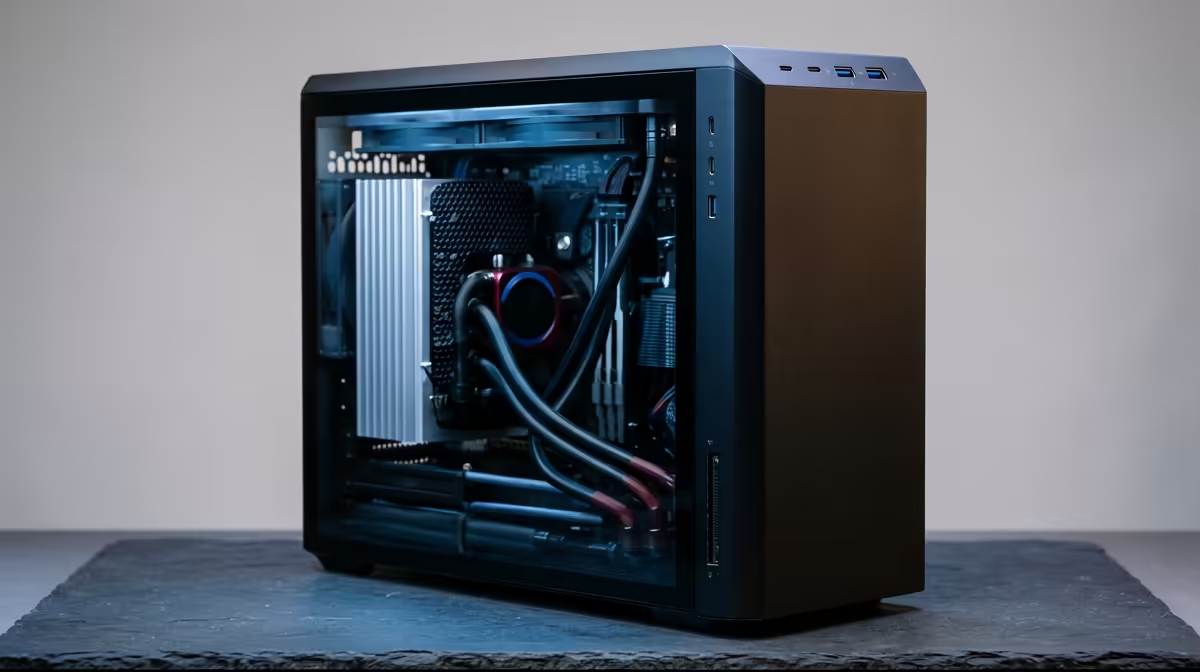
Staring at a stuttering timeline, waiting ages for a simple render to finish... sound familiar? For many South African creators, the dream of a smooth editing experience feels locked behind a massive price tag. But what if we told you a powerful, responsive machine is more accessible than you think? We’re diving deep into what makes a budget editing PC build tick, testing its real-world performance to show you how to get maximum creative power without emptying your wallet.
Forget the flashy RGB and overkill components for a moment. A successful budget editing PC build isn't about having the most expensive parts; it's about having the right parts working in harmony. The goal is balance. You need a CPU with enough cores to handle complex timelines, enough fast RAM to prevent bottlenecks, and a GPU that can accelerate effects and exports without costing a fortune.
For video editing, especially with software like Adobe Premiere Pro or DaVinci Resolve, your PC's power is spread across these key components. A weak link in the chain—like slow storage or not enough RAM—can bring even a powerful processor to its knees. Our focus is on allocating your budget smartly to optimise performance where it matters most for creative workflows.
Building an affordable editing PC is a game of strategic choices. Here’s where to focus your rands for the biggest performance gains.
The Central Processing Unit (CPU) is the heart of your editing machine, doing the heavy lifting during encoding and rendering. While single-core speed is important, modern editing software loves multiple cores and threads. This is where processors shine, offering incredible multi-threaded performance that can dramatically cut down your export times. For a budget editing PC build, a CPU with 6 to 8 cores provides a fantastic sweet spot for 1080p and even 1440p editing. Exploring some of the current AMD Ryzen PC deals is a great starting point to find a processor that delivers excellent value.
Don't skimp here! 16GB of RAM is the absolute minimum for video editing today, but 32GB is the real sweet spot for a budget build. It allows you to run your editing software, a browser, and other apps simultaneously without your system grinding to a halt.
For storage, a fast NVMe SSD for your operating system and applications is non-negotiable. It ensures your PC boots quickly and programs load in a snap. For your active project files and footage, a second large SATA SSD or another NVMe drive will ensure smooth playback and scrubbing on your timeline.
In DaVinci Resolve or Premiere Pro, navigate to your playback settings and set the timeline proxy resolution to half or quarter. This creates lower-quality stand-in files for editing, giving you buttery-smooth playback even with 4K footage on a budget system. The final export will still use the full-resolution source files!
While gamers obsess over graphics cards (GPUs), video editors have a different priority. You don’t need the most powerful card on the market. Instead, you need a modern GPU with solid video encoding/decoding hardware (like NVIDIA's NVENC) to accelerate your exports and specific effects. Many pre-built systems, including a wide range of Intel PC deals, come with perfectly balanced GPUs that offer excellent acceleration for creative work without the premium price of a top-tier gaming card.
So, what can you actually expect from a well-optimised, affordable editing PC? We configured a build with a modern 6-core CPU, 32GB of RAM, an NVMe SSD, and a capable mid-range GPU.
The Test: A 5-minute 1080p project in DaVinci Resolve, featuring multiple video clips, colour grading, animated titles, and background music.
The Results:
This is the kind of snappy, reliable performance that keeps you in the creative flow. It proves that a thoughtfully assembled budget editing PC build can easily handle demanding projects. You can achieve this level of power with many of the excellent PCs available for under R20,000, which come professionally built and tested.
Ready to Build Your Creative Engine? A powerful, well-balanced PC is the ultimate tool to unlock your creativity. Instead of spending weeks on research, get a professionally built and tested machine designed for performance. Explore our range of PCs under R20k and find the perfect build to bring your vision to life.
A capable budget editing PC build can range from R12,000 to R20,000. The final cost depends on balancing your CPU, RAM, and GPU for your specific editing software needs.
Yes, a well-configured budget PC can handle 4K video editing, especially by using proxies. For smooth timeline performance, focus on a modern CPU and at least 16GB of RAM.
While a balanced system is key, the CPU is often the most critical component for video editing, handling encoding and rendering. A capable GPU accelerates effects and playback.
16GB of RAM is a solid starting point for 1080p and light 4K editing. For complex projects with many effects or layers, 32GB is recommended for a smoother experience.
Both Intel and AMD offer excellent value CPUs for a budget editing PC. Compare current-generation Core i5 and Ryzen 5 processors to find the best price-to-performance ratio.
Not necessarily. An entry-level or mid-range GPU provides significant acceleration for effects and faster exports in most editing software without the cost of a high-end card.
Stuck pixel on a usb dac usually needs a settings, driver, thermal, or power check first. Work through safe SA troubleshooting steps before replacing parts or assuming a full upgrade.
Read more
Windows 11 with an RX 9070 XT build can miss a monitor because of input, cable, driver, or adapter conflicts. For SA gamers, check the signal path, hardware detection, and graphics driver before swapping parts.
Read more
Dragon Age The Veilguard PC build planning at R10,000 should stay cautious about parts and settings. Balance GPU, CPU, RAM, storage, cooling, and upgrade room before picking a South African gaming PC.
Read more
A recommended build for Stalker 2 Heart of Chornobyl at R50 000 should push high-refresh 1440p without poor balance. Shape the SA build around GPU power, CPU pairing, quiet cooling, storage, and upgrade life.
Read more
NBA 2K25 R100,000 PC build planning starts with balanced parts. For SA gamers, compare CPU and GPU fit, RAM needs, SSD space, PSU headroom and cooling before buying.
Read more
Stardew Valley R15,000 PC build planning starts with balanced parts. For SA gamers, compare CPU and GPU fit, RAM needs, SSD space, PSU headroom and cooling before buying.
Read more
Tests reported audio capture and local-network scanning on a specific LG television with its screen off. LG says supported standby modes can keep voice and connected-device features active, so owners should review model-specific settings.
PCIe 5.0 and PCIe 4.0 differ most in lane support, compatibility, and upgrade value for video editing in 4k. SA buyers should match the choice to their actual hardware and games.
Real world difference between b850 b650 mmo live service games sits in stability, networking, storage, and upgrade room. SA players should compare LAN quality, USB layout, RAM support, and SSD slots for always-updated games.
Dead Pixel on Wi-Fi 7 Router is likely a display-path or source-title issue, so check the screen, cable, driver state, and related system symptoms before blaming the device itself.
Industry reports point to another roughly 10 percent Intel processor increase from 5 October, but Intel has not published a consumer price list confirming the scope. South African buyers should treat it as a risk signal, not a guaranteed Rand change.

Put the headphones in pairing mode, open Bluetooth and devices in Windows 11, then add the headset. If it fails, remove the old pairing and check charge, range and drivers.
Microsoft says upcoming Windows 11 work will target memory use on 8GB PCs and improve boot and sign-in responsiveness. There is no public release date or measured uplift yet.
Windows 11 does not show CPU temperature in its standard Settings pages. Use your CPU maker's supported utility or a trusted monitor, then read idle and loaded temperatures in context.

For a stable RTX 5070 starting point, use 1440p, the High preset, Ray Tracing Medium and DLSS Balanced, then measure the base frame rate before adding Frame Generation. Path tracing is a separate showcase mode, not the default.

Microsoft's September release is reported to address 972 vulnerabilities, including two zero-days. The practical response is to back up, secure the BitLocker recovery key, prioritise exposed systems and verify business-critical apps after deployment.

Minecraft frame generation currently means an unofficial Fabric mod, not the same thing as official Bedrock RTX with DLSS upscaling. Check the game edition, loader, version, GPU path and base frame rate before installing anything.
HKC's 27-inch Shield 27Q560 runs QHD at 560Hz or 1280 x 720 at up to 1060Hz. The headline rate is specialised: resolution, sustained frame rate, ports and eventual South African support decide whether it is useful.