


Stuck Pixel Checks for a Mechanical Keyboard Setup
Stuck pixel on a Mechanical Keyboard is likely a display symptom around that setup, not the part itself. Check the monitor, cable, GPU output, drivers, and warranty path first.
Read moreFacing issues with your rig? Our budget gaming pc troubleshooting guide offers easy, South African-specific solutions to common problems like stuttering, crashes, and low FPS. Get your affordable gaming PC running smoothly again without breaking the bank! 🖥️⚡

So, you've booted up for a ranked match, your mates are in Discord, and... nothing. Black screen. Or maybe your frame rate in Apex Legends has suddenly dropped to slideshow levels. We've all been there. Owning a custom-built rig is awesome, but it means you're the first line of tech support. This guide to budget gaming PC troubleshooting is for every South African gamer who's faced that moment of panic. Let's get you back in the game. 🚀
Before you start pulling components out, let's cover the basics. These simple checks solve a surprising number of budget PC problems. Think of it as a pre-flight check for your rig.
First, the ridiculously obvious one: is everything plugged in securely? Check the power cable at the wall and at your PSU. Make sure your monitor cable is snug at both ends. After an unexpected outage, power surges can sometimes trip a switch, so check your multiplug too. A solid foundation for any rig starts with reliable power. Many gamers start their journey with one of our awesome budget gaming PCs, which are built to offer the best performance for your rand.
If the cables are solid, a full power cycle is your next move.
This simple process, known as a hard reset, can clear temporary glitches in your hardware's memory.
This is one of the most common issues, especially after building a new PC or moving your tower. Your fans spin, lights come on, but your monitor stays black. This is usually a POST (Power-On Self-Test) failure, often caused by a poorly seated component.
Your PC's memory sticks (RAM) can sometimes work themselves slightly loose or have a bad connection. Fixing this is easy.
Like RAM, the GPU is a large component that can sag or lose its connection. Reseating it follows the same principle. Ensure it's pushed fully into the PCIe slot and you hear a 'click'. Also, double-check that its power cables from the PSU are securely connected. For many, opting for one of our pre-built PC deals is a great way to skip these potential assembly headaches entirely.
You're finally in-game, but performance is terrible. This kind of budget gaming PC troubleshooting often points to either software or heat issues.
Outdated graphics drivers are a primary cause of poor gaming performance. Head to the NVIDIA or AMD website and download the latest drivers for your specific graphics card. Don't rely on Windows Update for this. A clean installation of your drivers can often work wonders.
Also, check for background processes. Is Windows downloading a massive update? Is your antivirus doing a full scan? Close any unnecessary applications before launching a game.
Your PC's worst enemy is dust. Once every few months, power down your PC, unplug it, and take it outside. Use a can of compressed air to blow dust out of your case fans, CPU cooler, and GPU fans. Clean filters mean better airflow, which leads to lower temperatures and more stable performance.
Budget builds can sometimes struggle with cooling, especially during a hot South African summer. Download a free tool like HWMonitor or MSI Afterburner to check your CPU and GPU temperatures while gaming. If your CPU is hitting over 90°C or your GPU is pushing past 85°C, you're likely thermal throttling—the hardware is slowing itself down to prevent damage. If cleaning doesn't help, it might be that your hardware is simply being pushed to its limit, and an upgrade from our selection of PCs under R20k could be the most effective fix.
Troubleshooting can fix a faulty setup, but it can't make an old component run a brand-new AAA title. If you've tried everything and your performance in modern games still isn't cutting it, your hardware might just be at the end of its useful life for demanding tasks.
A CPU from five years ago might struggle with the latest game engines, and a GPU with only 4GB of VRAM will have a tough time with modern textures. At this point, the most effective "fix" is an upgrade. This doesn't mean you need to break the bank; even a modest step up can make a world of difference. For those looking to eliminate bottlenecks for good, our range of powerful PCs above R20k offers top-tier performance that will last for years.
Ultimately, PC gaming is a journey of continuous improvement. Keeping an eye on the latest components and deals is part of the fun. You can always browse the best gaming PC deals in South Africa to see what new hardware could take your experience to the next level.
Ready to Ditch the Lag? Fixing your rig is rewarding, but nothing beats the feeling of unboxing a brand-new, flawlessly performing machine. If your troubleshooting journey ends at a hardware bottleneck, we're here to help you find the perfect upgrade. Explore Our Ultimate Range of Gaming PCs
A budget PC can slow down from background processes, outdated drivers, or thermal throttling. Start by closing unused apps and updating your GPU drivers for a quick boost.
To troubleshoot low FPS, lower your in-game graphics settings, ensure your display is plugged into the GPU not the motherboard, and check for overheating components.
Common issues include overheating due to our climate, power instability affecting components, and stuttering from unoptimized game settings on entry-level hardware.
Yes. First, check all power cables are secure, including the switch on the PSU. If it still won't start, the issue could be the power supply, a common failure point.
If your cheap gaming PC keeps crashing, a strategic upgrade like a better power supply (PSU) or more RAM can be a cost-effective solution over buying a new rig.
The first step is diagnosis. Identify the symptoms—is it a crash, a blue screen, or low performance? This helps narrow down whether it is a hardware or software problem.
Stuck pixel on a Mechanical Keyboard is likely a display symptom around that setup, not the part itself. Check the monitor, cable, GPU output, drivers, and warranty path first.
Read more
How to fix stuck pixel Windows 11 USB DAC issues starts with display-only tests. Check HDR, scaling, monitor input, USB cable movement, and safe South African support options before connecting the pixel issue to audio hardware.
Read more
Windows 11 Steam Deck monitor issues often start with display mode, USB-C output, drivers, or dock power. Use this how to fix monitor not detected windows 11 steam deck checklist for SA handheld PC setups.
Read more
Stalker 2 Heart of Chornobyl PC build planning at R100,000 should stay cautious about parts and settings. Balance GPU, CPU, RAM, storage, cooling, and upgrade room before picking a South African gaming PC.
Read more
RX 9070 XT build stuttering needs a step-by-step check before replacing parts. Review drivers, settings, thermals, power, background apps, display limits, cables, and game options before changing hardware.
Read more
GTA 6 on R15,000 needs careful part balance. This SA build guide frames CPU, GPU, RAM, SSD, cooling, and upgrade trade-offs without promising live prices, stock, or exact FPS.
Read more
NVIDIA lists 550W required system power for the RTX 5060 reference specification, based on a high-end test system. A quality 550W unit can be enough, but CPU draw, transient load, connectors and ageing decide real headroom.
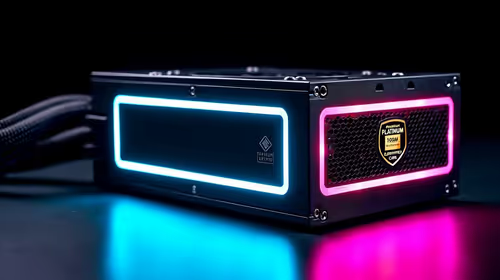
80+ Gold vs 80+ Platinum for couch co-op gaming is about PSU efficiency, heat, fan behaviour, quality, and wattage headroom, not direct FPS. SA buyers should compare the whole build.
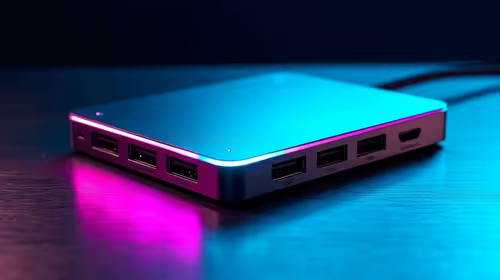
Upgrade your setup with the best USB-C hubs for creators. Discover why high-capacity card readers and dual 4K output are essential for professional South African content production. 🚀💻

B850 motherboard FPS drops needs a methodical troubleshooting pass. Review drivers, thermals, power settings, background apps, cables and game settings before replacing parts in an SA gaming setup.
NVIDIA lists 550W required system power for the RTX 5060 reference specification, based on a high-end test system. A quality 550W unit can be enough, but CPU draw, transient load, connectors and ageing decide real headroom.

OpenRGB's master branch now carries changes labelled for 1.0 final, including translation and platform work, but the official tags page still lists 1.0rc3.1 as the newest packaged release. Stable users should wait for the signed release channel.

A motherboard can remain useful for many years when power, cooling and connectors stay healthy. Replace it for confirmed faults, damaged power delivery or a blocked platform need, not simply because the calendar reaches a fixed age.
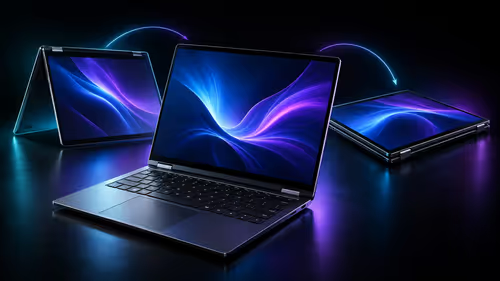
The VAIO T combines a 13.3-inch display with a multi-flip mechanism for laptop, tablet and outward-facing viewing modes. Orders begin in Japan on 18 September; South African availability is unconfirmed.
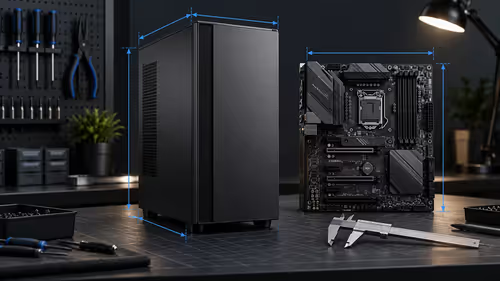
The smallest ATX case 2026 buyers should choose is the smallest chassis that still fits their exact graphics card, cooler, power supply and airflow plan. ATX support alone does not prove a case has the smallest footprint or volume.
In a 6 bit + FRC vs 8 bit comparison, native 8-bit panels can produce 256 levels per colour channel directly, while 6-bit plus FRC rapidly alternates nearby values to approximate the wider palette. Panel quality still depends on more than bit depth.
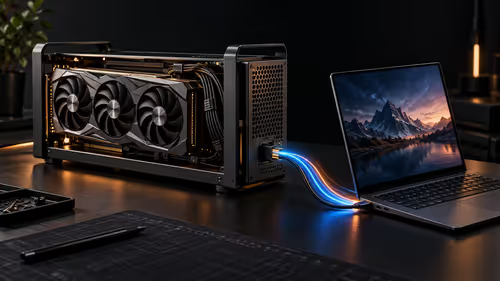
The UGREEN LinkStation Pro eGPU dock combines Thunderbolt 5 and OCuLink connections with an integrated 850W ATX 3.1 power supply and up to 140W laptop charging. South African availability is unconfirmed.
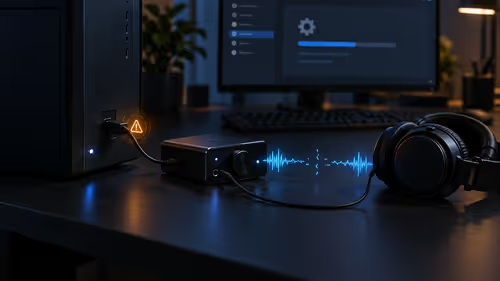
Windows 11 KB5124008 can leave some USB Audio Class 1.0 devices with no sound, Code 10 or failed multichannel output. Microsoft confirms the issue and says switching to two-channel stereo can restore audio for some users.