So, you’ve just dropped some serious ZAR on a shiny new graphics card, expecting buttery-smooth frame rates in Apex Legends. You fire it up, and… it’s better, but still stuttering. What gives? Welcome, fellow South African gamer, to the frustrating world of the CPU bottleneck. It’s when your PC’s brain can’t keep up with its muscle, holding your entire system back. This guide will help you diagnose and defeat it.
Understanding the CPU Bottleneck
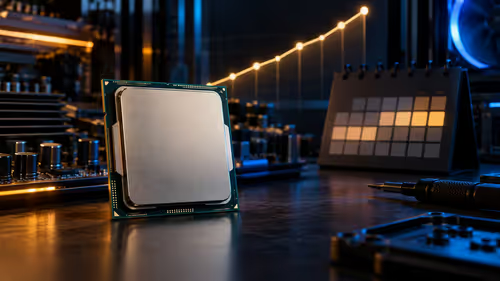
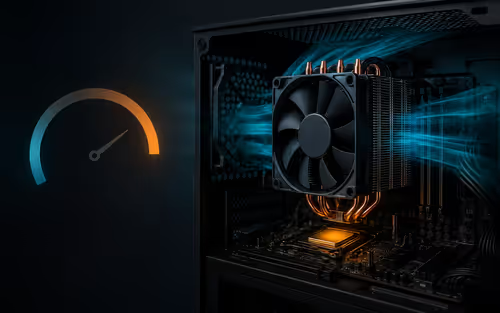
Think of your PC as a production line. Your graphics card (GPU) is the high-speed machine that renders beautiful visuals, and your central processing unit (CPU) is the manager, telling it what to draw. If the manager is slow and can't issue instructions fast enough, the powerful rendering machine sits idle, waiting. That delay is a CPU bottleneck.
In gaming, your CPU handles things like AI, physics, and player locations. When it gets overwhelmed, it can't feed your GPU data quickly enough, leading to lower-than-expected FPS and annoying stutters, no matter how powerful your graphics card is. This is a crucial concept in any balanced PC build in South Africa, where getting maximum performance for your rand is everything.
How to Spot a Performance Bottleneck 🔧
Not sure if your CPU is the culprit? It’s surprisingly easy to check. You don’t need fancy software, just the tools you probably already have.
Check Your In-Game Stats
The most reliable method is to monitor your component usage while playing a game.
- Get Monitoring Software: Use a tool like MSI Afterburner with RivaTuner Statistics Server (it’s free and works with any brand).
- Fire Up a Game: Choose a game that is known to be CPU-intensive, like Cyberpunk 2077 in crowded areas or a large-scale battle in Total War.
- Watch the Numbers: Look at your CPU and GPU usage percentages.
If your CPU usage is consistently hitting 95-100% while your GPU usage is sitting much lower (e.g., 60-70%), you’ve found your bottleneck. Your processor is running flat-out and can't keep up.
Resolution Reality Check ✨
A CPU bottleneck is often more noticeable at lower resolutions like 1080p. Why? Because at 1080p, your GPU can produce frames very quickly, putting more pressure on the CPU to keep up. At 1440p or 4K, the GPU has to work much harder, often becoming the limiting factor itself, which is actually what you want for a balanced system.
Building a Balanced PC in South Africa
The key to avoiding a CPU bottleneck is smart pairing. You don't need the most expensive components, just the right ones for your goals and budget. A well-matched system will see both your CPU and GPU working hard together.
The Art of CPU & GPU Pairing
A good rule of thumb is to pair components from similar performance tiers. For example, a mid-range CPU works beautifully with a mid-range GPU.
- For Mainstream Gaming (1080p/1440p): Pairing one of the latest Intel Core processors like an i5 with an NVIDIA RTX 4060 or RTX 4070 offers a fantastic, balanced experience without breaking the bank.
- For High-Performance Rigs: If you’re aiming for high-refresh-rate gaming, consider combining one of the powerful AMD Ryzen CPUs like a Ryzen 7 with a high-end card like a Radeon RX 7800 XT or better.
Ultimately, building a balanced PC is about synergy. Every part, from the processor to the RAM, should work together to deliver the smooth, immersive experience you paid for. Don't let one slow component spoil the whole build. 🚀
Ready to Build a Balanced Rig?
A CPU bottleneck can ruin your gaming experience, but building a balanced PC is easier than you think. Explore our massive range of PC components and find the perfect parts to unleash your system's true potential.