The Ultimate Graphics Card Compatibility Checklist: What to Check Before Buying
You’ve saved your hard-earned Rands for a massive performance boost. The excitement of unboxing a shiny new GPU is unmatched. However, nothing kills the vibe faster than realising your new part doesn't fit... or your PC won't turn on. Before you commit, you need a solid Graphics Card Compatibility Checklist: What to Check Before Buying. It’s the difference between a seamless upgrade and a frustrating return process. 🔧
Measure Your Physical Case Clearance
Modern cards are getting significantly larger with every generation. Some high-end MSI models now occupy three or even four expansion slots. You must measure the internal length of your chassis from the rear brackets to the front intake fans.
Don't forget to check the width as well. Some cards are so tall that the side panel won't close once the power cables are plugged in. Ensure there is enough "breathing room" for airflow to keep your temperatures stable during a hot South African summer. ✨
Verify Your Power Supply Capacity
Your power supply (PSU) is the heart of the system. Check the recommended wattage for your specific GeForce Graphics Cards choice. Don't just look at the total watts... check the available PCIe power connectors too.
High-end cards often require multiple 8-pin cables or the newer 12VHPWR connector. Using daisy-chained cables or cheap adapters is a recipe for disaster. Always ensure your PSU is from a reputable brand with at least an 80 Plus Bronze rating for reliability. ⚡
PSU Headroom Tip ⚡
Always aim for a power supply that offers at least 100W to 150W more than the GPU manufacturer's minimum recommendation. This provides a safety margin for transient power spikes... those tiny moments where a card draws extra juice during intense gaming scenes. It also keeps your fan noise lower by preventing the PSU from running at 100% load constantly.
Check Motherboard and Interface Standards
Most modern NVIDIA & AMD Graphics Cards use the PCIe x16 slot. While these versions are backwards compatible, using a PCIe 4.0 card on an older PCIe 3.0 board might slightly limit your bandwidth in specific scenarios.
Check if your motherboard has enough physical space around the primary slot. Large M.2 heatsinks or bulky CMOS batteries can sometimes interfere with the seating of the card. Ensure your BIOS is updated to the latest version to avoid any "No Display" errors upon first boot.
Match the Card to Your Monitor and Resolution
Whether you prefer the raw value of Radeon Graphics Cards or the ray-tracing prowess of Nvidia, your monitor choice matters. There is no point in buying a 4K-capable beast if you are playing on a 1080p 60Hz screen.
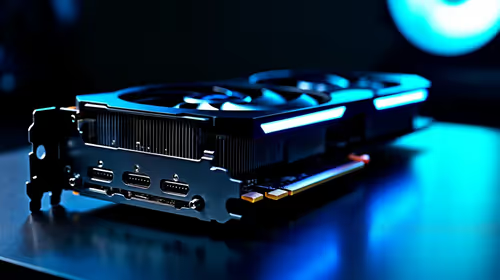
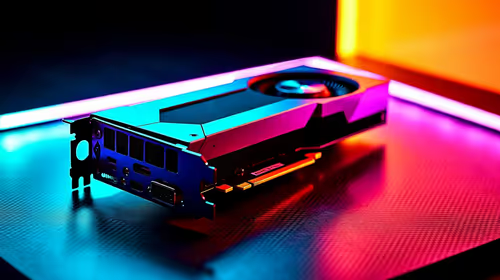
Verify the display outputs on the back of the card. Do you need multiple DisplayPort connections for a multi-monitor setup? Does your TV require HDMI 2.1 for high-refresh-rate gaming? Matching your GPU to your display ensures you aren't leaving performance on the table. 🚀
Ready to Find Your Perfect Match? Navigating the world of hardware can be tricky, but choosing the right GPU shouldn't be a gamble. Explore our massive range of graphics cards and find the perfect component to power your South African gaming rig today.