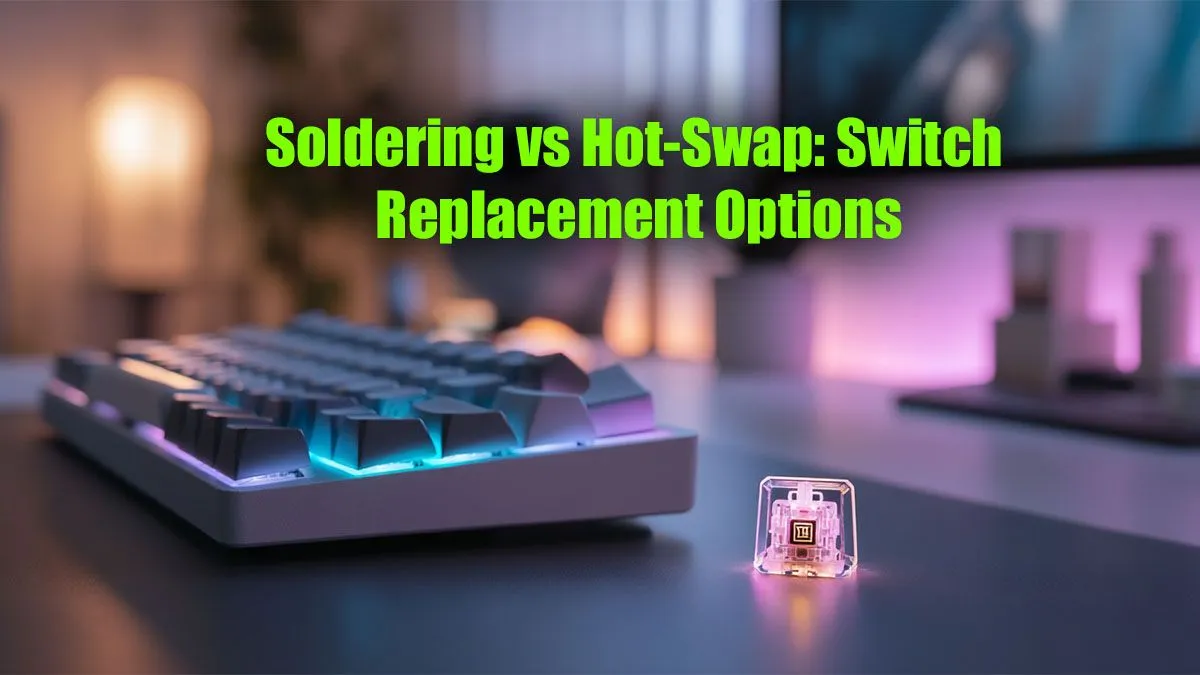
Thinking about a new mechanical keyboard? That satisfying clack is just the start. But before you splash out, there’s a crucial choice every SA gamer faces: hot-swap vs soldered. One offers ultimate freedom, the other, rock-solid simplicity. This isn't just a tech detail; it defines how you'll interact with your rig for years. Let’s figure out which board is right for you, right now.
The OG Standard: What is a Soldered Keyboard?
A soldered keyboard is the traditional champion of the mechanical keyboard world. In these boards, each individual switch is physically soldered onto the Printed Circuit Board (PCB). This creates a permanent, sturdy connection that’s been the industry standard for decades.
For many gamers, this is perfect. You get a reliable, durable board straight out of the box. Because they are simpler to mass-produce, you can often find some of the cheapest gaming keyboards in South Africa using a soldered design. They are the definition of "plug-and-play."
The downside? A lack of flexibility. If a switch fails or you decide you hate the feel of your clicky Blue switches and want to try smooth linear Reds, you're out of luck... unless you have a soldering iron and the skills to use it. For most people, a broken switch means a new keyboard. This is also why many all-in-one keyboard and mouse combos feature soldered boards—they’re built for simplicity and value.
The Customiser's Dream: Enter the Hot-Swap Keyboard 🔧
Hot-swap keyboards are the new kids on the block, and they’ve taken the enthusiast community by storm. The key difference is in the name: you can hot-swap the switches. The PCB has special sockets that allow you to pull switches out and plug new ones in using a simple tool, no soldering required.
Think of it like LEGOs for your keyboard. This opens up a universe of customisation. ✨
- Experiment Freely: Want to try Gateron Browns for typing and Cherry MX Speeds for gaming? You can.
- Easy Repairs: Spilled some Klippies and Coke and now your 'W' key is sticky or dead? Just pull out the faulty switch and pop in a new one. It’s a five-minute fix, not a R2000 replacement.
- Future-Proof: New, amazing switches will inevitably be released. With a hot-swap board, you can upgrade your keyboard's feel without replacing the entire unit.
The ability to instantly change your board's feel by trying out different keyboard switches is the main draw. You can take it even further by adding custom keyboard keycaps to complete your personalised look and feel.
Switch Sampler Secret 💡
Before committing to a full set of pricey switches, grab a small switch tester pack. For a few hundred ZAR, you can physically test the feel of different linear, tactile, and clicky switches (like Reds, Browns, and Blues) on your desk. It's the best way to find your perfect match without buyer's remorse.
Hot-Swap vs Soldered Keyboard: The Showdown
So, how do they stack up head-to-head? The choice between a hot-swap or soldered keyboard really boils down to your priorities.
Who Should Buy a Soldered Keyboard?
You're a great candidate for a soldered board if:
- You prefer a simple, no-fuss experience.
- You're on a tighter budget.
- You've found a keyboard with switches you already know and love.
- The idea of tinkering with tiny components gives you a headache.
Who Should Buy a Hot-Swap Keyboard?
A hot-swap board is probably your perfect match if:
- You love customising your gear.
- You want to experiment with the huge variety of mechanical switches available.
- You value long-term repairability and modularity.
- You see your keyboard as a hobby, not just a tool.
Ultimately, both are excellent options. The market is filled with amazing choices, and you can find incredible value across all the best gaming keyboard deals available today. And no matter which you choose, investing in a comfortable wrist rest is always a smart move for those long gaming sessions. 🚀
Ready to Find Your Perfect Feel?
Whether you crave the endless customisation of a hot-swap board or the set-and-forget reliability of a soldered one, your perfect keyboard is waiting. It’s the most important part of your setup. Make it count. Explore our massive range of gaming keyboards and find the perfect tool to conquer your game.