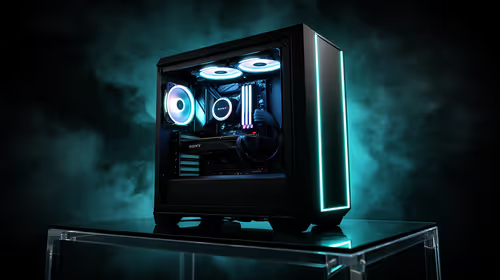
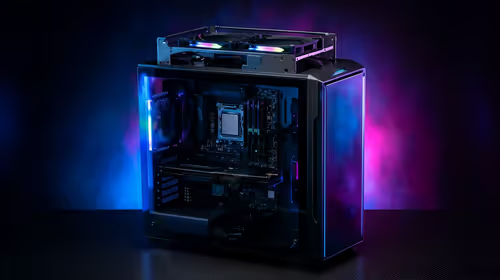
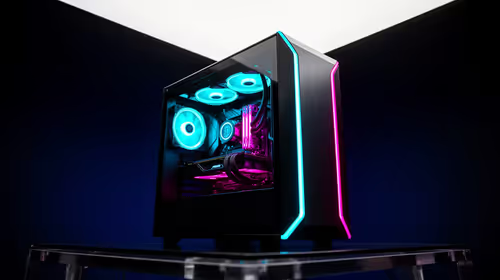
That sinking feeling as your screen goes black mid-match is an all-too-common nightmare for South African gamers. But what if your rig was built to withstand the dark? A truly outage-ready PC isn't just about a beefy UPS… it’s about building a smarter, more power-efficient machine from the ground up. And the foundation for that build might just be the clean, cool, and surprisingly affordable Gamemax CLAW 460 White case.
Reliable Everyday Performance
But the real secret weapon is efficiency. A PC that uses less power will stay on for much longer when the grid fails. This is where your chassis choice becomes critical.
A case with excellent airflow, like the Gamemax CLAW 460, keeps your components running cool. Cooler components are more efficient and require less fan speed, which reduces overall power draw. It’s a small but crucial part of creating a truly outage-ready PC that sips power instead of guzzling it. ⚡
Assembling Your Efficient Powerhouse Core
With a high-airflow case as our starting point, every component choice should be viewed through the lens of performance-per-watt. The goal is to get maximum frames without maxing out your electricity bill… or draining your UPS in five minutes.
Choosing a Power-Sipping GPU
The graphics card is usually the most power-hungry part of any gaming rig. When building for efficiency, you need to look beyond raw benchmarks and consider the TDP (Thermal Design Power). A lower TDP often means less power consumption.
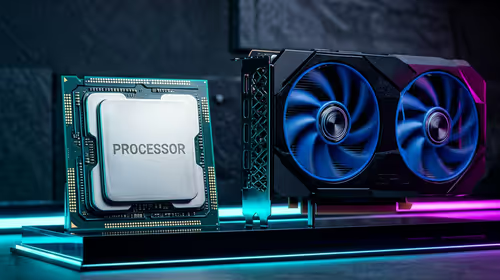
Thankfully, modern GPUs are incredibly efficient. Both NVIDIA GeForce graphics cards and their AMD Radeon options offer fantastic performance without needing a mini power station to run. Look for models with advanced cooling solutions, as better cooling directly contributes to sustained efficiency.
For example, many of the range of MSI graphics cards are renowned for their TWIN FROZR cooling systems, which keep temperatures and power draw in check even under heavy load.
UPS Sizing Pro Tip 💡
To correctly size your UPS, add up the max power draw (in Watts) of your PC and monitor. Multiply that number by 1.5 to get the recommended VA (Volt-Amperes) rating. For an efficient 500W build, a 1000VA UPS (around 600W output) is a great starting point, giving you precious minutes to finish your game and shut down safely.
The Gamemax CLAW 460 White: The Perfect Foundation
So, why is this specific case a great starting point for our build? The Gamemax CLAW 460 White isn't just about looking good (though its clean, minimalist aesthetic is a definite plus ✨). It's built for performance.
- High Airflow Design: With a mesh front panel and ample ventilation, it ensures a constant supply of cool air to your components.
- Spacious Interior: It offers plenty of room to work in and supports a wide variety of components, including the longest and most powerful modern graphics cards.
- Smart Layout: The layout promotes clean cable management, which doesn't just look neat—it actively improves airflow by removing obstructions.
By starting with a chassis that prioritises cooling, you're setting every single component up for success. You’re building a system that runs quieter, cooler, and, most importantly, more efficiently.
The Result: A Smarter Gaming Rig 🚀
Combining an efficient power supply, a modern GPU with a sensible TDP, and a high-airflow case like the CLAW 460 creates a powerful synergy. This isn't just another gaming PC; it's a strategic setup designed to survive South Africa's energy challenges.
When the power inevitably cuts, your low-wattage system will place a much smaller strain on your UPS, giving you significantly more time than a power-hungry, heat-generating monster. That extra time is the difference between victory and a frustrating disconnect.
Ready to Choose Your Next Pc Setup?
The key is smart component selection. A power-efficient machine doesn't just save you on your electricity bill—it keeps you in the game when the lights go out. Explore our massive range of PC components and find the perfect parts to conquer the dark.