Staring at your FPS counter, wishing you could squeeze a few more frames out of your rig without forking out thousands of Rands? You're not alone. For many South African gamers, a tight budget is a reality. But what if you could unlock free performance hidden inside your processor? That's the promise of overclocking budget CPUs, and this guide will show you how to do it safely. Let's get started and get more power for your buck. 🚀
Understanding the Basics of Overclocking
So, what is overclocking? Think of it like tuning a car's engine. Your CPU (Central Processing Unit) comes from the factory set to run at a specific maximum speed, or "clock speed," measured in gigahertz (GHz). Overclocking is the process of manually pushing that speed beyond its official limit.
The goal is simple: make your processor work harder to get better performance in games and applications. A successful overclock can mean smoother gameplay, higher frame rates, and faster loading times. But it’s not without risks... pushing your hardware harder generates more heat and can lead to instability if not done carefully. This safe guide is here to help you navigate that.
Is Your Budget CPU Ready for an Overclock?
Before you dive into your PC's BIOS, the most important question is: can your hardware even handle it? Not all components are created equal, and attempting to overclock the wrong parts is a recipe for frustration.
The Processor and Motherboard Combo
First, the CPU itself must be "unlocked." This means the manufacturer allows you to change its core multiplier.
- For Intel: Look for CPUs with a "K" or "KF" at the end of their model number (e.g., Core i5-13600K). These are designed for overclocking. Many budget-friendly Intel CPUs are locked, so always check the specs.
- For AMD: The good news is that most modern AMD Ryzen CPUs are unlocked right out of the box, making them a popular choice for enthusiasts on a budget. ✨
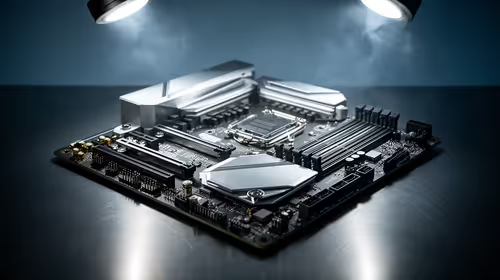
Your motherboard is just as important. You'll need a chipset that supports overclocking (like Intel's Z-series or AMD's B-series and X-series). A board with decent Voltage Regulator Modules (VRMs) and heatsinks is also crucial for delivering stable power and keeping things cool.
Cooling is Not Optional 🔧
When you overclock, you generate more heat. The stock cooler that came with your budget CPU is likely not up to the task. Investing in a decent aftermarket air cooler or a basic All-in-One (AIO) liquid cooler is one of the most important steps for safe and stable overclocking. It's a non-negotiable part of the process!
A Safe Step-by-Step Guide to Overclocking
Ready to begin? Remember the golden rule: go slow and test at every step. This isn't a race.
1. Establish a Baseline
Before you change anything, you need to know your starting point. Download and run benchmarking software like Cinebench to get a performance score. Use a monitoring tool like HWMonitor to check your CPU temperatures under load with a stress test program like Prime95. Note these numbers down.
2. Enter the BIOS/UEFI
Restart your computer and press the designated key to enter the BIOS (usually DEL, F2, or F12). Every BIOS looks different, but you're looking for sections labelled "OC Tweaker," "Ai Tweaker," or something similar related to frequency and voltage settings.
3. Make Small Adjustments
Find the "CPU Core Ratio" or "Multiplier." This is what you'll be changing. Increase it by a very small increment (e.g., from 40 to 41, representing 4.0GHz to 4.1GHz). Don't touch the voltage yet! Save your changes and reboot into Windows.
4. Stress Test, Repeat, and Monitor
Once back in Windows, run your stress test again for at least 15-20 minutes. Keep a close eye on your temperatures with HWMonitor. If your PC is stable and temps are well below 90°C, you can repeat the process: reboot, increase the multiplier by one step, and test again.
Eventually, you will hit a wall where your PC crashes or won't boot. This is your current limit. You can now either dial it back to the last stable setting or carefully increase the CPU core voltage in tiny increments to achieve stability at the higher speed. Research safe voltages for your specific CPU model before doing this.
The Big Question: Is Overclocking Budget CPUs Worth It?
For South African gamers, the answer is often a resounding yes. When a new graphics card or processor costs a significant chunk of a month's salary, getting 5-15% more performance for free is a massive win. Overclocking budget CPUs can extend the life of your current build, helping you keep up with new game releases for another year or two without a costly upgrade.
It turns a good-value processor into a great one. While it won't magically make a Core i3 perform like a Core i9, it can be the difference between a choppy 50 FPS and a smooth 60 FPS. If you're building a new PC or looking to upgrade, considering a processor's overclocking potential is a smart way to maximise your investment. You can find a wide variety of CPU processors online that offer fantastic overclocking headroom.
Ready to Build Your Performance Rig?
Whether you're a seasoned overclocker or just looking for the best bang-for-your-buck, the right CPU is the heart of your PC. Explore our massive range of PC components and find the perfect parts to conquer your game.