So, you’ve done it. The boxes are here, stacked high with potential... a beastly new CPU, a graphics card that cost more than your first car, and a motherboard gleaming with promise. The excitement is electric! But then, a cold dread creeps in as you try to slot the CPU into the socket... and it doesn’t fit. Suddenly, your dream build turns into a costly paperweight. In South Africa, ensuring PC component compatibility isn’t just smart; it’s essential to avoid expensive, heartbreaking mistakes.
The Core Handshake: CPU & Motherboard Compatibility
Getting your CPU and motherboard to work together is the first and most critical step. Think of the motherboard's CPU socket as a lock and the CPU as its unique key. An AMD Ryzen 7000 series CPU (AM5 socket) will never fit into an Intel motherboard (like an LGA 1700 socket), and vice versa. It's a non-negotiable physical match. 🔧
Beyond the socket, you have the chipset. While a high-end Intel Core i9 might physically fit in a budget H610 motherboard, the board's power delivery and features won't be able to handle it properly, throttling your performance. Ensuring the chipset (e.g., B760, Z790) matches your CPU's capabilities is crucial for a stable and optimised system, a principle we follow even for our budget gaming PCs.
RAM: More Than Just Gigabytes
Memory compatibility is another classic trip-up. We're in a transition period between DDR4 and DDR5 RAM. These two generations have different physical notches and are not interchangeable. A motherboard is either DDR4 or DDR5... never both. Trying to force a DDR5 stick into a DDR4 slot is a quick way to damage both components.
Always check your motherboard's specifications to confirm which generation it supports. This simple check ensures you get the performance you paid for, which is vital when building powerful PCs under R20k where every rand counts. Speed matters too, so ensure your motherboard officially supports the RAM frequency (e.g., 6000MHz) you're buying.
Pro Compatibility Tip ⚡
Always check your motherboard manufacturer's website for the Qualified Vendor List (QVL). This is a comprehensive list of the exact RAM kits that have been tested and are guaranteed to work with that specific board. It takes the guesswork out of choosing memory and helps prevent stability issues down the line.
The Power Trio: GPU, Power Supply, and Case
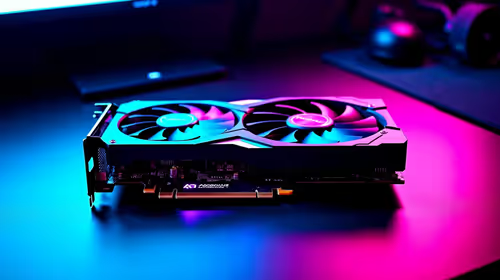
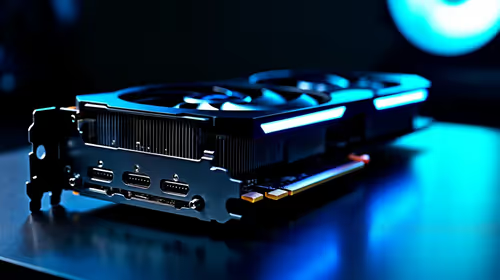
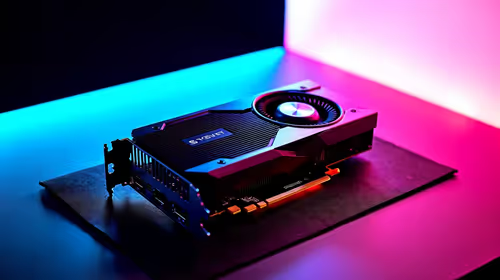
You’ve got your eyes on a top-tier graphics card, a true monster for 4K gaming. But will it fit? Modern GPUs are massive, and you must check three dimensions: length, height, and width against your case's specifications. Many a builder has had to leave the side panel off their case because their new GPU was a few millimetres too long.
Then there's power. Your Power Supply Unit (PSU) needs enough wattage to run everything, but also the right connectors. Newer high-end NVIDIA cards often require a specific 16-pin (12VHPWR) power connector. A quality PSU is the heart of your system, especially in high-performance PCs above R20k where stable power is non-negotiable. Skipping this check can lead to a system that won't even turn on. This is one of many details expertly handled in quality pre-built PC deals, saving you the headache. ✨
Final Compatibility Checks for a Smooth Build
The big parts are sorted, but a few smaller details can still cause trouble. When it comes to storage, ensure your motherboard has the M.2 slots you need—and that they support the type of drive you have (NVMe or SATA).
Lastly, think about cooling. That giant air cooler might be great for your CPU, but will its height prevent your case's side panel from closing? Or will it block your first RAM slot? These final checks are the difference between a smooth, satisfying build and a frustrating afternoon of troubleshooting. Looking at the component combinations in the best gaming PC deals can be a great way to see what parts are proven to work well together. 🚀
Ready to Build Without the Worry? Ensuring perfect PC component compatibility can be complex. Skip the stress and let our experts handle it. Design your perfect rig with guaranteed compatibility. Build your dream PC with our Custom PC Builder and game with complete peace of mind.