Loadshedding hits. The lights go out, the Wi-Fi dies, and your epic gaming session comes to a screeching halt. Sound familiar? For South African gamers, keeping the power on is half the battle. But what if your PC didn't have to be an energy-guzzling monster? A carefully planned, power-efficient Ryzen 7000 build isn't just a nice-to-have; it's a strategic advantage against Eskom's unpredictable schedule, keeping you in the game for longer.
Why a Power-Efficient Build is a Loadshedding Lifesaver
When the power cuts, every watt counts. Your Uninterruptible Power Supply (UPS) can only last so long, and a high-performance PC can drain it in minutes. This is where building for efficiency pays off. A PC that sips power instead of chugging it means significantly longer runtime on your battery backup. Suddenly, you have enough time to finish that competitive match or safely save your progress in a sprawling open-world RPG.
The secret sauce is AMD's Zen 4 architecture. The Ryzen 7000 series delivers incredible performance while being remarkably efficient, making it the perfect foundation for a loadshedding-proof gaming rig. By choosing the right components, you create a balanced system that delivers top-tier frames without tripping the breaker or draining your UPS instantly. It’s about gaming smarter, not just harder.
Choosing the Right Ryzen 7000 CPU for Efficiency
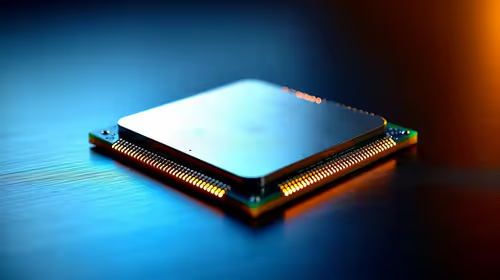
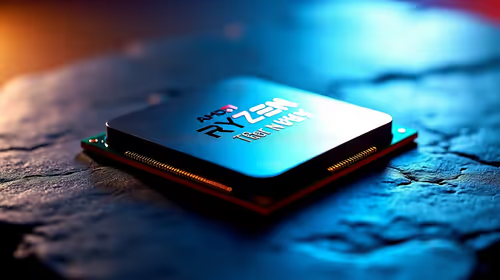
The heart of any power-efficient Ryzen 7000 build is the processor itself. While the top-end "X" variants offer blistering speeds, their non-X counterparts are the champions of efficiency. CPUs like the Ryzen 5 7600 or Ryzen 7 7700 come with a default 65W TDP (Thermal Design Power). This lower power target translates directly into less energy consumption and less heat, without a huge sacrifice in gaming performance.
This contrasts with some higher-end chips that can pull significantly more power under load. While many powerful Intel CPUs offer fantastic performance, for a build focused purely on maximising UPS runtime, the 65W AMD Ryzen CPUs are a phenomenal choice. You get modern performance that's perfectly suited for today's games, all while keeping your power draw lean. For those on a budget, you can find some fantastic processors under R7000 that strike an ideal balance between price and efficient performance.
Efficiency Pro Tip ⚡
For the ultimate in low-power performance, enable 'Eco-Mode' in your motherboard's BIOS or via AMD's Ryzen Master software. This simple tweak can lower your 65W Ryzen CPU's power consumption even further, often with only a minimal impact on gaming frame rates. It's a fantastic way to stretch your UPS battery life to its absolute maximum during loadshedding.
Building Around Your Efficient Core 🔧
A CPU is just one part of the puzzle. To create a truly energy-sipping machine, every component needs to be chosen with efficiency in mind.
Motherboard & GPU Synergy
You don't need a top-of-the-line, power-hungry X670E motherboard. A quality B650 motherboard provides all the features a gamer needs, including PCIe 5.0 support and DDR5, but with a more modest power footprint.
For your graphics card, look for a model with a great performance-per-watt ratio. NVIDIA's RTX 40 series, like the GeForce RTX 4060 or 4070, are excellent examples. They use the efficient Ada Lovelace architecture to deliver amazing visuals and high frame rates while consuming surprisingly little power compared to previous generations.
The Unsung Hero: Your Power Supply (PSU)
Don't overlook your PSU! An 80+ Gold or Platinum-rated power supply is crucial. These units are highly efficient at converting AC power from the wall to DC power for your components, meaning less energy is wasted as heat. Crucially, don't oversize it. A 650W-750W Gold PSU running at 50% load is far more efficient than a 1200W PSU running at 20% load. A well-chosen power supply is a cornerstone of a reliable and power-efficient Ryzen 7000 build for loadshedding.
The Loadshedding-Proof Experience ✨
Imagine this: Stage 4 is announced. Your friends start logging off, but you just smile. Your rig sips power so gently that your UPS barely notices. You finish your raid, claim your loot, and log off on your own terms. That’s the peace of mind an efficient build gives you.
By pairing a smart Ryzen 7000 CPU with other energy-conscious parts, you get a PC that’s not only powerful but also practical for the South African reality. You’ll enjoy lower electricity bills, a cooler and quieter system, and most importantly, the freedom to game without constantly watching the clock. When it comes to picking the right parts, browsing a comprehensive selection of CPU processors is the best place to start your journey.
Ready to Build Your Loadshedding-Proof PC? The AMD Ryzen 7000 series offers an incredible blend of performance and efficiency, making it the perfect heart for a modern South African gaming rig. Explore our wide range of PC components and start planning the build that will keep you in the game, no matter the schedule.