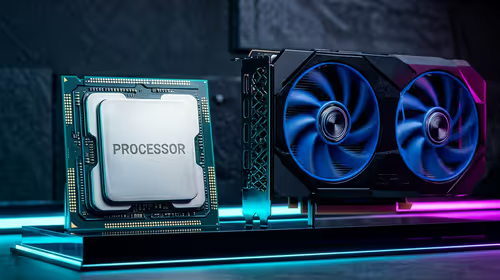
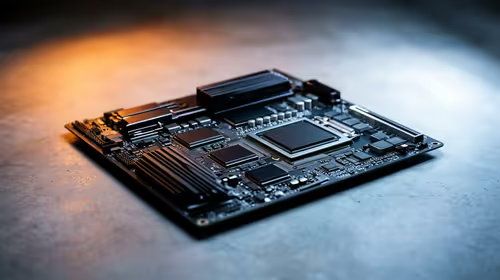
So, you've got your eye on the AMD Ryzen 5 5500. Smart move. It's a budget king in South Africa, offering incredible value for 1080p gaming rigs. But pairing it with a B550 motherboard, while logical, can lead to some sneaky performance traps. Before you click "add to cart," let's make sure you're not making one of these common Ryzen 5 5500 B550 build mistakes that could leave performance on the table.
The Biggest Ryzen 5 5500 B550 Build Mistake: The PCIe 4.0 Misunderstanding
Here’s the number one issue we see: builders assume that because the B550 motherboard supports PCIe 4.0, their whole system will. Unfortunately, the Ryzen 5 5500 CPU itself only supports PCIe 3.0.
What does this actually mean for you? 🤔
Your super-fast Gen 4 NVMe SSD will run at half its potential speed, capped by the CPU's Gen 3 lanes. While this might not be noticeable in most games right now, it impacts file transfer speeds and could become a bottleneck as future games leverage faster storage tech. Similarly, while most current graphics cards won't be significantly hampered, you're not getting the full bandwidth your motherboard offers.
This is a classic Ryzen 5 5500 B550 build mistake that limits your PC from day one. For builders who want to unlock that Gen 4 speed for their storage and GPU, upgrading to a Ryzen 7 CPU is often the most direct path to a more balanced and future-proof system.
Choosing the Wrong B550 Motherboard
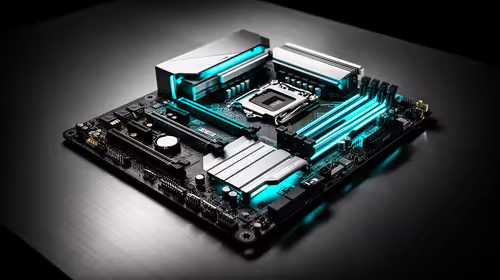
Not all B550 motherboards are created equal. Grabbing the absolute cheapest board you can find to save a few hundred Rand can cause headaches down the line. A common build mistake is ignoring crucial features that affect both current stability and future upgrades.
Key Features to Watch For:
- VRMs (Voltage Regulator Modules): These deliver stable power to your CPU. The Ryzen 5 5500 isn't a power hog, but a board with weak VRMs will struggle if you ever decide to drop in a more powerful CPU like a Ryzen 9.
- I/O (Input/Output): Do you have enough USB ports? Is the built-in audio good enough? Check the rear panel before you buy.
- BIOS Flashback: This feature lets you update the motherboard's BIOS without a CPU installed. It's a lifesaver if your board's factory BIOS doesn't support the Ryzen 5 5500 out of the box.
Check Your RAM Slots ⚡
Always check the motherboard's QVL (Qualified Vendor List) on the manufacturer's website before buying RAM. This ensures the specific RAM kit you want has been tested for compatibility and stability at its advertised speeds with that exact board, preventing frustrating boot-up issues.
Building from scratch can be tricky, which is why many gamers start with pre-vetted kits. Our curated AMD barebone kits are designed to avoid these compatibility issues, and we have options for the other side too, including Intel barebone kits, ensuring a solid foundation no matter your preference.
Neglecting RAM Speed and Configuration
Ryzen CPUs thrive on fast memory. Pairing your Ryzen 5 5500 with a slow, single stick of RAM is like putting budget tyres on a sports car... you’re just crippling its potential. 🔧
The sweet spot for price-to-performance is a dual-channel kit (that means two sticks) of DDR4 RAM running at 3200MHz or 3600MHz. Running two sticks enables dual-channel mode, effectively doubling the bandwidth between your CPU and memory. This single choice can boost your frame rates in games by a noticeable margin. Opting for a single 16GB stick over a 2x8GB kit is a frequent build problem that's easy to avoid.
By sidestepping these common Ryzen 5 5500 B550 build mistakes, you ensure every Rand spent translates directly into performance. If you want to skip the guesswork entirely, exploring expertly paired CPU and motherboard bundles guarantees compatibility and optimises your budget from the start.