Is your CPU bottlenecking that shiny new graphics card? You've spent your hard-earned Rands on a beastly GPU, but your frame rates still dip at the worst moments. Before you start pricing new processors, what if you could unlock a free performance boost already hiding in your rig? We’re talking about safe CPU overclocking, a builder’s secret for unleashing your PC’s true potential without spending another cent. Let's get into it. 🚀
Understanding the Basics of Safe CPU Overclocking
At its core, overclocking means running your processor at a higher speed (measured in gigahertz, or GHz) than its official factory setting. Think of it like tuning a car engine… you’re carefully pushing the components to deliver more power. The key word here is carefully. A haphazard approach can lead to instability or even damage.
The goal of safe CPU overclocking is to find the perfect balance between higher clock speeds, stable voltage, and manageable temperatures. It’s a process of small, incremental changes and rigorous testing to ensure your system remains rock-solid for daily use and intense gaming sessions.
The Essential Toolkit for Overclocking Your CPU Safely
Before you even think about entering your PC’s BIOS, you need to make sure you have the right hardware. Pushing your CPU generates more heat and requires a motherboard that can deliver clean, stable power.
Here’s your checklist:
- An Unlocked CPU: For Intel, this means a processor with a 'K' or 'KF' suffix (e.g., Core i7-14700K). For AMD, almost all modern Ryzen CPUs are unlocked for overclocking.
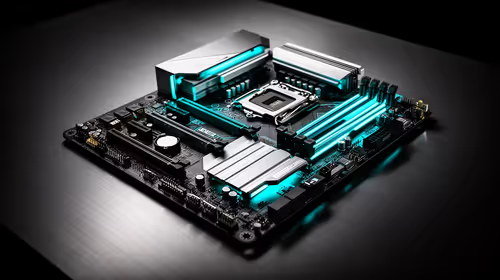
- A Capable Motherboard: You'll want a motherboard with a robust Voltage Regulator Module (VRM) to handle the extra power draw. Look for Intel Z-series (e.g., Z790) or AMD X-series or B-series (e.g., X670, B650) chipsets.
- Serious Cooling: The stock cooler won't cut it. A high-performance air cooler or, even better, an All-in-One (AIO) liquid cooler is non-negotiable for keeping temperatures in a safe range. For mission-critical builds where stability is everything, components found in powerful workstation PCs provide a great benchmark for reliability.
Essential Monitoring Tools 🔧
Always have monitoring software like HWMonitor or CPU-Z running on a second screen while you test. This gives you a live, real-time view of your CPU's clock speed, temperature, and voltage. Watching these vitals is the most important part of safe CPU overclocking, helping you spot trouble before it leads to a system crash.
A Step-by-Step Guide to a Safe Overclock
Ready to start? Remember, patience is your best friend here. This isn't a race.
Step 1: Establish Your Baseline
Before changing anything, you need to know your starting point. Download and run a benchmarking tool like Cinebench R23 and a stress-testing utility like Prime95. Run them at stock settings and write down your scores and maximum CPU temperature. This is the baseline you’ll be trying to beat.
Step 2: Enter the BIOS/UEFI
Restart your PC and press the designated key (usually Del, F2, or F12) to enter the BIOS. Every motherboard's BIOS looks different, but the core settings are universal. Look for sections labelled "Overclocking," "Advanced Frequency Settings," or similar.
Step 3: The Slow and Steady Method
The two main levers you'll be pulling are the CPU Core Ratio (or Multiplier) and the CPU Core Voltage (Vcore).
- Adjust the Multiplier: Increase your CPU multiplier by a small increment. If your stock speed is 4.5GHz (a multiplier of 45x), try increasing it to 46x for 4.6GHz.
- Test for Stability: Save your settings, reboot into Windows, and run Cinebench. If it completes successfully, you're on the right track.
- Rinse and Repeat: Go back into the BIOS and increase the multiplier again. Repeat this process until your system fails to boot or the benchmark crashes. This is your current stability limit.
- Increase Voltage (Slightly!): Now, go back to the last stable multiplier setting. Increase the Vcore by a tiny amount, like 0.01v. This can provide the stability needed for the next multiplier step.
The core loop is: increase multiplier -> test -> if unstable, increase voltage slightly -> test again.
Knowing Your Limits and When to Stop
The biggest enemy of a safe overclock is heat. Your primary goal is to keep your CPU temperature under 90-95°C during a stress test. If you see temps creeping higher, you’ve pushed too far. It's time to either dial back your clock speed or improve your cooling. ✨
If your system becomes unstable with constant blue screens or crashes, it's a clear sign to revert to your last known stable settings. For gamers who want guaranteed, out-of-the-box performance to pair with a powerful GPU, exploring expertly built NVIDIA GeForce gaming PCs is a fantastic, hassle-free alternative.
The Payoff: Is It Worth the Effort?
Absolutely. A successful and safe CPU overclock can give you a 5-15% performance uplift for free, making your games smoother and your applications snappier. The satisfaction of tuning your own machine is immense, but it definitely takes time and patience.
If you'd rather jump straight into the action with a rig that’s already been pushed to its stable limits by professionals, a pre-configured AMD Radeon gaming PC offers incredible performance from the moment you plug it in. The choice between DIY tuning and a pro build is all yours.
Ready for Peak Performance?
Safe CPU overclocking is a rewarding way to squeeze every drop of power from your hardware. But if you prefer guaranteed stability and expert tuning right out of the box, Evetech has your back. Explore our range of custom-built DeepSeek PCs and let our pros build the rig of your dreams.