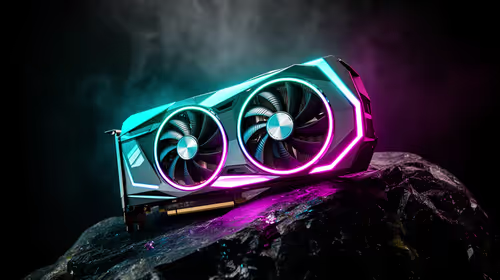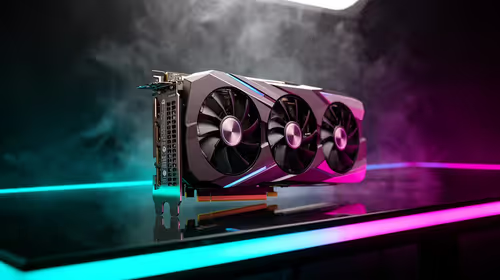
Dreaming of hitting that "Go Live" button on Twitch but worried your budget can't handle the hardware? You're not alone. For many South African gamers, the cost of a high-end streaming rig feels out of reach. But what if you could start your journey today? It’s entirely possible to stream to Twitch with an RTX 3050, a powerful entry-level GPU that punches well above its weight, delivering a quality broadcast without emptying your wallet.
Why the RTX 3050 is a Smart Choice for Streaming
The secret weapon for anyone looking to stream to Twitch with an RTX 3050 is a piece of dedicated hardware inside the card called the NVIDIA Encoder, or NVENC. In the past, streaming required your PC's main processor (CPU) to do all the heavy lifting of encoding your gameplay into a video format for Twitch. This often resulted in stuttering gameplay and a laggy stream.
NVENC takes that entire workload off your CPU. ⚡
This means your processor is free to focus on running your game smoothly, while the GPU handles both rendering the graphics and encoding the stream simultaneously. It’s a huge advantage for single-PC setups, making budget-friendly cards part of NVIDIA's GeForce RTX lineup a fantastic starting point for aspiring creators. This efficiency is the core reason why an RTX 3050 for streaming is such a viable and popular option in South Africa.
Optimising Your RTX 3050 Twitch Stream Settings
Getting a smooth, professional-looking broadcast is all about the right settings. Firing up OBS (Open Broadcaster Software) with a new card can be intimidating, but a few tweaks will get your RTX 3050 Twitch stream looking crisp. Forget CPU-draining x264 encoding; we’re going all-in on NVIDIA’s magic.
Here are the key settings to configure in OBS:
Essential OBS Settings
- Encoder: Navigate to
Settings > Output. Change theOutput ModetoAdvanced. Under theStreamingtab, selectNVIDIA NVENC H.264 (new). This is non-negotiable! - Rate Control: Set this to
CBR(Constant Bitrate). - Bitrate: For Twitch, a bitrate between 4500 and 6000 Kbps is the sweet spot for a quality 1080p stream. If your internet struggles, dropping to 3500 for a 720p stream is perfectly fine.
- Preset:
Qualityis the best balance.Max Qualitymight introduce a tiny performance hit for minimal visual gain on this card. - Resolution & FPS: In the
Settings > Videotab, set yourBase (Canvas) Resolutionto your monitor's native resolution (e.g., 1920x1080) and theOutput (Scaled) Resolutionto what you want to stream (1920x1080 or 1280x720). Aim for60FPS for smooth action.
Proper cooling helps maintain performance during long sessions, and you'll find great solutions on popular models from brands like MSI.
Pro Tip: Use NVIDIA Broadcast 🎙️
Your RTX card gives you free access to the NVIDIA Broadcast app. It uses AI to remove background noise from your mic and can even create a virtual green screen with surprising accuracy. It's an incredible tool for elevating your stream's production value with zero extra cost.
What Games Can You Realistically Stream?
So, you're set up and ready to go. What can you actually play while streaming with an RTX 3050? This GPU shines with popular, well-optimised esports titles. You can comfortably play and stream games like:
- Valorant
- CS: GO
- Apex Legends
- Fortnite (using Performance Mode)
- League of Legends
For more demanding AAA games like Cyberpunk 2077 or Elden Ring, you’ll need to make some compromises. This usually means lowering in-game graphical settings from High to Medium and ensuring features like DLSS (Deep Learning Super Sampling) are enabled to claw back performance. While some competing AMD Radeon cards offer great gaming performance, the maturity and quality of the NVENC encoder give the RTX 3050 a distinct edge for single-PC streaming.
Exploring Other Entry-Level Options
The RTX 3050 is a fantastic starting point, but it's wise to know the landscape. The tech world moves fast, and there are always alternatives to consider. For example, newer options like Intel Arc graphics cards are entering the market, bringing features like AV1 encoding which promises better quality at lower bitrates... though software support is still catching up.
It's also important not to confuse gaming cards with powerful workstation graphics cards. While those cards are beasts for 3D rendering or scientific computing, their drivers and architecture are not optimised for gaming and streaming, making an RTX card the clear winner for this purpose.
Ultimately, for a proven, reliable, and budget-friendly start, it's hard to look past the value offered by the RTX 3050. It’s the perfect companion for taking your first steps into the exciting world of content creation. ✨
Ready to Start Your Streaming Journey? 🚀 The GeForce RTX 3050 is a fantastic and affordable gateway for South Africans wanting to build their Twitch presence. Stop dreaming and start doing. Explore our massive range of NVIDIA graphics cards and find the perfect GPU to conquer your world.