Quick Answer
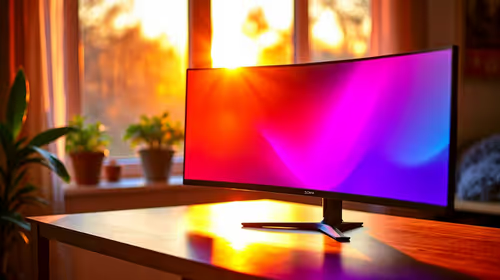
For UCT Architecture students, the best monitor setup under R15,000 in 2026 is a 27-inch 1440p IPS panel as the primary display, ideally with accurate factory calibration and a wide color gamut (sRGB 100% or P3 coverage). A secondary 24-inch 1080p display for reference materials completes the setup within budget.
What UCT Architecture Students Actually Need from a Monitor
Architecture at UCT involves a specific combination of software that makes monitor selection different from pure gaming or general use. Autodesk AutoCAD, Revit, Rhino 3D, Grasshopper, Adobe Creative Suite, and rendering tools like V-Ray or Enscape are the core of an architecture workflow. These applications demand:
Color accuracy: Architectural renders, material selections, and presentation visuals need consistent color representation. A monitor that shifts warm or cool will cause you to make incorrect material and lighting decisions in renders that look wrong when presented.
Resolution: AutoCAD and Revit at 1080p on a 27-inch monitor shows jagged line drawings due to low pixel density. 1440p on 27 inches gives you 108 PPI - enough for crisp vector lines in CAD drawings without needing display scaling.
Panel size: Architecture students spend long hours at the screen. A 27-inch primary monitor reduces eye strain compared to a 24-inch, and the extra screen real estate accommodates tool panels and the drawing canvas simultaneously without feeling cramped.
Ergonomics: Height adjustability, tilt, and rotation (pivot for portrait mode) matter for reviewing long drawings and section elevations. Look for a monitor with a fully adjustable stand rather than a fixed-height base.
Recommended Primary Monitor: 27-inch 1440p IPS Under R10,000
The primary display is where your design work happens. In the R6,000 - R10,000 range, several strong options exist:
Key specifications to prioritize:
- Resolution: 2560x1440 (WQHD/1440p)
- Panel: IPS for wide viewing angles and color consistency
- Color gamut: 99% sRGB minimum; Adobe RGB coverage is a bonus for print-focused work
- Brightness: 350 nits or higher for legibility under office lighting
- Connectivity: DisplayPort 1.4 + HDMI 2.0 + USB-C (USB-C is useful for laptop connection without an adapter)
- Refresh rate: 60Hz is sufficient for architecture work; 144Hz is a bonus if you also game
For UCT students who will also use the setup for gaming in the evenings, a 1440p 144Hz IPS panel covers both use cases well. Evetech's monitor range includes multiple 1440p IPS panels in the R6,000 - R9,000 range that meet these criteria.
Avoid VA panels as your primary architecture display. VA panels have slower pixel response in grey-to-grey transitions and can exhibit black smear - acceptable for gaming but problematic when panning large CAD drawings where ghosting obscures fine lines.
Secondary Monitor: 24-inch 1080p for Reference Materials
A dual-monitor setup is near-essential for architecture students by second year. The workflow typically runs the main CAD or modelling window on the primary 1440p display, with reference drawings, email, PDF specifications, and web research on the secondary screen.
In the R2,000 - R3,500 range, a 24-inch 1080p IPS monitor handles this role well. The pixel density difference between your primary 1440p 27-inch and the secondary 1080p 24-inch is small enough (93 PPI vs 108 PPI) that text and images look consistent across both screens.
For the secondary monitor, prioritize a matching color profile to your primary display. Use Windows Color Calibration or DisplayCAL to match brightness and white point between both monitors so your reference images accurately represent how they will look in your final renders.
Total spend for a dual-monitor setup: R8,500 - R13,500, well within the R15,000 budget and leaving R1,500 - R6,500 for a quality monitor arm or desk riser.
Monitor Arms and Ergonomics for UCT Architecture Students
A dual-monitor arm (R800 - R2,000 for a quality dual arm) transforms a desk setup by freeing surface space for physical drawing tools, models, and studio materials. For architecture students working across res, digs, or koshuis, desk space is often limited - a monitor arm can create the equivalent of 20-30cm of additional clear desk surface.
Position your primary monitor so the top of the screen is at or slightly below eye level. This reduces neck strain during long rendering waits and late studio nights. The secondary monitor can be positioned slightly lower and to the side at a 15-30 degree angle to your natural viewing direction.
For UCT students using a laptop as the primary computer, ensure your monitors have USB-C with DisplayPort Alternate Mode or use a compatible docking station. Most modern architecture-capable laptops support dual external displays via USB-C or Thunderbolt, eliminating the need for a discrete desktop GPU for the monitor connection.
Frequently Asked Questions
Is 1440p worth it over 1080p for AutoCAD and Revit? Yes, significantly. Line drawings in AutoCAD look noticeably crisper at 1440p on a 27-inch monitor. At 1080p the lower pixel density causes aliasing on diagonal lines in drawings that is fatiguing to work with over long sessions.
Do architecture students at UCT need a color-calibrated monitor? For Photoshop compositing, material renders, and any print-destined work, a factory-calibrated IPS panel is important. For pure CAD work, standard IPS color accuracy is sufficient. If you are doing physical model photography or exterior render presentations, accurate sRGB coverage matters.
How do I manage two monitors during loadshedding at my res or digs? A 1000VA UPS can power a 27-inch monitor (35-60W) and a 24-inch monitor (20-40W) alongside a laptop for approximately 1-2 hours during a power outage. This is enough to save your work and finish an active render. A UPS is a practical essential for any SA student doing time-critical architecture work.
Is ultrawide better than dual monitors for architecture? An ultrawide 34-inch 3440x1440 monitor offers a seamless single-panel experience that some architecture students prefer. However, at equivalent quality, an ultrawide costs more than a dual 1440p + 1080p setup. Within a R15,000 budget, dual monitors give you more total screen real estate and workflow flexibility.