Quick Answer
A 240Hz monitor does not cause Windows blue screens on its own; a BSOD points to a GPU driver, RAM, or storage fault. If crashes started, roll back the graphics driver and run a quick memory test first. The 240Hz panel is a passive display and almost never the root cause of a stop code.
What actually causes blue screen on a 240Hz gaming monitor
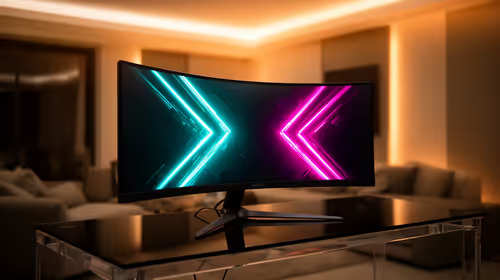
Blue screens carry a stop code, and on a high-refresh 240Hz LCD setup the usual triggers are an unstable GPU driver, faulty RAM, or an overclock pushed too far. A bad DisplayPort cable can drop signal and look display-related, but a true BSOD is a system fault. Note the stop code from the blue screen; it points straight at the failing subsystem. A typical 240Hz panel needs a 1ms response and a DisplayPort 1.4 or HDMI 2.1 cable rated for the full 240Hz; cheap cables cap you at 120Hz or 144Hz.
Safe checks to fix blue screen on a 240Hz gaming monitor
Use DDU to clean-uninstall the GPU driver, then install the latest stable version. Run a MemTest86 pass overnight and reset any CPU or GPU overclock to stock. Swap in a known-good DisplayPort 1.4 cable to rule out signal loss. Replacing the 240Hz monitor should be the last step, not the first. Work through one change at a time and retest, noting what helped, so you can tell a settings fix from a genuine hardware fault without guesswork.
FAQ
Is my 240Hz gaming monitor broken if it keeps showing blue screen?
Usually not. Blue screen on a 240Hz gaming monitor is far more often a cable, driver, or settings problem than a panel failure. Replacing the monitor should be your last step after the checks above.
Could a Windows update cause blue screen on a 240Hz gaming monitor?
Yes. Updates often reset refresh rate, swap drivers, or disable adaptive sync, which can trigger blue screen. Reinstall the GPU driver and re-check your display settings after every major Windows update.
How much does a replacement DisplayPort cable cost in SA?
A certified DisplayPort 1.4 cable rated for high refresh runs roughly R200 to R450 at Evetech, far cheaper than a new monitor. Ruling out the cable first often solves blue screen for the price of a small accessory.
Pro Tip
Before spending on a new 240Hz gaming monitor, swap to a certified DisplayPort 1.4 cable and confirm the full refresh rate in Windows; that single check resolves most blue screen reports for under R450.