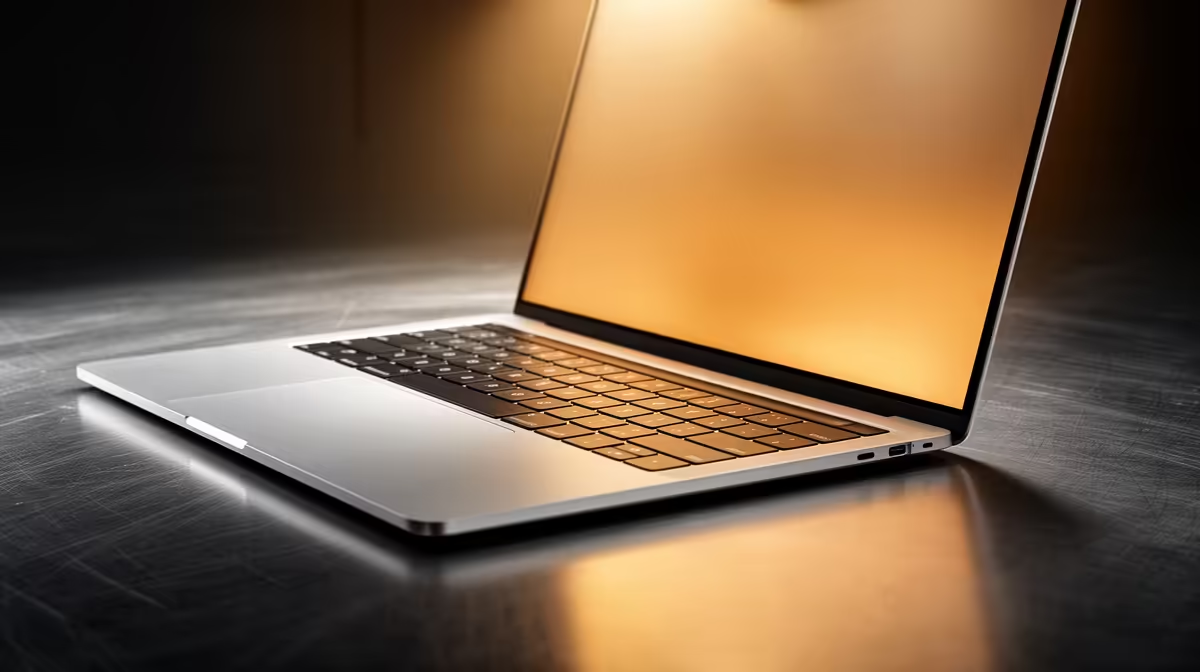
Apple quotes the M5 MacBook Air AI performance jump over the M4 at roughly 4x for on-device inference, and that figure points squarely at the redesigned Neural Engine. The number sounds dramatic, but what actually changes for someone using the machine day to day is more specific than a marketing headline, so here is what the gain buys you.
Quick Answer
The M5 MacBook Air is up to roughly 4x faster than the M4 for AI workloads, driven by a faster Neural Engine. That speed feeds Apple Intelligence, on-device Siri and ChatGPT handoff, and machine-learning features inside creative apps, where it shows up as quicker, smoother results rather than a number on a chart.
What the Neural Engine actually does
The Neural Engine is the dedicated block of silicon Apple uses for machine-learning maths, separate from the CPU and GPU. When an app runs a model on-device, such as live transcription, image cleanup, or text generation, that work lands on the Neural Engine.
A roughly 4x improvement there means tasks that the M4 chewed through in a few seconds can resolve closer to real time on the M5. The benefit is biggest for sustained or repeated AI tasks rather than a single quick action you would not notice either way.
Where the speed shows up in real use
Apple Intelligence features are the clearest beneficiary. Writing tools, summarisation, and image generation run partly on-device, so a faster Neural Engine means less waiting between asking and seeing a result.
Siri and ChatGPT handoff get snappier on the parts handled locally before any request reaches the cloud. The on-device portion resolves faster, so the whole interaction feels more immediate.
Creative apps lean on ML for tasks like subject selection, noise reduction, audio cleanup, and upscaling. Photographers and video editors running these tools repeatedly across a project feel the cumulative time saving most.
For everyday browsing, email, and document work, the AI gain is largely invisible because those tasks barely touch the Neural Engine. If your workload is ordinary productivity, the M4 still feels fast and the upgrade case rests almost entirely on AI-heavy use. You can line up the current options on the MacBooks page at Evetech to see which configuration fits.
Should you upgrade from an M4?
If you bought an M4 MacBook Air recently and your AI use is light, there is no pressure to jump. The everyday experience between the two is close, and the M4 remains a strong machine.
The upgrade makes sense if you lean on on-device AI heavily: running local ML in creative software, generating text and images through Apple Intelligence all day, or wanting the smoothest possible Siri experience. For buyers coming from an older Intel Mac or an M1, the leap is far larger and the M5 is an easy recommendation. To compare against what other shoppers are choosing, the laptop best sellers give a quick read on popular configurations.
Frequently Asked Questions
Is the M5 MacBook Air really 4x faster than the M4?
Apple quotes up to roughly 4x specifically for on-device AI and machine-learning tasks handled by the Neural Engine. It is not a 4x jump in general performance like web browsing or app launching, which see far smaller gains.
Will I notice the AI improvement in everyday use?
Only if your daily work involves AI features. Apple Intelligence, on-device Siri, and ML tools in creative apps benefit clearly, while ordinary email, browsing, and documents feel about the same as on the M4.
Should I upgrade from an M4 to an M5 for AI?
If you use on-device AI heavily, yes, the speed gain is meaningful. If your AI use is occasional, the M4 still serves you well and the upgrade is hard to justify on AI alone.
Does the faster Neural Engine help battery life?
Running AI tasks faster can mean the chip finishes work and idles sooner, which helps efficiency on those tasks. The headline battery story for the MacBook Air still comes mainly from the overall chip design rather than the AI block alone.
Weighing an M5 against your current Mac? Compare the configurations and pricing on the MacBooks range at Evetech and pick the Air that matches how much AI work you actually do.