

Unisa Student Tech Preferences: Q1 2026 Report
Unisa Student Tech Preferences: Q1 Report. SA market intelligence with local buyer data, pricing shifts & actionable insights for smart purchasing.
Read moreRTX 5060 Minimum PSU Requirement: Don't Undersize. SA-focused analysis with local pricing data, real-world insights & actionable buying advice.
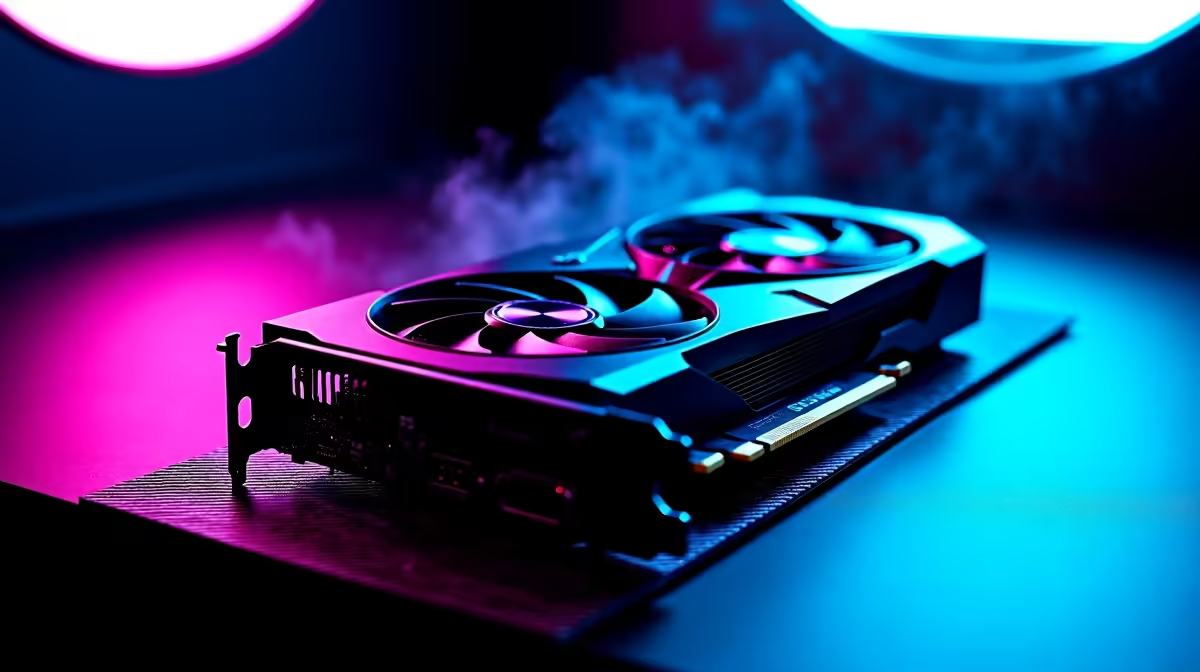
The RTX 5060 has a recommended minimum PSU requirement of 650W, though 750W is strongly advised for a full gaming system. Undersizing your power supply risks instability, crashes, and hardware damage - especially during GPU power spikes that can exceed 300W momentarily.
If you're building around the RTX 5060 in South Africa, getting the PSU right is one of the most critical decisions you'll make. Pair it with a unit that's too small and you'll face random shutdowns, failed boot attempts, and potentially shortened hardware lifespan - all expensive problems when replacement parts are priced in ZAR.
Nvidia rates the RTX 5060 at a 150W TDP, but that number doesn't tell the whole story. Modern GPUs - particularly Nvidia's Ada and Blackwell-generation cards - experience brief transient power spikes that can exceed 2-3x the rated TDP for milliseconds. These spikes occur during heavy workloads and demanding scenes. A PSU that's perfectly rated for steady-state draw can trip its overcurrent protection during these peaks, causing the dreaded instant shutdown mid-game. For the RTX 5060 specifically, you need headroom above the base rating, not a unit matched exactly to spec.
The RTX 5060 doesn't run in isolation. Your CPU, RAM, storage drives, case fans, and any RGB components all draw from the same rail. A typical mid-range build with a Core i5 or Ryzen 5 CPU, 32GB DDR5, two NVMe drives, and case fans will add 150-200W on top of GPU draw. That puts you comfortably at 350-400W under sustained load, which means a 550W PSU is already running at 65-75% capacity with no room for spikes. A 650W unit is the floor, and 750W is the sensible choice. For overclocked systems or those running a more power-hungry CPU like a Core i9 or Ryzen 9, step up to 850W.
A no-name 750W unit from a grey-market SA supplier is not equivalent to a quality 650W unit from a reputable brand. PSU efficiency ratings (80+ Bronze, Silver, Gold, Platinum) tell you how efficiently the unit converts AC from the wall to DC for your components. Gold-rated units are the sweet spot for most South African builders - they waste less power as heat, which matters during summer loadshedding cycles when every watt counts. Crucially, a quality PSU has tighter voltage regulation and better capacitors that handle transient spikes without flinching. Never buy a PSU without a reputable brand name and at least an 80+ Bronze certification.
Q: Can I run an RTX 5060 on a 550W PSU? A: Technically it may power on, but it's not recommended. A budget build with a low-power CPU might just scrape by, but any transient spike during gaming could trigger a shutdown or corrupt data. 650W is the safe minimum.
Q: Does PSU wattage affect gaming performance? A: Not directly, but an undersized PSU causes throttling and instability that absolutely hurts performance. An adequately powered GPU can hold its boost clocks consistently, delivering better frame rates.
Q: Is a modular PSU worth the extra cost in SA? A: Yes, for cable management and airflow. Modular units let you only run the cables you need, improving airflow and making your build look cleaner. The price premium is typically R200-400 over non-modular equivalents at the same wattage.
Ready to Find Your Perfect Match? Browse pre-built gaming PCs with properly spec'd PSUs already matched to the GPU - no guesswork required.
RTX 5060 Minimum PSU Requirement: Don't available at Evetech.co.za with local warranty and fast delivery.
RTX 5060 Minimum PSU Requirement: Don't - check Evetech for latest stock and SA pricing.
Depends on your use case. RTX 5060 Minimum PSU Requireme offers good value at current Rand pricing.
Unisa Student Tech Preferences: Q1 Report. SA market intelligence with local buyer data, pricing shifts & actionable insights for smart purchasing.
Read more
Mouse Stock Levels in Pretoria: June Report. Current stock data & price tracking for SA buyers. See what is available and where prices are heading.
Read more
Is Gen 5 NVMe Faster Than Gen 4 for Gaming Detailed answer with SA data, expert analysis & practical recommendations for local buyers.
Read more
Core Ultra 9 285K for Streaming: Performance. Real-world benchmark data, FPS numbers & performance analysis. What SA gamers can actually expect.
Read more
Tax & Customs on Imported PSUs. Practical breakdown of costs, regulations & whether it makes financial sense for SA buyers.
Read more
Is Ryzen 9 9950X Compatible with Core Ultra 7 265K Detailed answer with SA data, expert analysis & practical recommendations for local buyers.
Read more
MacBook Pro for Machine Learning in 2026: Can Apple Silicon Compete Detailed answer with SA data, expert analysis & practical recommendations for local buyers.
Choose the Right SATA SSD for machine learning. Step-by-step instructions with SA-specific tips, common pitfalls to avoid & expert recommendations.
Overwatch 2 Competitive Settings Servers. Tested & verified settings for best FPS and visual quality on SA hardware budgets.
League of Legends Settings for 144Hz Gaming. Tested & verified settings for best FPS and visual quality on SA hardware budgets.

Every AMD CPU Ranked for Gaming: Tier List. SA-focused analysis with local pricing data, real-world insights & actionable buying advice.

Easter Family Bundles: Monitors. Hand-picked gift ideas at every budget tier. SA pricing & Evetech availability included.

Ryzen 7 9800X3D Running 100 Degrees: Cooler. Diagnosis steps, proven fixes & when to seek professional help. SA-specific support info included.

Most Affordable Laptops : Starting from R8,000. Full parts list, Rand pricing & expected performance. Build confidently with SA-available components.
Storage Stock Levels in Port Elizabeth: December. Current stock data & price tracking for SA buyers. See what is available and where prices are heading.
Ryzen 7 10800X3D Apex Legends Gaming Performance. Real-world benchmark data, FPS numbers & performance analysis. What SA gamers can actually expect.
Mouse Technology: 2023- Evolution in Gaming. Technology trajectory, what it means for SA buyers & how to future-proof your next purchase.
FAQ: Is my hard drive failing Detailed answer with SA data, expert analysis & practical recommendations for local buyers.