

Core Ultra 5 245K Gaming Performance: Full Optimization
Core Ultra 5 245K Gaming Performance: Full. Real-world benchmark data, FPS numbers & performance analysis. What SA gamers can actually expect.
Read moreRTX 5070 Hot Spot Temperature High: Diagnosis. Systematic diagnosis process, recovery options & when to seek professional data recovery in SA.
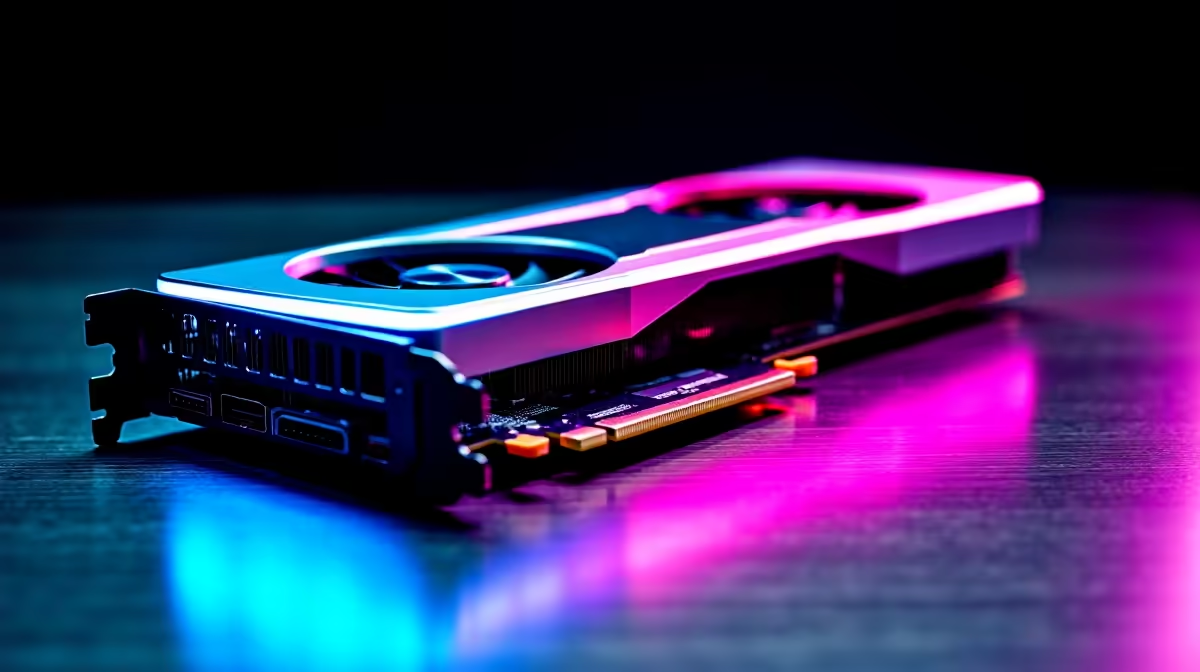
The RTX 5070 uses a hot spot temperature metric that reads significantly higher than the average GPU temperature, which often alarms users who are not familiar with how it works. A hot spot temperature of 80-95 degrees Celsius on the RTX 5070 is normal. The hot spot measures the single hottest point on the die, not the average, so it will always read higher than your core or memory junction temperatures. If your hot spot exceeds 100-105 degrees consistently, that warrants investigation.
NVIDIA's RTX 5000 series reports multiple thermal readings: GPU core temperature, hot spot temperature, and memory junction temperature. The hot spot sensor sits at the thermal junction of the GPU die and measures the peak temperature at a single point rather than an average across the chip. This means the hot spot reading will always be 10-20 degrees higher than your average GPU temperature under identical conditions.
For the RTX 5070, NVIDIA rates the maximum junction temperature at 107 degrees Celsius. Running at 85-95 degrees hot spot during heavy gaming is operating well within spec. Monitoring tools like HWiNFO64 and GPU-Z expose these values clearly, and seeing a hot spot of 90 degrees alongside a core temp of 72 degrees is completely normal operation.
The confusion arises because MSI Afterburner by default shows the core GPU temperature, while HWiNFO64 breaks out hot spot as a separate reading. Comparing the wrong values across tools creates the impression of an abnormally high temperature.
Genuine hot spot temperature issues on the RTX 5070 manifest in specific ways. If your hot spot is exceeding 100 degrees regularly during normal gaming loads, or if it is hitting the 107-degree throttle threshold, the card is either dealing with poor case airflow, an inadequate cooler mount, or dried thermal interface material.
For South African users during summer in Gauteng and the Western Cape, ambient temperatures above 30 degrees in a poorly ventilated room can push GPU temperatures into ranges that are normally benign elsewhere but approach throttle territory locally. Case airflow becomes more critical in warmer SA climates. A mid-tower with two front intake fans and a rear exhaust should keep the RTX 5070 operating comfortably even in summer.
Throttling itself is the real diagnostic signal. If your GPU clock speeds are dropping during gaming loads and you see hot spot temperatures above 100 degrees simultaneously, the thermal solution needs attention. If clock speeds hold steady and the hot spot is reading 90-95 degrees, everything is working as intended.
If you have confirmed the RTX 5070 is actually throttling due to temperature rather than misreading the hot spot value, the diagnostic steps are straightforward. First, check case airflow: remove the side panel and run a benchmark. If temperatures drop significantly with the panel off, airflow inside the case is the problem. Add intake fans or reposition existing ones.
Second, check that the card is not being restricted by the PCIe slot positioning or other components blocking airflow over the GPU cooler. Some compact mATX cases cramp the GPU with storage or cable routing.
Third, if the card is older and has seen extended use, the thermal pads between the GPU die and the heatspreader can degrade. This is less common on newer RTX 5070 units but is worth checking on any card that has run hot for an extended period.
What is the safe hot spot temperature limit for the RTX 5070? NVIDIA specifies a maximum junction temperature of 107 degrees Celsius for the RTX 5070. Operating below 100 degrees hot spot consistently is ideal, and most users will see 80-95 degrees during typical gaming loads.
Will the RTX 5070 throttle itself if it gets too hot? Yes. The RTX 5070 implements automatic thermal throttling that reduces clock speeds to prevent damage if temperatures approach the maximum junction limit. You will see GPU clock drops in monitoring software when throttling occurs.
Should I apply a custom fan curve to manage RTX 5070 hot spot temperatures? If your hot spot is approaching 100 degrees, a more aggressive fan curve through MSI Afterburner can bring temperatures down at the cost of slightly more fan noise. A target of keeping hot spot below 95 degrees under full gaming load is a reasonable goal.
Ready to Find Your Perfect Match? Shop RTX 5070 graphics cards at Evetech with full warranty coverage for South African buyers.
RTX 5070 Hot Spot Temperature High: Diag available at Evetech.co.za with local warranty and fast delivery.
RTX 5070 Hot Spot Temperature High: Diag - check Evetech for latest stock and SA pricing.
Depends on your use case. RTX 5070 Hot Spot Temperature offers good value at current Rand pricing.
Core Ultra 5 245K Gaming Performance: Full. Real-world benchmark data, FPS numbers & performance analysis. What SA gamers can actually expect.
Read more
Huawei MatePad Range : Which Model Should You Buy. Complete product range with SA pricing, key specs & recommendations for different budgets.
Read more
Are Wireless Gaming Peripherals as Good as Wired in 2026 Detailed answer with SA data, expert analysis & practical recommendations for local buyers.
Read more
Are Big And Tall Gaming Chairs Good for Long Gaming Sessions Detailed answer with SA data, expert analysis & practical recommendations for local buyers.
Read more
PCIe Bandwidth Saturation: Multiple GPU Issue. Diagnosis steps, proven fixes & when to seek professional help. SA-specific support info included.
Read more
Intel Keyboard: Value. SA-focused analysis with local pricing data, real-world insights & actionable buying advice.
Read more
MacBook Pro for Machine Learning in 2026: Can Apple Silicon Compete Detailed answer with SA data, expert analysis & practical recommendations for local buyers.
Choose the Right SATA SSD for machine learning. Step-by-step instructions with SA-specific tips, common pitfalls to avoid & expert recommendations.

Overwatch 2 Competitive Settings Servers. Tested & verified settings for best FPS and visual quality on SA hardware budgets.

League of Legends Settings for 144Hz Gaming. Tested & verified settings for best FPS and visual quality on SA hardware budgets.
Every AMD CPU Ranked for Gaming: Tier List. SA-focused analysis with local pricing data, real-world insights & actionable buying advice.
Easter Family Bundles: Monitors. Hand-picked gift ideas at every budget tier. SA pricing & Evetech availability included.

Ryzen 7 9800X3D Running 100 Degrees: Cooler. Diagnosis steps, proven fixes & when to seek professional help. SA-specific support info included.
Most Affordable Laptops : Starting from R8,000. Full parts list, Rand pricing & expected performance. Build confidently with SA-available components.

HBADA Chairs : Range and Pricing. Complete product range with SA pricing, key specs & recommendations for different budgets.
Ryzen 7 9800X3D for Music Production: Performance. Real-world benchmark data, FPS numbers & performance analysis. What SA gamers can actually expect.

Winter Cooling Management: Headsets. SA-focused analysis with local pricing data, real-world insights & actionable buying advice.

AKRacing Gaming Chair Range: Which Model Is Right. Complete product range with SA pricing, key specs & recommendations for different budgets.