Two terms are starting to show up in home-internet conversations, and most people have no idea whether they matter: 5G RedCap and 5.5G. RedCap, short for Reduced Capability and also called NR-Light, is a slimmed-down flavour of 5G that runs on Standalone networks. For South African homes relying on fixed-wireless internet, it could shift what the router on your windowsill costs and how it performs.
Quick Answer
5G RedCap (NR-Light) is a 3GPP Release 17 variant of 5G built on Standalone networks, with around 30 operators across 21 countries already investing in it as of early 2025. For SA fixed-wireless users it points toward cheaper, lower-power CPE hardware rather than a raw speed jump, while 5.5G describes the broader next step in 5G capability.
What RedCap actually is
Full 5G NR devices support wide bandwidth, multiple antennas and complex duplexing. RedCap deliberately strips that back. It gives a device a reduced feature set that is plenty for a defined band of uses but is not chasing flagship broadband throughput. The payoff is simpler, cheaper, lower-power radios. RedCap was introduced in 3GPP Release 17, and a further-trimmed version called eRedCap arrived in Release 18, capping speeds even lower for the cheapest, most power-frugal devices.
Why it leans on Standalone 5G
RedCap rides on the 5G Standalone architecture, the version of 5G that runs on a native 5G core rather than leaning on older 4G infrastructure. Standalone unlocks features like network slicing and lower-latency service classes. As operators expand Standalone coverage and refarm spectrum away from ageing LTE, RedCap-capable fixed-wireless routers become an attractive way to deliver broadband while freeing up older network assets.
What it means for South African homes
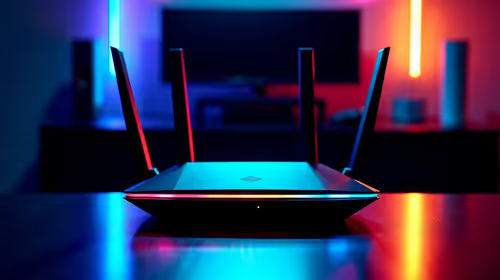
For fixed-wireless access, the FWA that many SA households use instead of fibre, RedCap is less about peak speed and more about cost and efficiency. A RedCap CPE (the router that receives the mobile signal) needs less complex radio hardware, which can bring the device price down and reduce power draw. In a market where fixed-wireless is a real fibre alternative in many suburbs, cheaper and more efficient hardware widens access. RedCap is emerging as a viable FWA option in markets moving away from LTE, which describes the SA picture closely. The current networking and connectivity range at Evetech covers the routers and Wi-Fi gear that turn any home internet feed into reliable coverage across the house.
Where 5.5G fits
5.5G is the umbrella term for the next stage of 5G evolution, layering in higher capacity and smarter capability on top of today's networks. RedCap and 5.5G are not the same thing: RedCap simplifies devices for cost and efficiency, while 5.5G pushes the network's ceiling higher. For a home user the practical question is simpler than the jargon suggests. Better networks plus cheaper compatible hardware means more competitive home-internet choices over the next few years. Whatever generation your router runs on, the cabling, adapters and peripherals that support a clean home setup are in the accessories best sellers at Evetech.
Frequently Asked Questions
Is RedCap faster than the 5G I have now?
No. RedCap is built for lower cost and power, not higher peak speed. Its value for home internet is more affordable, efficient router hardware rather than a raw throughput increase.
Do I need a new router for RedCap?
Yes, eventually. RedCap needs a RedCap-capable CPE device. Existing routers will not gain the feature through a software update, so the benefit arrives with new hardware as it reaches the market.
When will this reach South Africa?
Commercial RedCap network support began emerging through 2024 and 2025, with wider device availability rolling out across 2025 and 2026. SA timing depends on local operators expanding Standalone 5G coverage.
What is the difference between RedCap and eRedCap?
RedCap is the first reduced-capability tier. eRedCap, from 3GPP Release 18, trims it further, capping peak rates lower (around 10Mbps down) for the cheapest, lowest-power devices aimed at the most basic connected uses.
Whatever feeds your home internet, the gear that spreads it through the house matters most day to day. Explore routers, mesh systems and Wi-Fi hardware in the networking range at Evetech: https://www.evetech.co.za/networking/x/1623