


GTA 6 Max Settings on RTX 5070: Complete Guide
GTA 6 Max Settings on RTX 5070. Tested & verified settings for best FPS and visual quality on SA hardware budgets.
Read moreAMD 3D V-Cache explained: Discover how stacked L3 cache boosts gaming FPS and if the price premium is justified in South Africa. 🚀 Is the upgrade worth your Rands in 2025? Find out now! 🎮
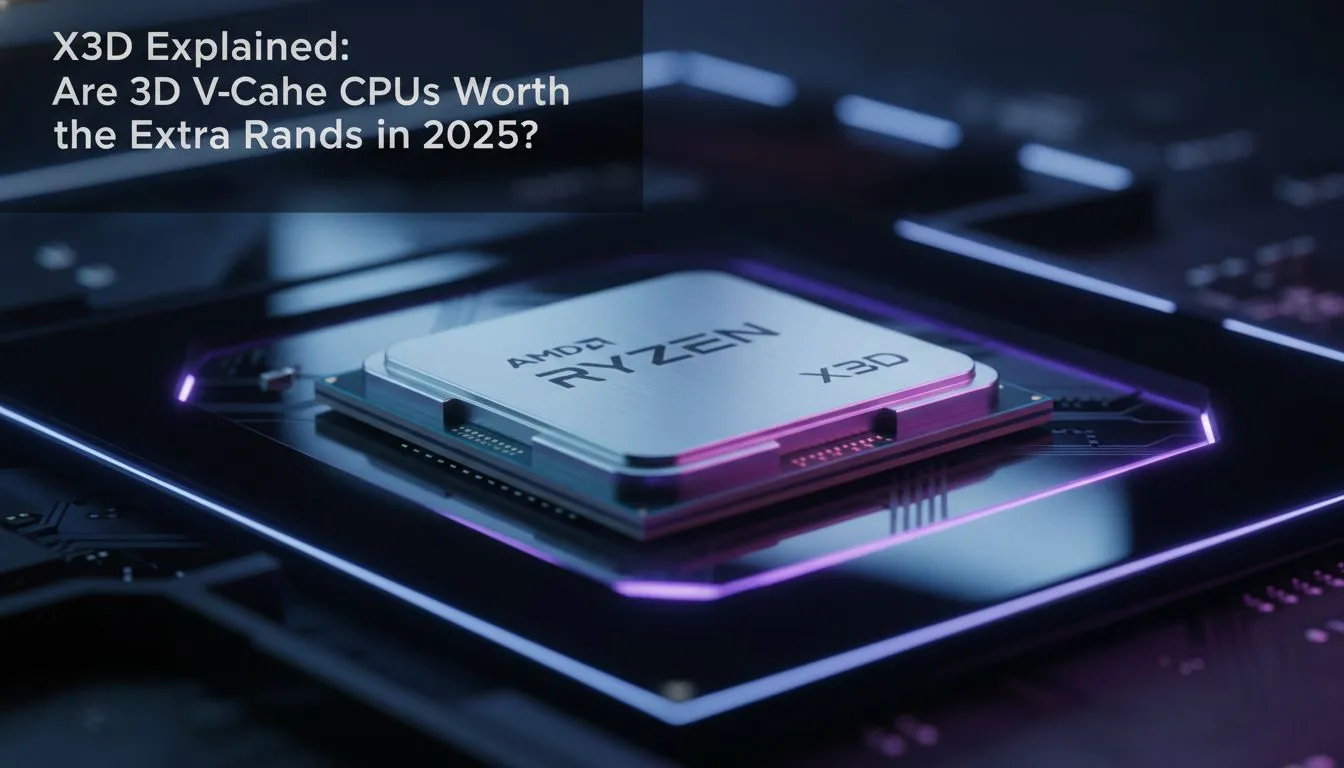
Stuttering frames in the middle of a tense firefight in Cape Town? Or maybe your new rig just isn’t hitting those buttery-smooth frame rates you dreamed of? You’re not alone. As games get more complex, the CPU bottleneck is real. Enter AMD’s secret weapon: 3D V-Cache. But what is it, and are X3D CPUs worth it in 2025 for your gaming setup? Let's dive deep and find out.
Let’s break it down, nice and simple. Think of your CPU’s cache as a tiny, ultra-fast workbench right next to its main processing cores. The bigger and faster this workbench (called L3 cache), the less time the CPU wastes fetching data from your main system RAM.
AMD 3D V-Cache explained simply is a revolutionary way of stacking an extra, massive layer of this L3 cache directly on top of the processor. 🚀 It’s like adding a second level to your workbench. This gives the CPU immediate access to a gigantic pool of game data, drastically speeding up operations and reducing latency. For gamers, this means smoother, more consistent frame rates. It's a clever piece of engineering that directly targets gaming performance, making it a hot topic for anyone looking at new CPU processors.
Okay, the theory sounds cool, but what does it mean for your actual gaming sessions? The performance uplift from an X3D CPU can be massive, but it shines brightest in specific scenarios.
Games that juggle a lot of unpredictable data—think sprawling open worlds like Cyberpunk 2077, complex simulations, or high-player-count battle royales like Warzone—see the biggest gains. The extra cache keeps the CPU fed, preventing the micro-stutters that can get you eliminated. For competitive gamers chasing every last frame, this technology can be the difference between winning and losing a duel. When you're looking at the latest AMD CPU options, the X3D models are often positioned as the top-tier gaming champions for this very reason.
No tech is perfect, and it’s important to understand the trade-offs. To manage heat and power within the stacked design, X3D CPUs often have slightly lower maximum clock speeds compared to their non-X3D siblings.
What does this mean? For tasks that rely on raw, single-core frequency—like some productivity applications or file compression—a non-X3D chip might actually be faster. This is where the competition heats up. For a workstation built for video editing or 3D rendering, a chip from the Intel CPU lineup might offer better value. In fact, for pure multi-threaded productivity, a top-end processor like an Intel Core Ultra 9 could pull ahead, making the choice less about which is "best" and more about what's best for your specific needs.
Before you spend your hard-earned Rands on an X3D chip, do a quick search on YouTube for "Ryzen 7 7800X3D vs Ryzen 7 7700X in [Your Favourite Game]". Benchmarks are your best friend. Some games are heavily GPU-bound and won't see a massive benefit, while others will fly. A few minutes of research can ensure your money is well spent.
So, we come to the big question. For a South African gamer building a PC in 2025, is an X3D processor the right call? The answer is a classic: it depends. ✨
If your PC is a dedicated gaming machine and you want the absolute smoothest experience possible, then yes, X3D CPUs are absolutely worth it. The improvement to frame consistency (1% lows) is something you can truly feel. For this user, investing in a powerhouse like an AMD Ryzen 9 with 3D V-Cache is the pinnacle of gaming performance.
This is a tougher call. You need to weigh your priorities. If you spend 80% of your time gaming and 20% editing videos, the X3D is likely still the better choice. If that ratio is closer to 50/50, a non-X3D AMD CPU or a high-core-count Intel chip might provide a more balanced performance profile across all your tasks.
If you're on a tight budget, the premium price of an X3D model might be better allocated to a more powerful graphics card. A balanced system is always key, and a mid-range CPU paired with a beastly GPU will often deliver a better overall gaming experience than a top-tier CPU with a mid-range GPU.
Ultimately, AMD's 3D V-Cache technology is a phenomenal innovation for PC gaming. It delivers tangible, noticeable performance gains where they matter most.
Ready to Build Your Ultimate Rig? Whether you've decided an X3D CPU is your next upgrade or you're weighing up the competition, the perfect processor is waiting. Explore our massive range of CPUs and find the heart of your next PC build today.
It is a vertical cache stacking innovation that triples the L3 cache on Ryzen CPUs, significantly reducing latency and boosting gaming frame rates.
Yes. The massive cache delivers superior FPS in CPU-bound games and simulation titles, often outperforming more expensive processors.
They work, but standard high-frequency Ryzen chips often offer better value and speed for productivity tasks like rendering and encoding.
Not necessarily. X3D chips fit standard AM4 or AM5 sockets, though you will likely need a BIOS update to ensure compatibility.
The stacked cache layer acts as a thermal insulator, trapping heat. We recommend a high-quality AIO or air cooler to maintain optimal performance.
The Ryzen 7 7800X3D remains a top choice for gamers, balancing price and elite performance, while newer 9000-series models offer future-proofing.
GTA 6 Max Settings on RTX 5070. Tested & verified settings for best FPS and visual quality on SA hardware budgets.
Read more
Cyberpunk 2077 Max Settings on RTX 5080. Tested & verified settings for best FPS and visual quality on SA hardware budgets.
Read more
Starfield Max Settings on RTX 5070 Ti. Tested & verified settings for best FPS and visual quality on SA hardware budgets.
Read more
AMD RX 9050 XT: Rumoured Specs, Price & Release. SA-focused analysis with local pricing data, real-world insights & actionable buying advice.
Can RTX 4080 Super Run AI Workloads for SA Developers Detailed answer with SA data, expert analysis & practical recommendations for local buyers.
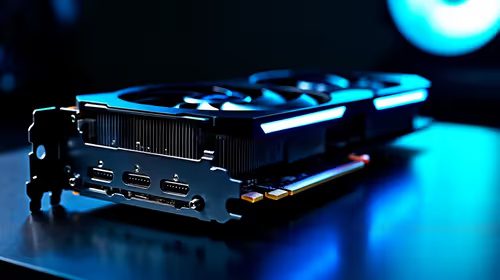
Can RTX 4090 Run AI Workloads for SA Developers Detailed answer with SA data, expert analysis & practical recommendations for local buyers.
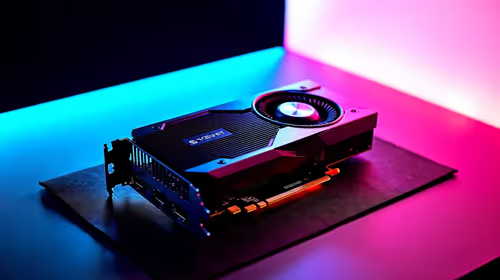
Top Settings for Intel Arc B580 at Ultrawide 1440p picks evaluated on performance, value & SA availability with current Rand pricing from Evetech.

RTX 4060 CS2 Low Settings at 1080p: FPS Results. Real-world benchmark data, FPS numbers & performance analysis. What SA gamers can actually expect.

Visual Artifacts: Possible GPU Issue Issue #1. Diagnosis steps, proven fixes & when to seek professional help. SA-specific support info included.

Can the RTX 4090 Handle 1440p 144Hz Gaming. Performance testing verdict with real data & practical recommendations for SA buyers.

Top ASUS GPU Under R15000 picks evaluated on performance, value & SA availability with current Rand pricing from Evetech.
GTA 6 Max Settings on RTX 5070. Tested & verified settings for best FPS and visual quality on SA hardware budgets.
Cyberpunk 2077 Max Settings on RTX 5080. Tested & verified settings for best FPS and visual quality on SA hardware budgets.
Starfield Max Settings on RTX 5070 Ti. Tested & verified settings for best FPS and visual quality on SA hardware budgets.
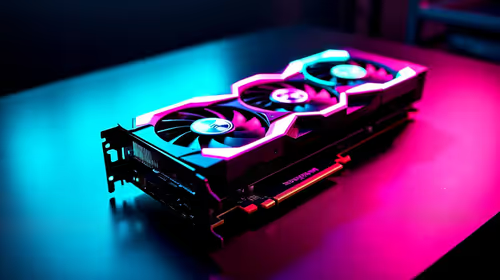
Top RTX 5090 Under R5000 picks evaluated on performance, value & SA availability with current Rand pricing from Evetech.