

GTA 6 Max Settings on RTX 5070: Complete Guide
GTA 6 Max Settings on RTX 5070. Tested & verified settings for best FPS and visual quality on SA hardware budgets.
Read moreDiscover which budget GPU dominates ray tracing: Intel Arc A580 vs AMD RX 6600. 🎮 Benchmark showdown reveals FPS supremacy!
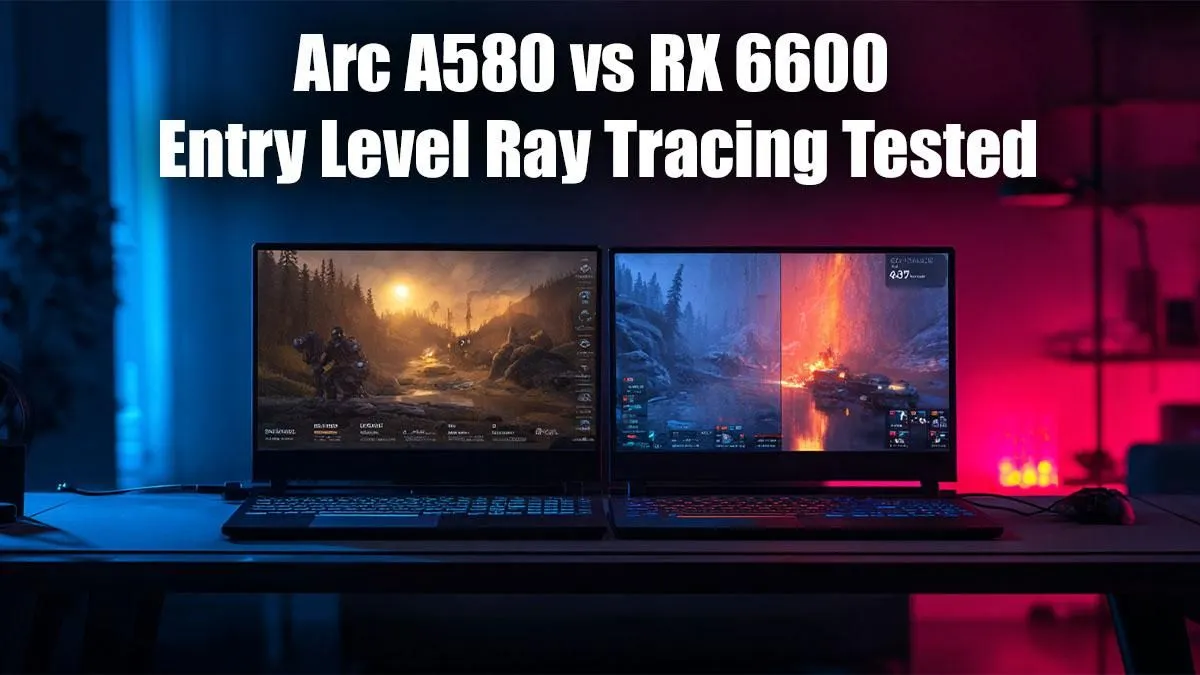
Mzansi gamers, ever found yourself staring at specs, wondering if that shiny new GPU will truly deliver those breathtaking, realistic reflections and shadows? The mid-range market is bustling, and two contenders often spark debate: Intel's Arc A580 and AMD's Radeon RX 6600. When it comes to the demanding world of ray tracing, choosing between them isn't always straightforward. Let's dive deep into the Arc A580 vs RX 6600 ray tracing performance and see which one offers the best value for your hard-earned rands. 🇿🇦
Ray tracing is a rendering technique that simulates the physical behaviour of light. Think ultra-realistic reflections on wet surfaces, dynamic shadows that accurately react to light sources, and global illumination that makes every scene feel more immersive. It's a visual feast, but it demands serious graphical horsepower. Both the Intel Arc A580 and the AMD RX 6600 offer hardware acceleration for ray tracing, promising a step up from older cards. But how do they stack up in the real world, especially when the frames per second (FPS) count?
Intel's entry into the discrete GPU market with its Arc series brought a fresh perspective. The Arc A580, positioned firmly in the mid-range, boasts dedicated Ray Tracing Units (RTUs) designed to handle these complex calculations. Early driver optimisations have significantly boosted its capabilities since launch, making it a more viable option today. In titles that leverage its architecture well, like Cyberpunk 2077 or Control, the Arc A580 can surprise, often trading blows with or even outperforming its AMD counterpart in specific ray-traced scenarios, especially at 1080p.
However, the experience can vary. Driver maturity is still a journey, and some games might not yet be fully optimised for Arc, leading to inconsistent performance. But for a card that often sits in a similar price bracket to the RX 6600, its ray tracing potential is genuinely exciting. When building a new system or upgrading, understanding the A580's strengths is key. For those considering a complete system solution that offers both power and portability, our extensive range of laptop specials for sale in South Africa might offer the perfect all-in-one package.
The AMD Radeon RX 6600, built on the well-established RDNA 2 architecture, also features dedicated Ray Accelerators. This card has been a favourite among budget-conscious gamers for its excellent rasterisation performance at 1080p. When it comes to ray tracing, the RX 6600 performs admirably, but generally sits a step below its direct NVIDIA competitors in this specific metric. It can handle lighter ray tracing effects in many modern games, but pushing settings to "Ultra" with ray tracing enabled might see FPS drop significantly.
The RX 6600 shines when paired with AMD's FSR (FidelityFX Super Resolution) technology, which can upscale lower-resolution frames to boost performance, making ray tracing more playable. This is crucial for maintaining decent frame rates without sacrificing too much visual fidelity. If an AMD GPU like the RX 6600 piques your interest, you might also be keen on the robust performance of AMD laptops on special, offering powerful gaming on the go.
To boost ray tracing FPS, always try lowering the "Ray Tracing Quality" setting first, rather than switching it off entirely. Also, enable upscaling technologies like FSR (for AMD) or XeSS (for Intel Arc) to maintain smooth gameplay. Every frame counts!
When we put the Arc A580 vs RX 6600 ray tracing performance head-to-head, the results can be a mixed bag, but a pattern emerges.
In many scenarios, particularly at 1080p with moderate ray tracing settings, the A580 can pull ahead, sometimes by a noticeable margin. For those leaning towards Intel's Arc A580 for their desktop build, remember that Intel also powers a range of powerful portable machines. Check out our Intel laptops on special for mobile gaming excellence.
While ray tracing is a fantastic feature, it's not the only metric. For overall rasterisation performance at 1080p, both cards are strong contenders. The RX 6600 generally offers reliable, high-frame-rate gaming in non-ray-traced titles, making it a solid all-rounder. The Arc A580, meanwhile, has been rapidly improving, often matching or even exceeding the RX 6600 in traditional gaming benchmarks in recent driver releases.
Consider your budget and the games you play most. If you're chasing the bleeding edge of visual fidelity with ray tracing on a tight budget, and are willing to tinker with settings and drivers, the Arc A580 might offer a more compelling (and sometimes surprising) experience. If you prefer rock-solid, consistent performance across the board with decent ray tracing capability when needed, the RX 6600 remains a formidable choice.
Ultimately, finding the right gaming machine means balancing budget and performance, whether it's for a desktop build or a portable setup. Don't miss out on our best gaming laptop deals if portability is your priority, as understanding GPU performance is key across all platforms.
Upgrade Your Rig Today! Ready to experience stunning visuals and smooth gameplay? Explore Evetech's incredible range of GPUs, gaming PCs, and laptops to find your perfect match. Shop now at Evetech for performance that leaves lag in the dust.
The RX 6600 edges out Arc A580 in raw RT performance.
Yes, both handle 1440p gaming at medium settings.
XeSS shows competitive fps gains in RT workloads.
Newer titles like Cyberpunk 2077 and Hogwarts Legacy show RT boosts.
Arc A580 provides similar efficiency to RX 6600 with its 10GB VRAM.
AMD FSR leads XeSS in most ray tracing benchmarks.
RX 6600 maintains cooler temperatures under RT stress tests.
GTA 6 Max Settings on RTX 5070. Tested & verified settings for best FPS and visual quality on SA hardware budgets.
Read more
Cyberpunk 2077 Max Settings on RTX 5080. Tested & verified settings for best FPS and visual quality on SA hardware budgets.
Read more
Starfield Max Settings on RTX 5070 Ti. Tested & verified settings for best FPS and visual quality on SA hardware budgets.
Read more
Can RTX 4080 Super Run AI Workloads for SA Developers Detailed answer with SA data, expert analysis & practical recommendations for local buyers.
Can RTX 4090 Run AI Workloads for SA Developers Detailed answer with SA data, expert analysis & practical recommendations for local buyers.
Top Settings for Intel Arc B580 at Ultrawide 1440p picks evaluated on performance, value & SA availability with current Rand pricing from Evetech.
RX 7600 Overclocking Guide: Safe OC Settings for. Real-world benchmark data, FPS numbers & performance analysis. What SA gamers can actually expect.
RTX 4060 CS2 Low Settings at 1080p: FPS Results. Real-world benchmark data, FPS numbers & performance analysis. What SA gamers can actually expect.
Visual Artifacts: Possible GPU Issue Issue #1. Diagnosis steps, proven fixes & when to seek professional help. SA-specific support info included.
Can the RTX 4090 Handle 1440p 144Hz Gaming. Performance testing verdict with real data & practical recommendations for SA buyers.
Top ASUS GPU Under R15000 picks evaluated on performance, value & SA availability with current Rand pricing from Evetech.
GTA 6 Max Settings on RTX 5070. Tested & verified settings for best FPS and visual quality on SA hardware budgets.
Cyberpunk 2077 Max Settings on RTX 5080. Tested & verified settings for best FPS and visual quality on SA hardware budgets.
Starfield Max Settings on RTX 5070 Ti. Tested & verified settings for best FPS and visual quality on SA hardware budgets.
Top RTX 5090 Under R5000 picks evaluated on performance, value & SA availability with current Rand pricing from Evetech.