Quick Answer
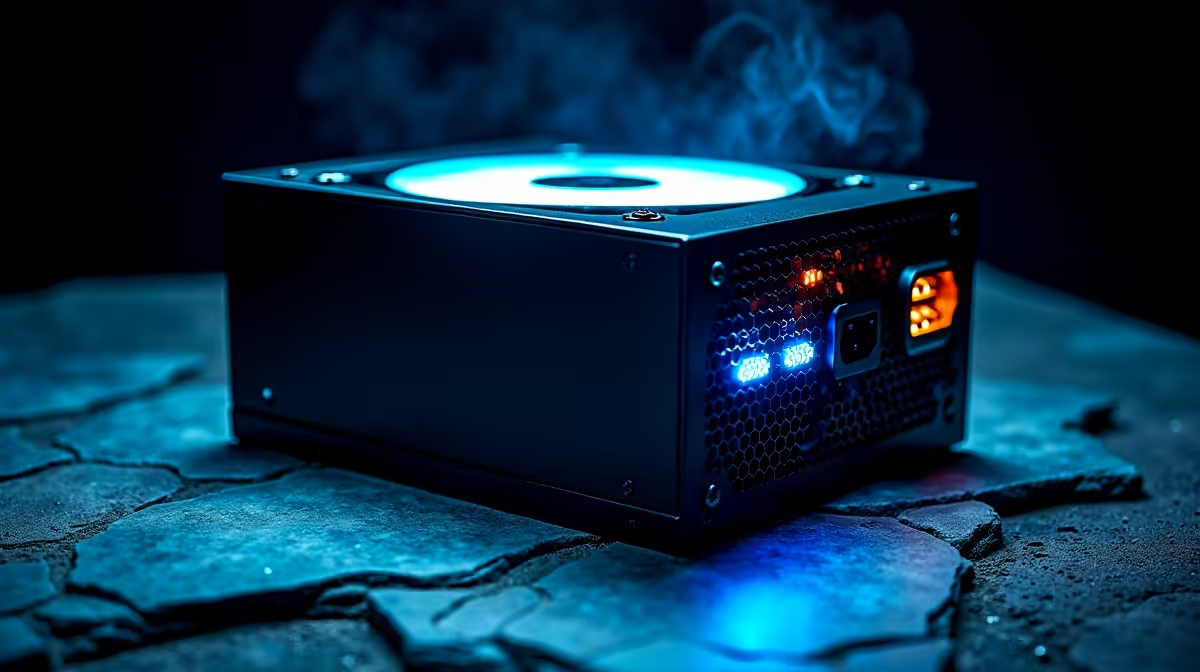
For strategy and sim games the honest answer is that ATX 3.1 versus 3.0 changes almost nothing you will feel. The 3.1 update mainly hardens the GPU power connector into the 12V-2x6 design and refines excursion timing. A quality 750W unit of either revision powers a modern RTX-class card identically.
What Changed From 3.0 to 3.1
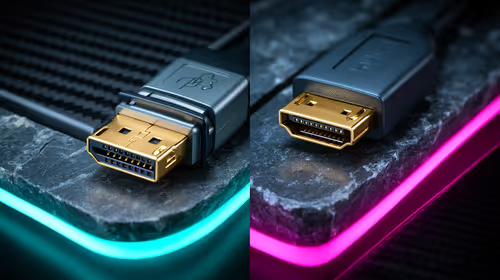
The big leap was ATX 3.0, which introduced the 12VHPWR cable and a requirement that the PSU survive power excursions up to 200 percent of rated wattage for short bursts. ATX 3.1 refines that into the sturdier 12V-2x6 connector with better seating, and relaxes some excursion timing now that GPU spikes are better understood.
For late-game Civilization, Stellaris, Total War and Cities: Skylines II saves where CPU turn times and sim depth dominate, neither change alters performance. A 750W ATX 3.0 Gold unit and a 750W ATX 3.1 Gold unit will both power an RTX-class card the same way; 3.1 simply lowers the already-small risk of a poorly seated connector.
How to Size and Choose in SA
Wattage and efficiency matter far more than the ATX revision for a %s rig. A modern mid-to-high build typically wants 750W-850W, with 1000W only for the very top GPUs. At Evetech, solid 80+ Gold units sit around R1,800-R3,500 depending on wattage and modularity.
If you are buying new, an ATX 3.1 unit with a 12V-2x6 connector is the cleaner long-term pick. If you already own a good ATX 3.0 unit, there is no reason to replace it.
FAQ
Is the 12V-2x6 connector on ATX 3.1 safer than 12VHPWR?
It is a refinement with better contact seating that lowers the already-small risk of a poorly inserted plug overheating. The cable is backward compatible, so for strategy and sim games either works as long as you seat it fully until it clicks.
Will an ATX 3.0 PSU bottleneck a new GPU?
No. ATX 3.0 was designed specifically for the power excursions of current cards, so it powers them at full performance. The ATX revision affects connector design, not how many frames your GPU produces.
How do I avoid melted GPU power connectors?
Push the 12VHPWR or 12V-2x6 plug all the way in until it clicks and avoid sharp cable bends right at the connector. This seating issue, not the ATX version, is the real cause of overheating plugs.
Buyer Tip
Whichever revision you buy, push the 12VHPWR 12V-2x6 plug in until it clicks fully home; a half-seated connector is the real cause of melted plugs, not the ATX version.