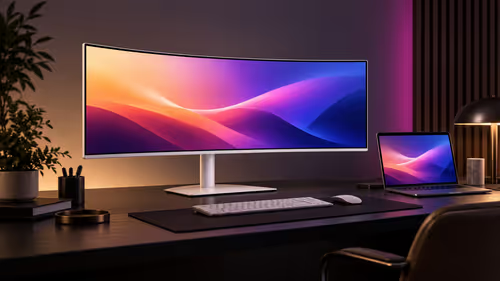
Ever spent hours perfecting the colour grade on a photo, only to see it on another device and find the colours look… off? It’s a gut-wrenching moment for any creative in South Africa. Often, the culprit isn’t your skill; it’s your screen. The secret enemy is poor backlight uniformity, a subtle flaw that can sabotage your best work. Understanding backlight uniformity for photo editing isn't just tech talk; it's fundamental to getting predictable, professional results every time.
Understanding Monitor Backlight Uniformity
So, what is this technical-sounding term? Simply put, monitor backlight uniformity refers to a screen's ability to maintain a consistent level of brightness and colour across its entire surface. Imagine your monitor as a canvas. In a perfect world, a solid white screen would be perfectly, evenly white from corner to corner. The same goes for black, grey, or any other colour.
However, most displays, especially budget PC monitors, have slight variations. You might see brighter patches, often called "hotspots," or darker areas, known as "bleed" or "clouding," especially near the edges. For everyday use like browsing or sending emails, you'd hardly notice. But for creative work, these inconsistencies can be a disaster.
Why Backlight Uniformity is Crucial for Creatives
For photographers, graphic designers, and video editors, what you see must be what you get. The importance of backlight uniformity for photo editing cannot be overstated.
Let's say you're editing a landscape shot. You adjust the shadows in the bottom-left corner to bring out some detail. But what if your monitor is naturally darker in that corner? You might overcompensate, making the shadows too bright. When you print the photo or view it on a calibrated screen, that corner will look washed out and unnatural. 😬
This problem affects everything:
- Colour Grading: Subtle colour shifts in one area of the screen can lead you to make incorrect adjustments that affect the entire image.
- Retouching: Skin tones become impossible to balance accurately if one side of the face appears warmer or cooler due to screen flaws.
- Design Work: A brand's specific Pantone colour might look correct in the centre of your screen but appear slightly different near the edge, leading to inconsistent branding materials.
Even the world of gaming monitors, once focused purely on speed, now sees creators demanding better colour performance for streaming and content creation.
How to Check Your Monitor's Uniformity
You don't need fancy lab equipment to get a basic idea of your screen's performance. The "dark room test" is a simple and effective method.
The Dark Room Test
- Find a dark room. Turn off the lights to minimise reflections and ambient light.
- Display a solid colour. Open a full-screen image of solid black, then solid white, and finally a 50% grey. You can easily find these test images online.
- Observe carefully. Look at the screen from your normal viewing distance. Do you see any blotches, brighter spots, or colour shifts? Pay special attention to the corners and edges.
While no consumer monitor is 100% perfect, a good quality panel will show minimal, barely noticeable variations. If your screen looks like a cloudy night sky on the black test, you have a uniformity problem. The shape of some displays, like immersive curved monitors, can sometimes present unique challenges, but high-end models are engineered to handle this.
Quick Uniformity Check 🔧
a quick and easy test, head to YouTube and search for "backlight bleed test." You'll find videos that cycle through solid colours, making it simple to spot inconsistencies on your display without needing to download any files. Pair this with the right stand or arm from our [monitor accessories](https: www.evetech.co.za PC-Components buy-monitor-accessories-368) to ensure you're viewing it from the optimal angle.
Finding a Monitor with Great Backlight Uniformity
When you're ready to upgrade, what should you look for? While manufacturers don't always advertise uniformity specs, you can increase your chances of getting a great panel.
Professional-grade 4K and 5K monitors are specifically built for colour accuracy and often feature uniformity compensation technology. These are the gold standard for serious creative work. While convenient, some portable monitors may compromise on this front to achieve their slim form factor, making them better for secondary tasks rather than final colour grading.
Ultimately, the best approach is to read and watch detailed reviews from trusted sources like RTINGS.com or Hardware Unboxed. They use specialised equipment to measure uniformity and provide objective data. Investing in a quality monitor is an investment in your work's quality, and you can often find some great monitor deals that put professional features within reach. ✨