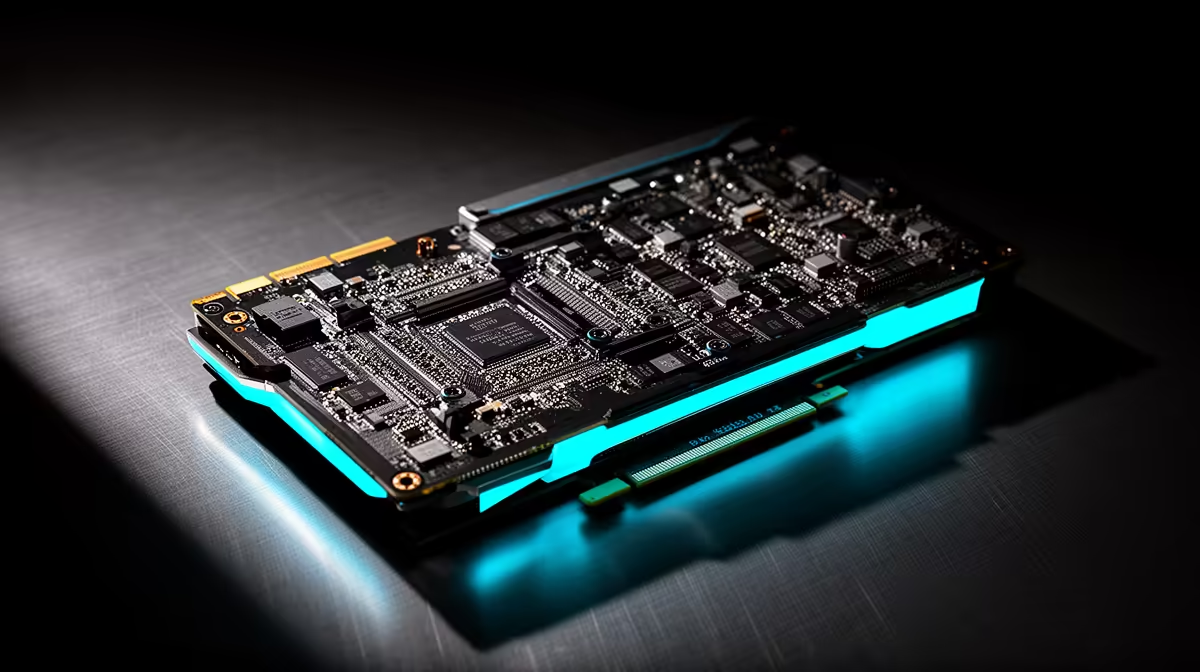
ComfyUI tempts you into a corner. You start generating Flux images on a 16GB card, it works, then you add video with LTX-2 and suddenly half your workflows throw memory errors or crawl through endless offloading. The honest answer for anyone who wants one rig that does everything is to stop fighting the ceiling: the best all-round GPU for ComfyUI is a 24GB NVIDIA RTX card, because that capacity covers image, video, and upscaling without constant compromise.
Quick Answer
A 24GB NVIDIA RTX GPU is the practical all-round pick for ComfyUI. It runs Flux image generation, LTX-2 video, and RTX upscaling on a single card, and at 24GB you can often skip quantisation entirely and stay in native PyTorch, where 16GB cards force you into workarounds.
Why 24GB is the line that matters
Flux image generation alone can push past what a 16GB card comfortably holds, and that is before you touch video. LTX-2 video and the multi-stage pipelines around it are where memory demand climbs hard, and the practical guidance for serious video work in ComfyUI lands at 24 to 32GB. Below that you are managing VRAM constantly, offloading the VAE to the CPU, using lighter models, and accepting slower runs.
At 24GB the experience changes. An RTX 4090 with 24GB handles full-precision Flux.1 Dev with headroom, supports dual ControlNet plus IP-Adapter without manual memory management, and generates a Flux Dev image in around 6 seconds. You can skip quantisation or stay on a light Q5 only where you want to, keep models in PyTorch, and move through iterations faster because the card is not paging data in and out. The difference is not just whether a workflow runs, but whether you sit waiting for it.
Why NVIDIA specifically for ComfyUI
This is not brand loyalty, it is how the software is built. ComfyUI targets NVIDIA CUDA first, and the ecosystem around it, including the RTX Video Super Resolution upscaler node, is built for RTX hardware. AMD's ROCm support exists but lags, with partial coverage and more friction on the exact nodes you will want for video and upscaling. Key acceleration paths like xformers and Flash Attention are NVIDIA-only, meaning AMD users start from a slower baseline before any tuning.
One card for three jobs
The reason a single 24GB RTX card earns the "all-round" label is that the three main ComfyUI workloads have different appetites, and 24GB feeds all of them.
- Flux image generation runs without the memory gymnastics a smaller card forces, including full-precision models and stacked adapters simultaneously.
- LTX-2 video sits inside the 24 to 32GB band where the two-stage pipelines are designed to live. Cards with 20GB or less cannot run full-resolution Mochi and CogVideoX without heavy degradation.
- RTX upscaling uses the dedicated Super Resolution node to take 720p output toward 4K on the same card.
That is the case for buying once rather than juggling settings forever. For a sense of which current cards hit 24GB, the GPU best sellers list at Evetech is the quickest filter.
What it means for an SA build
The temptation here is to save on the card and spend elsewhere, but for AI generation the GPU is the workload, and the VRAM ceiling is what decides whether you can run modern video models at all. If your plan is to do image, video, and upscaling rather than just images, size for 24GB from the start. Going back to swap the card later costs more than buying it right once. A complete AI-focused PC build wraps the right card with the system memory and storage these workflows lean on.
The supporting hardware that keeps the GPU fed
A 24GB card does not run in isolation, and a few surrounding choices decide whether you get its full benefit. System RAM matters because ComfyUI offloads parts of the pipeline to it, particularly with video where the VAE or text encoder may sit in system memory. Skimping here forces more aggressive offloading and slows everything down, so pairing a 24GB card with generous RAM keeps the GPU from waiting on the rest of the machine.
Storage is the other half. Modern image and video models are large files, and a fast NVMe SSD loads them far quicker than a SATA drive, which shortens the wait between switching workflows. For long video generations the difference between a fast and slow drive shows up every time you load a new checkpoint.
Quantisation: when to use it and when not to
On a 16GB card you quantise out of necessity, shrinking models to fit and accepting some quality loss. The luxury of 24GB is choice. You can run full-precision models where quality matters and reach for a light Q5 only where you want extra speed or headroom. That flexibility -- deciding rather than being forced -- is the real day-to-day value of the larger card.
Planning for what you will run next
Models keep getting heavier, and the LTX-2 video pipelines that sit at 24 to 32GB today set the direction of travel. Buying at 24GB rather than 16GB is partly about the workflows you run now and partly about not being locked out of the next generation of models in a year. It is the difference between a card that lasts the build and one you replace early.
Frequently Asked Questions
Can I run ComfyUI on a 16GB card?
You can run Flux images on 16GB, but LTX-2 video and heavier pipelines force constant VRAM management, offloading, and lighter models. For an all-round rig that does video and upscaling too, 24GB removes most of that friction.
Why not AMD?
ComfyUI is built CUDA-first, so NVIDIA RTX cards get the smoothest support and access to features like the RTX Video Super Resolution node. AMD's ROCm support is partial and lags, which means more troubleshooting on exactly the video and upscaling nodes you would want.
Is 24GB enough for video, or do I need more?
24GB is the practical minimum for comfortable LTX-2 video work, with 24 to 32GB being the recommended band. Professional-length, high-resolution video work benefits from 48GB or more, but for a single all-round home rig 24GB is the sensible target.
Does the GPU matter more than the CPU here?
For ComfyUI generation, yes. The heavy lifting happens on the GPU and its VRAM, so that is where the budget belongs. The CPU and system RAM matter for feeding the pipeline, but they are not the constraint that decides which models you can run.
If you want one machine that handles Flux images, LTX-2 video, and upscaling without fighting memory limits, build it around a 24GB RTX card. Explore the AI PC range at Evetech to get the whole rig matched to the workload.