


PCIe 5.0 vs PCIe 4.0 for Cinematic Story Games in SA
PCIe 5.0 and PCIe 4.0 differ most in lane support, compatibility, and upgrade value for cinematic story games. SA buyers should match the choice to their actual hardware and games.
Read moreThe M5 MacBook Air is the top Mac for SA music producers needing a silent setup: its fanless design produces zero fan noise and handles Logic Pro sessions without thermal throttling. From around R24,999, it delivers professional results without the M5 Pro premium.

A recording session ruined by a laptop fan spinning up at the worst possible moment is a problem only producers fully understand. A condenser mic a metre from your keyboard will happily capture every whir. The M5 MacBook Air answers that with the simplest fix imaginable: it has no fan at all. For South African producers tracking vocals, acoustic guitars, or anything quiet in a normal room, a fanless Mac that stays silent under a heavy Logic Pro session is close to ideal, and it starts from around R24,999.
The M5 MacBook Air is the best Mac for most SA music producers because it is completely fanless, so it produces zero fan noise during recording, and the M5 chip handles substantial Logic Pro sessions without throttling. From around R24,999 it delivers professional results, and you only step up to an M5 Pro machine if you regularly run very large orchestral templates or heavy real-time processing.
Most laptop reviews treat fan noise as a minor annoyance. In a recording context it is a hard technical limit. A sensitive microphone does not distinguish between your voice and the broadband hiss of a cooling fan two feet away. Once that noise is in the recording, no plugin removes it cleanly, because it was captured into the same signal as the performance you wanted.
The M5 Air sidesteps the problem at the hardware level. With no fan and no moving parts, there is nothing to spin up when a session gets demanding. The chip simply runs warmer and continues working. For a home studio, a bedroom setup, or a spare room treated with a few soft furnishings, that means the only thing your mic picks up is the take.
A fanless design does mean the M5 Air relies on passive cooling, so under an extreme, sustained, hours-long render it will eventually run warmer than an actively cooled machine. In practice, tracking and mixing are bursty workloads, not constant maximum load, and the Air handles real Logic Pro sessions, plenty of audio tracks, software instruments, and effects, without the thermal throttling that would interrupt playback. For the overwhelming majority of producers, the silence is pure upside.
The M5 chip pairs strong single-core performance with unified memory, which is exactly the shape of work a digital audio workstation demands. Logic Pro leans on fast per-core speed for live instrument playback and low-latency monitoring, and the unified memory architecture keeps sample libraries and audio buffers close to the processor.
The portability matters more than producers expect. The Air is thin and light enough to move between a desk, a sofa, and a friend's place for a collaboration without thinking about it. Battery life on Apple silicon is long enough that you can track an idea away from a wall socket and not watch the meter. And because macOS and Logic Pro are tuned together, audio driver behaviour and Core Audio latency are consistent in a way that saves a lot of troubleshooting time.
The one decision worth real thought is unified memory. The base configuration is fine for songwriting, podcasting, and modest sessions. If you load large sampled instruments, big drum libraries, orchestral patches, or run many instances of demanding plugins, step up to a higher memory configuration at purchase, because unified memory is soldered and cannot be added later. Storage is similar: native audio recording fills a drive faster than people expect, so size it for the projects you actually keep rather than the bare minimum. You can compare the full MacBook Air lineup to see which memory and storage tier fits your workflow.
The Air is the right call for most, but not everyone. Consider a Pro-tier MacBook with active cooling if your sessions regularly involve very large orchestral or film-scoring templates with hundreds of tracks, heavy real-time convolution reverb and amp modelling stacked across many channels, or long mixdowns and stem renders run back to back for hours. Those workloads benefit from sustained cooling and the higher memory ceilings the Pro machines offer.
There is a price premium for that headroom, and it is real. The honest question is whether your projects routinely hit the Air's limits or only do so on rare, extreme sessions. If it is the latter, the money is better spent on a memory bump to the Air, a good audio interface, and proper monitoring than on a Pro chip you will rarely fully use.
The laptop is one piece. The silent advantage of the Air pays off fully only when the rest of the chain is sound. An audio interface gives you clean preamps and proper monitoring latency. A decent condenser or dynamic mic suits the room you actually record in, and a treated corner, even just a rug, curtains, and a soft panel behind the mic, does more for your recordings than most gear upgrades. Closed-back headphones keep monitoring out of the mic during tracking.
For SA producers specifically, the value of a fanless machine is amplified by our reality: most home studios are ordinary rooms in flats and houses without dedicated, isolated booths. You are recording in a space that already has some ambient noise, so removing the one noise source you can control, the laptop, is the highest-leverage move available. If you are weighing the Air against other portable options, the best-selling laptops page is a useful place to see how it sits against the wider field.
Yes. The M5 chip handles real Logic Pro sessions with many audio tracks, software instruments, and effects without throttling. The main thing to get right is choosing enough unified memory for the sample libraries you use.
For tracking and mixing it stays comfortable, because those are bursty workloads rather than constant maximum load. Only extreme, hours-long sustained rendering pushes a fanless design toward its thermal limit, and that is where a Pro machine makes sense.
Step above the base memory if you load large sampled instruments or run many heavy plugins, since unified memory is soldered and cannot be upgraded later. For songwriting and modest sessions the base configuration is genuinely fine.
A microphone captures fan noise into the same signal as your performance, and no plugin removes it cleanly afterward. A silent, fanless laptop means the mic only records the take, which is why producers value it.
Buy the Air unless your projects routinely involve film-scoring templates or all-day rendering. For the vast majority of producers, a well-specced Air plus a good interface and monitoring beats spending the premium on a Pro chip.
Building a silent home studio? Explore the MacBook Air range at Evetech, pick the memory tier your sessions need, and start tracking without a fan in the mix.
Yes. The M5 chip handles real Logic Pro sessions with many audio tracks, software instruments, and effects without throttling. The main thing to get right is choosing enough unified memory for the sample libraries you use.
For tracking and mixing it stays comfortable, because those are bursty workloads rather than constant maximum load. Only extreme, hours-long sustained rendering pushes a fanless design toward its thermal limit, and that is where a Pro machine makes sense.
Step above the base memory if you load large sampled instruments or run many heavy plugins, since unified memory is soldered and cannot be upgraded later. For songwriting and modest sessions the base configuration is genuinely fine.
A microphone captures fan noise into the same signal as your performance, and no plugin removes it cleanly afterward. A silent, fanless laptop means the mic only records the take, which is why producers value it.
Buy the Air unless your projects routinely involve film-scoring templates or all-day rendering. For the vast majority of producers, a well-specced Air plus a good interface and monitoring beats spending the premium on a Pro chip.
PCIe 5.0 and PCIe 4.0 differ most in lane support, compatibility, and upgrade value for cinematic story games. SA buyers should match the choice to their actual hardware and games.
Read more
ATX 3.1 vs ATX 3.0 for streaming on Twitch and YouTube buyers - what changes is mostly about compatibility, budget, upgrade path, and setup fit. SA buyers should check device support and real needs before expecting a clear win from either option.
Read more
OLED vs Mini-LED for video editing in 4k is mainly about fit, features, compatibility, cost, and upgrade path, not one automatic winner. SA buyers should match the choice to the setup.
Read more
The real world difference between IPS and VA for streaming on Twitch and YouTube is colour consistency versus contrast. For SA creators, match the panel to OBS previews, chat visibility, camera work, and long editing sessions after live streams.
Read more
IPS vs OLED for Couch Co-Op Gaming comes down to contrast, motion, burn-in care, refresh needs, desk use, and game type. SA buyers should match the choice to their setup instead of assuming one option always wins.
Read more
FSR 4 and FSR 3.1 affect competitive esports only if they preserve clarity, latency, and stable frame pacing. SA players should compare response feel, motion quality, and support in the specific titles they grind.
Read more
Wi-Fi 7 vs Wi-Fi 6e for cinematic story games comes down to router support, latency goals, device compatibility, and coverage. SA buyers should match the choice to the real network setup.
The real world difference between PCIe 5.0 and PCIe 4.0 for MMO and live-service games is usually about loading, patches, and headroom. SA players should weigh NVMe speed, GPU lanes, CPU limits, and platform cost.
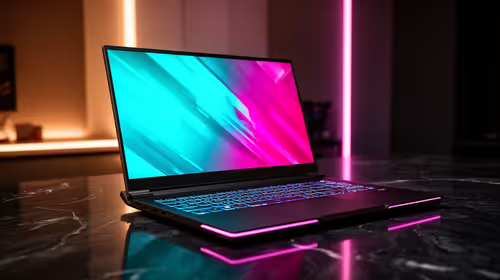
Windows 11 gaming laptop dead pixel checks begin with a full-screen colour test. This how to fix dead pixel windows 11 gaming laptop guide helps SA users compare settings, drivers, external screens, and warranty routes.
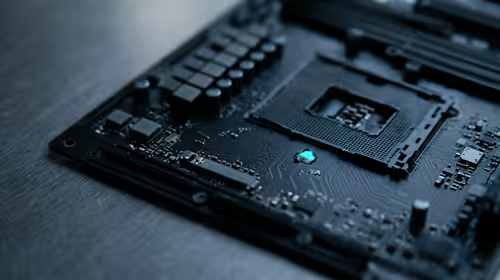
AM5 motherboard stuck pixel fixes in South Africa start with panel, cable, GPU output, and Windows checks. Use a clean test path before blaming the motherboard or replacing screen hardware.
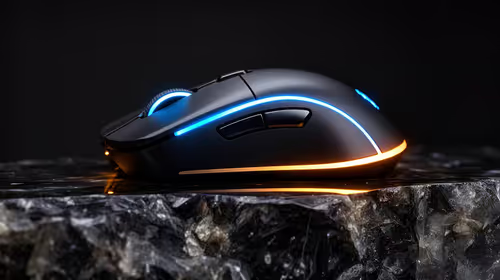
FPS drops blamed on a wireless mouse often point to input, driver, USB, network, or system-load checks. Use a quick SA-friendly troubleshooting flow to isolate software, firmware, thermals, storage, and game settings before replacing hardware.

How to fix fps drops on steam deck starts with power profile, shader cache, storage health, and per-game settings. For South Africa, check charger quality, heat, and download stability before assuming the handheld needs repair. Retest after updates.
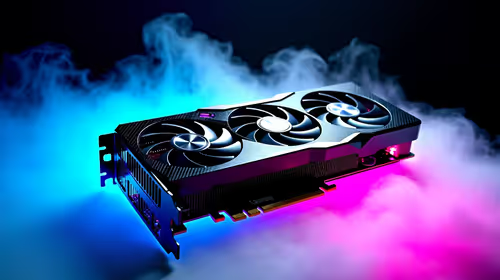
How to fix low FPS after an RTX 5080 build upgrade starts with driver cleanup, display settings, thermals, and power mode. For SA gamers, verify GPU usage, PCIe speed, RAM profile, and CPU limits before changing parts.
Hollow Knight Silksong at 4K needs a GPU matched to settings, VRAM, CPU balance, and monitor goals. Use this SA guide to compare tiers without treating FPS target or prices as fixed.
How to fix FPS drops after a Ryzen 9 9950X3D starts with BIOS, chipset, EXPO, power, and GPU driver checks. It helps isolate upgrade stutter on high-end SA gaming rigs before you change hardware, reinstall Windows, or retune cooling.
PCIe 5.0 and PCIe 4.0 differ most in lane support, compatibility, and upgrade value for cinematic story games. SA buyers should match the choice to their actual hardware and games.

FPS drops Windows 11 mechanical keyboard issues can come from USB polling, keyboard utilities, power settings, or overlays. This gaming checklist helps test input-device causes before deeper GPU or CPU troubleshooting.
ATX 3.1 vs ATX 3.0 for streaming on Twitch and YouTube buyers - what changes is mostly about compatibility, budget, upgrade path, and setup fit. SA buyers should check device support and real needs before expecting a clear win from either option.