


PCIe 5.0 vs PCIe 4.0 for Cinematic Story Games in SA
PCIe 5.0 and PCIe 4.0 differ most in lane support, compatibility, and upgrade value for cinematic story games. SA buyers should match the choice to their actual hardware and games.
Read moreUSB microphones like the Shure MV7 pack a built-in analogue-to-digital converter and up to 36 dB of internal gain, recording directly into any PC or Mac with no separate audio interface required.
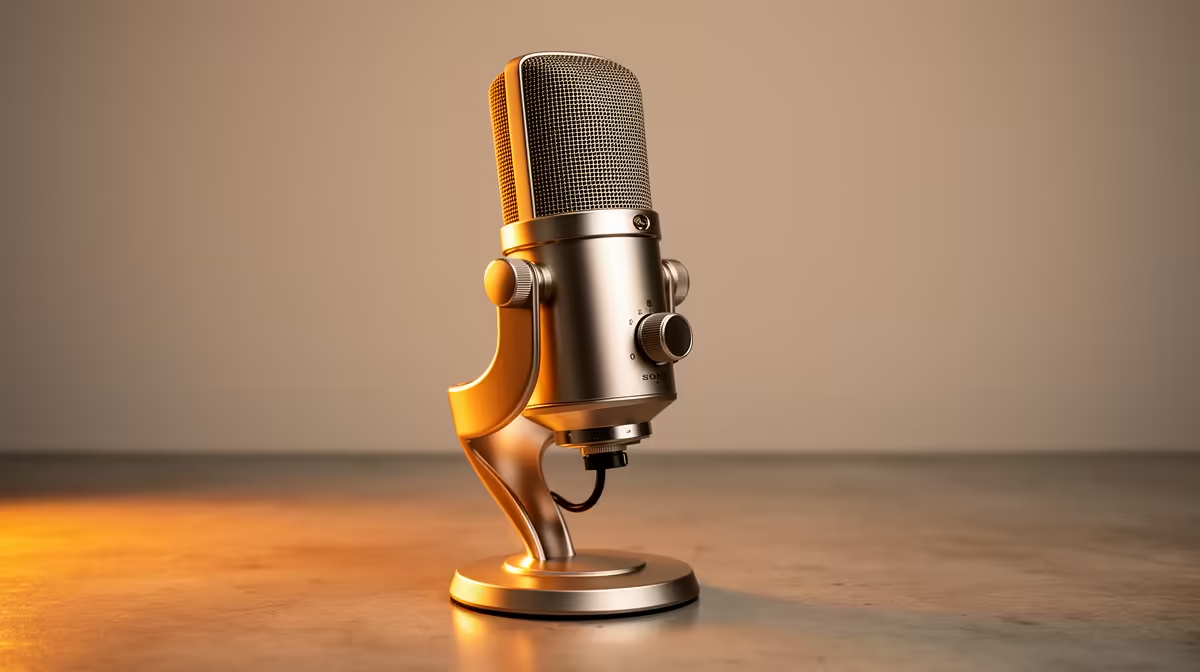
A creator-grade microphone used to mean a separate audio interface, phantom power and a tangle of XLR cables before you ever recorded a word. USB microphones collapsed that whole chain into one device by putting the analogue-to-digital converter inside the mic body, so something like the Shure MV7 can run up to 36dB of internal gain and record straight into a PC or Mac with nothing in between.
The best USB microphone for most creators in 2026 is a dynamic model with onboard processing, such as the Shure MV7 family, which records cleanly with no interface and includes built-in gain, monitoring and noise tools. Budget between R3,000 and R8,000 -- the lower end covers a capable entry cardioid mic, the upper end gets you a flagship with dual USB and XLR outputs and a full DSP suite.
The reason a USB mic is simpler is structural. A traditional studio mic outputs a tiny analogue signal that needs an interface to amplify it and convert it to digital. A USB mic does both jobs internally: a preamp lifts the signal, a converter digitises it, and the result travels down a single USB cable that the operating system recognises as an audio device with no drivers to install.
That self-contained design is why these mics are recommended for people who want to record, not to engineer. You skip the interface cost, the phantom power switch and the gain-staging across two devices. The trade-off is that you are locked into the mic's own preamp and converter, but on the better models that hardware is genuinely good.
The Shure MV7 and its newer MV7+ revision sit at the top of the plug-and-play category for a reason. The MV7 is a dynamic mic, which means it rejects room noise well and forgives an untreated space, and it offers both USB and XLR outputs so you can start over USB now and move to an interface later without buying a new mic.
Condenser mics are more sensitive and capture more detail, but that sensitivity also captures the keyboard, the fan and the echo off a bare wall. A dynamic capsule is less sensitive by design, so it picks up your voice up close and leaves most of the room behind it. For a bedroom studio or a home office, that is usually the better starting point.
The MV7+ adds onboard DSP that earns its place: an auto-level mode that rides your gain so you do not clip when you get loud, a digital pop filter, real-time denoising and a 3.5mm headphone jack for zero-latency monitoring so you hear yourself without delay. There is also a customisable LED touch panel, which is cosmetic but pleasant. The point of all of it is that decisions which used to require an interface and software now happen inside the mic.
Not everyone needs the flagship. The right pick depends on what you record and where.
A dynamic USB mic with a cardioid pattern is ideal. It captures one voice cleanly, rejects the rest of the room and stays consistent even if your mic technique drifts. The MV7 family is the obvious recommendation, but the category has solid options at lower prices for a single host.
Streamers benefit from onboard monitoring and quick-mute controls, plus the noise rejection of a dynamic capsule when the room is not treated. A mic that you can adjust by touch without alt-tabbing into software keeps a live show smooth.
This is the one case where a condenser USB mic can make sense, because the extra detail matters and you can control the room. Just go in knowing a condenser will demand a quieter space than a dynamic mic does.
A USB mic is a closed system. When you outgrow its built-in preamp or converter, you replace the whole unit. This is not always a problem, because the better USB mics use hardware that is genuinely competitive with budget interfaces, but it is worth knowing before you buy. The MV7 addresses this by including an XLR output: you can start over USB today and move to a dedicated interface when your setup grows, changing nothing but the cable. Budget models without an XLR output do not give you that option, so they are a higher-commitment purchase than they appear.
Whichever direction you go, the audio chain does not end at the mic; a closed-back headset for monitoring is the other half of recording cleanly, and you can pair one from our headphones and headset range at Evetech so you actually hear what the mic is capturing. For buyers who want a quick read on current demand, the popular headsets and audio gear at Evetech shows what SA creators are currently picking up.
For voice work, yes. Modern USB mics like the MV7 use the same quality of capsule and converter found in interface-based setups, and the result is broadcast-suitable for podcasts, streams and video. Music recording is where a dedicated interface can still pull ahead.
A cheaper dynamic USB mic records perfectly well for a single voice. The MV7 family justifies its price with build quality, onboard DSP, monitoring and the option to switch to XLR later, which matters if you expect to grow your setup.
A dynamic capsule is less sensitive, so it captures your voice up close while rejecting room noise, fans and echo. That makes it far more forgiving in an untreated home space, which is where most creators record.
It provides zero-latency monitoring, meaning you hear your own voice in real time directly from the mic rather than through the computer, which would add a slight delay. It keeps your timing natural while recording or streaming.
If you buy a mic with both USB and XLR outputs, like the MV7, yes. You can start fully plug and play over USB and move to an XLR interface later without replacing the microphone.
Setting up a recording or streaming space? Pair the right mic with proper monitoring by browsing the headphones and headset range at Evetech: https://www.evetech.co.za/components/headphone-headsets-100
For voice work, yes. Modern USB mics like the MV7 use the same quality of capsule and converter found in interface-based setups, and the result is broadcast-suitable for podcasts, streams and video. Music recording is where a dedicated interface can still pull ahead.
A cheaper dynamic USB mic records perfectly well for a single voice. The MV7 family justifies its price with build quality, onboard DSP, monitoring and the option to switch to XLR later, which matters if you expect to grow your setup.
A dynamic capsule is less sensitive, so it captures your voice up close while rejecting room noise, fans and echo. That makes it far more forgiving in an untreated home space, which is where most creators record.
It provides zero-latency monitoring, meaning you hear your own voice in real time directly from the mic rather than through the computer, which would add a slight delay. It keeps your timing natural while recording or streaming.
If you buy a mic with both USB and XLR outputs, like the MV7, yes. You can start fully plug and play over USB and move to an XLR interface later without replacing the microphone.
PCIe 5.0 and PCIe 4.0 differ most in lane support, compatibility, and upgrade value for cinematic story games. SA buyers should match the choice to their actual hardware and games.
Read more
ATX 3.1 vs ATX 3.0 for streaming on Twitch and YouTube buyers - what changes is mostly about compatibility, budget, upgrade path, and setup fit. SA buyers should check device support and real needs before expecting a clear win from either option.
Read more
OLED vs Mini-LED for video editing in 4k is mainly about fit, features, compatibility, cost, and upgrade path, not one automatic winner. SA buyers should match the choice to the setup.
Read more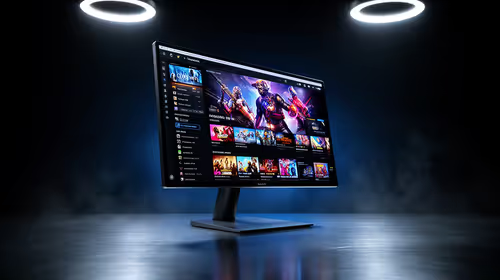
The real world difference between IPS and VA for streaming on Twitch and YouTube is colour consistency versus contrast. For SA creators, match the panel to OBS previews, chat visibility, camera work, and long editing sessions after live streams.
Read more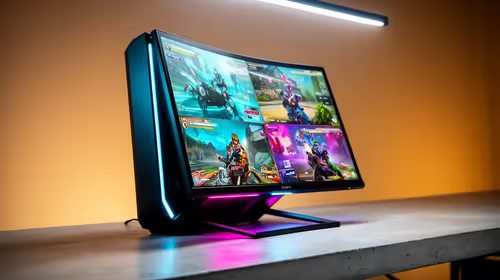
IPS vs OLED for Couch Co-Op Gaming comes down to contrast, motion, burn-in care, refresh needs, desk use, and game type. SA buyers should match the choice to their setup instead of assuming one option always wins.
Read more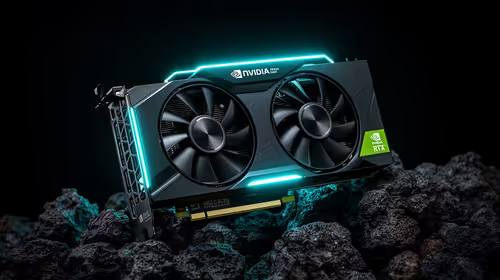
FSR 4 and FSR 3.1 affect competitive esports only if they preserve clarity, latency, and stable frame pacing. SA players should compare response feel, motion quality, and support in the specific titles they grind.
Read more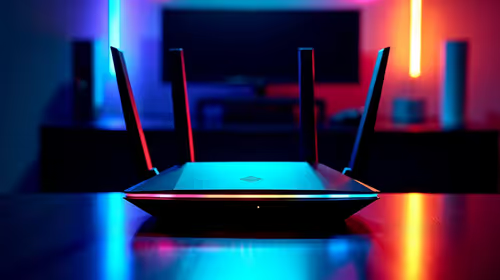
Wi-Fi 7 vs Wi-Fi 6e for cinematic story games comes down to router support, latency goals, device compatibility, and coverage. SA buyers should match the choice to the real network setup.
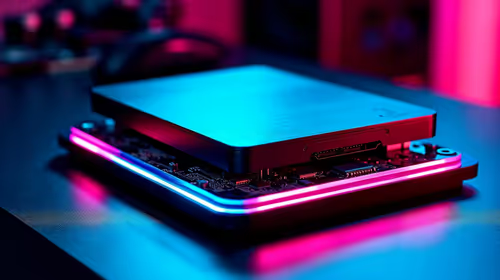
The real world difference between PCIe 5.0 and PCIe 4.0 for MMO and live-service games is usually about loading, patches, and headroom. SA players should weigh NVMe speed, GPU lanes, CPU limits, and platform cost.
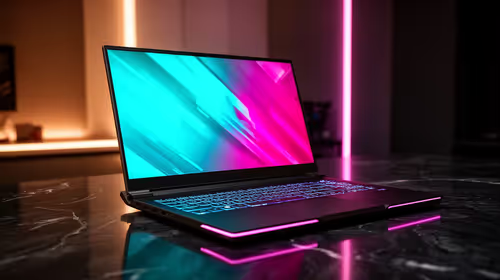
Windows 11 gaming laptop dead pixel checks begin with a full-screen colour test. This how to fix dead pixel windows 11 gaming laptop guide helps SA users compare settings, drivers, external screens, and warranty routes.
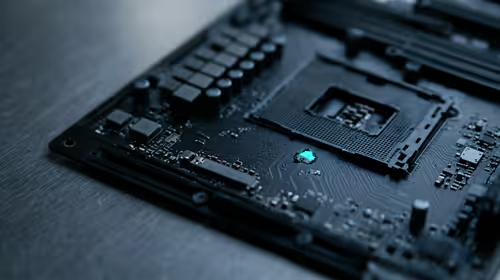
AM5 motherboard stuck pixel fixes in South Africa start with panel, cable, GPU output, and Windows checks. Use a clean test path before blaming the motherboard or replacing screen hardware.
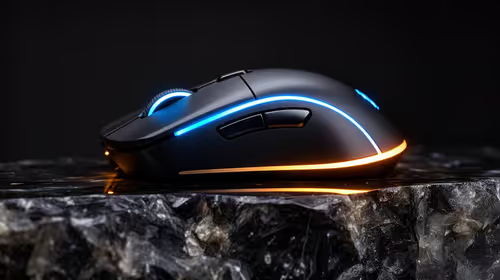
FPS drops blamed on a wireless mouse often point to input, driver, USB, network, or system-load checks. Use a quick SA-friendly troubleshooting flow to isolate software, firmware, thermals, storage, and game settings before replacing hardware.
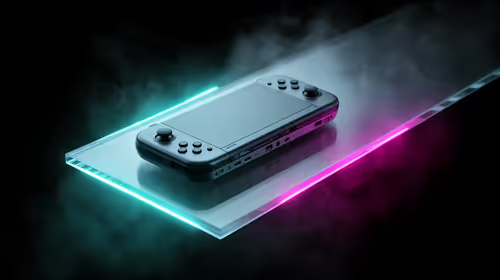
How to fix fps drops on steam deck starts with power profile, shader cache, storage health, and per-game settings. For South Africa, check charger quality, heat, and download stability before assuming the handheld needs repair. Retest after updates.
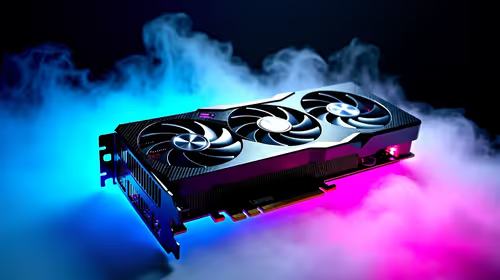
How to fix low FPS after an RTX 5080 build upgrade starts with driver cleanup, display settings, thermals, and power mode. For SA gamers, verify GPU usage, PCIe speed, RAM profile, and CPU limits before changing parts.
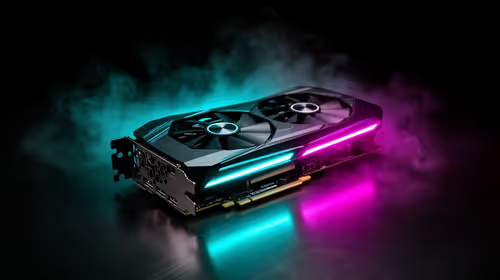
Hollow Knight Silksong at 4K needs a GPU matched to settings, VRAM, CPU balance, and monitor goals. Use this SA guide to compare tiers without treating FPS target or prices as fixed.
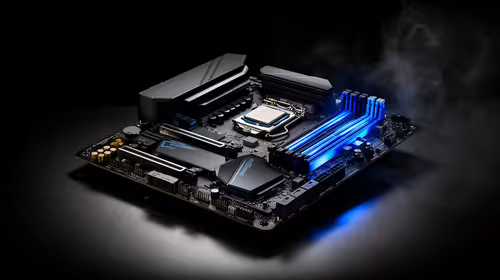
How to fix FPS drops after a Ryzen 9 9950X3D starts with BIOS, chipset, EXPO, power, and GPU driver checks. It helps isolate upgrade stutter on high-end SA gaming rigs before you change hardware, reinstall Windows, or retune cooling.
PCIe 5.0 and PCIe 4.0 differ most in lane support, compatibility, and upgrade value for cinematic story games. SA buyers should match the choice to their actual hardware and games.
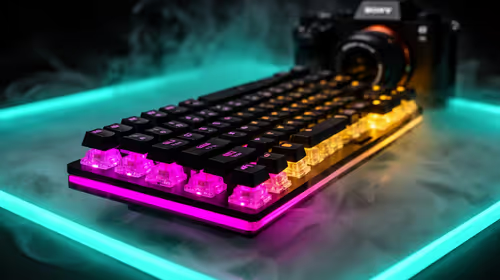
FPS drops Windows 11 mechanical keyboard issues can come from USB polling, keyboard utilities, power settings, or overlays. This gaming checklist helps test input-device causes before deeper GPU or CPU troubleshooting.
ATX 3.1 vs ATX 3.0 for streaming on Twitch and YouTube buyers - what changes is mostly about compatibility, budget, upgrade path, and setup fit. SA buyers should check device support and real needs before expecting a clear win from either option.