


Complete Guide: Setting Up Monitor Light
Setting Up Monitor Light. Tested & verified settings for best FPS and visual quality on SA hardware budgets.
Read moreDiscover the best workstation GPU for 8K video production to crush render times. 🚀 We analyze VRAM, CUDA cores, and memory bandwidth so you can edit RED and ARRI footage completely lag-free. Upgrade your studio today.

Staring at a stuttering 8K timeline is enough to make any South African creator want to throw their PC out the window. Those massive files, complex colour grades, and multi-layer effects demand insane power. Your CPU is important, sure, but the real hero in this story is your graphics card. Choosing the best workstation GPU for 8K video production isn't just an upgrade… it's an investment in your sanity and your deadlines. Let's dive in. 🚀
Why does 8K video bring even high-end gaming PCs to their knees? It's a simple matter of data. An 8K frame has four times the pixels of a 4K frame. When you're scrubbing through raw footage, applying LUTs, or rendering final exports, your GPU is processing a staggering amount of information. Without the right hardware, you're stuck with proxy workflows and endless render queues.
A powerful graphics card accelerates everything from playback to encoding, especially in software like DaVinci Resolve and Adobe Premiere Pro. This is where a dedicated workstation graphics card truly shines, offering optimised drivers and hardware specifically for these creative tasks.
When you're shopping for an 8K video production GPU, a few key specs matter more than anything else. Don't just look at the price tag; understand what you're paying for.
Video RAM, or VRAM, is critical. It's the ultra-fast memory on the GPU itself where active frame data is stored. For smooth 8K editing, 16GB of VRAM should be your absolute minimum. Anything less, and you risk "out of memory" errors and choppy playback, especially with complex timelines or effects. For serious professional work, 24GB or more is the sweet spot.
Think of CUDA cores as the processing workhorses within your GPU. The more cores, the more data can be processed in parallel, leading to faster renders and effects processing. Many modern NVIDIA GeForce graphics cards also feature Tensor Cores, which are specialised for AI tasks—a huge benefit for features like auto-reframing, scene detection, and advanced noise reduction.
Always install NVIDIA's Studio Driver instead of the Game Ready Driver for creative work. Studio Drivers are specifically tested and optimised for stability and performance in professional applications like Premiere Pro, DaVinci Resolve, and Blender. It's a free performance boost that many people overlook!
For those ready to build a true 8K powerhouse, NVIDIA's high-end RTX series is the undisputed champion.
Cards like the RTX 4080 SUPER and RTX 4090 offer a phenomenal blend of massive VRAM pools and an incredible number of CUDA cores, making them ideal for even the most demanding projects. You'll find excellent versions of these cards from trusted brands. For example, MSI is known for its robust cooling solutions, while Palit often provides fantastic value without compromising on performance. Choosing the best workstation GPU for 8K video production often comes down to these brand-specific features and your budget.
Looking ahead is also smart. As technology evolves, keeping an eye on the next generation of cards, like the potential RTX 5060 or the higher-tier RTX 5070, can help you plan a future-proof upgrade path for handling 12K footage and beyond.
Ready to Render Without Limits? Choosing the right GPU is the key to unlocking a smoother, faster creative workflow. Stop waiting for renders and start creating at the speed of thought. Explore our massive range of PC components and find the perfect engine for your 8K projects today.
For smooth 8K video editing, 24GB of VRAM is the minimum recommendation. Complex workflows with RED Raw or heavy effects often require 48GB or more to prevent crashing.
Yes, the RTX 4090 is an exceptional choice for 8K rendering due to its 24GB VRAM and massive CUDA core count, offering top-tier performance for creative professionals.
GeForce cards offer great value, but professional RTX (formerly Quadro) cards provide higher VRAM limits (up to 48GB+), which is critical for complex 8K timelines.
Absolutely. A powerful GPU significantly accelerates rendering, effects processing, and timeline playback, especially in GPU-accelerated apps like DaVinci Resolve.
High-VRAM cards like the NVIDIA RTX 6000 Ada or RTX 4090 are ideal, as DaVinci Resolve relies heavily on GPU power for color grading, noise reduction, and playback.
Yes, high-end AMD Radeon PRO cards with large memory buffers handle 8K well, though NVIDIA currently maintains a lead in CUDA-optimized creative software support.
Setting Up Monitor Light. Tested & verified settings for best FPS and visual quality on SA hardware budgets.
Read more
Assassins Creed Shadows Ultrawide Support: 21:9. Clear setup instructions with SA-specific considerations, troubleshooting tips & recommended components.
Read more
Complete Gaming Setup Guide for the Collector. Clear setup instructions with SA-specific considerations, troubleshooting tips & recommended components.
Read more
Will the Steam Deck 2 Have an OLED Screen? Leaked. Plain-English explanation of what it means, why it matters & how it affects your buying decisions in SA.
Read more
Setting Up Ultrawide 144Hz. Tested & verified settings for best FPS and visual quality on SA hardware budgets.
Read more
Kingdom Come: Deliverance 2 Ultrawide Support. Clear setup instructions with SA-specific considerations, troubleshooting tips & recommended components.
Read more
When Will the RTX 6090 Launch in South Africa Detailed answer with SA data, expert analysis & practical recommendations for local buyers.
Top Valorant Settings for RTX 5070: FPS Optimisation picks evaluated on performance, value & SA availability with current Rand pricing from Evetech.
RDNA 3.5 Graphics in Ryzen AI 400? Can You Game. Plain-English explanation of what it means, why it matters & how it affects your buying decisions in SA.

GPU Price Index : December Report. Current stock data & price tracking for SA buyers. See what is available and where prices are heading.

Core i5-14600K + B760 + RTX 5060 Build Under. Full parts list, Rand pricing & expected performance. Build confidently with SA-available components.
RX 7600 Apex Legends at 4K: FPS Benchmark. Real-world benchmark data, FPS numbers & performance analysis. What SA gamers can actually expect.
RX 7900 XTX GTA 6 at 4K: FPS Benchmark & Optimal. Real-world benchmark data, FPS numbers & performance analysis. What SA gamers can actually expect.
Head-to-head comparison of RTX 5070 vs RX 9070 XT: Gaming Performance for SA gamers. Performance benchmarks, Rand pricing & which delivers better value.
Starfield Max Settings on RTX 5070. Tested & verified settings for best FPS and visual quality on SA hardware budgets.
Top RX 7800 XT Model Under R8,000 picks evaluated on performance, value & SA availability with current Rand pricing from Evetech.
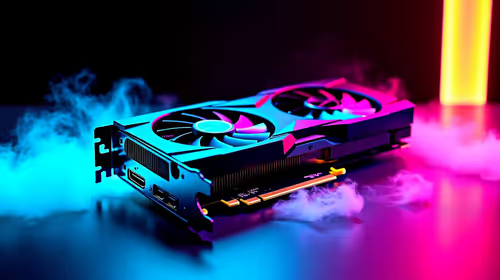
RTX 5070 Valorant Optimised Settings: Graphics. Real-world benchmark data, FPS numbers & performance analysis. What SA gamers can actually expect.
Top Laptop with Core i7 + RX 7700S: Picks picks evaluated on performance, value & SA availability with current Rand pricing from Evetech.