Quick Answer
Setting up a Blue Yeti microphone correctly takes about 15 minutes and involves positioning the mic properly, configuring your operating system audio settings, selecting the right polar pattern for your environment, and adjusting gain to a level that captures your voice clearly without clipping. The Blue Yeti is a plug-and-play USB microphone that requires no drivers on Windows or macOS, but getting it sounding professional requires deliberate configuration rather than default settings.
Physical Setup and Positioning
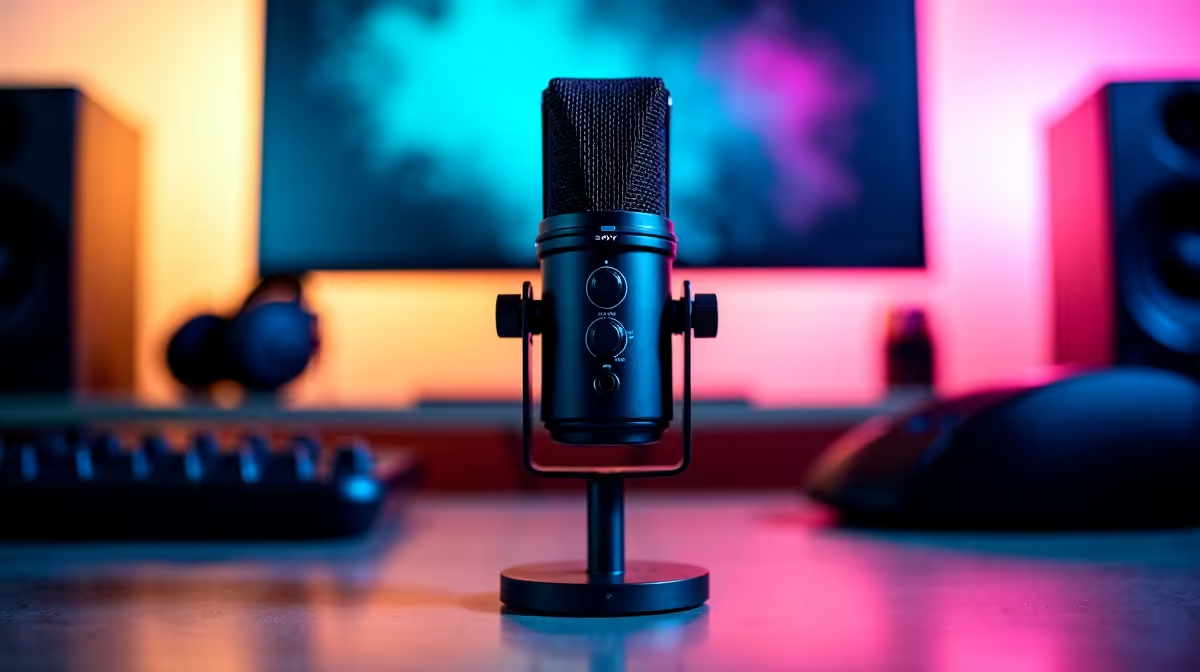
The Blue Yeti is a side-address microphone, meaning you speak into the side of the capsule housing rather than the top. The Yeti logo faces you when the mic is positioned correctly. This is one of the most common setup mistakes: speakers position the top of the mic toward their mouth as they would with a traditional microphone, which significantly degrades audio quality since the capsule pattern is optimised for side-address pickup.
Mount the Yeti on its included desktop stand or, for better audio quality, on a boom arm that lets you position it 15cm to 25cm from your mouth at a slight downward angle toward your lips. A boom arm keeps the mic off your desk surface, which eliminates sympathetic vibration from keyboard typing and desk movement. Vibration from desk contact is audible in recordings and streams as low-frequency rumble. An inexpensive shock mount compatible with the Yeti's 5/8-inch thread eliminates the remaining mechanical noise transmission.
Position the mic slightly off-axis to your mouth, angled so it points at the corner of your lips rather than directly at your mouth. This reduces plosive sounds (the hard P and B sounds that cause audio spikes) without needing a pop filter, though a foam windscreen or pop filter is still recommended for clean professional audio.
Polar Pattern Selection
The Blue Yeti offers four polar patterns selectable via the switch on the rear: Cardioid, Bidirectional, Omnidirectional, and Stereo. For solo streaming, podcasting, voiceover, and gaming content creation, Cardioid is the correct pattern for almost every use case. Cardioid captures sound from the front of the microphone and rejects sound from the sides and rear, which reduces room noise, echo, and background sounds from fans or open windows.
Bidirectional captures from the front and rear, making it useful for two-person interviews with both speakers facing the mic from opposite sides. Omnidirectional captures evenly from all directions and is suited to conference calls or group discussions. Stereo mode uses all four capsules to create a stereo image and suits music recording but adds complexity to streaming setups.
For SA home setups where room treatment is minimal and background noise from traffic or loadshedding generators may be present, Cardioid with careful physical placement is your strongest tool for clean audio before any software noise suppression is applied.
Gain Settings and Windows Audio Configuration
The Yeti has a physical gain control knob on the rear. The common mistake is setting gain too high, which causes clipping (harsh distortion) and picks up room noise more aggressively. Set gain so your voice peaks between -12dB and -6dB in your recording software, with peaks never hitting 0dB. On Windows, open Sound settings, find the Blue Yeti as your input device, and set the Windows input level between 70 and 80 percent. Do not set it to 100 percent. Control gain primarily with the physical knob, not the Windows slider.
In OBS Studio for streaming, add the Blue Yeti as an audio input capture source. Apply a Noise Suppression filter (set to RNNoise mode for best quality) and a Compressor filter to even out volume variation. Set the Compressor ratio to 4:1 with a threshold around -18dB. This combination produces a consistent, broadcast-quality voice signal without needing additional hardware.
For Discord, go to Voice and Video settings, select the Blue Yeti as your input device, and disable Voice Activity detection in favour of Push to Talk or set the input sensitivity threshold manually. Discord's default Noise Suppression is Krisp-powered and works well with the Yeti as input.
Monitoring and Headphone Output
The Blue Yeti includes a built-in headphone output via the 3.5mm jack on the bottom of the unit. This provides zero-latency direct monitoring of your microphone signal, meaning you hear exactly what the mic picks up without the delay that software monitoring introduces. Plug headphones directly into the Yeti and use the headphone volume knob on the front to control monitoring level. Mute the Yeti with the mute button on the front when you need to pause without cutting the signal in your recording software.
The headphone output also functions as a standard audio playback device. You can set the Blue Yeti as your Windows default playback device to hear all system audio through your headphones while simultaneously monitoring your mic, though most users prefer to keep system audio on a separate playback device and use the Yeti headphone out for mic monitoring only.
Frequently Asked Questions
Why does my Blue Yeti sound echoey or roomy? Echo and room sound are caused by audio reflecting off hard surfaces and being picked up by the microphone. Move the mic closer to your mouth, switch to Cardioid pattern, and add soft furnishings behind and to the sides of your recording position. A bookshelf full of books, thick curtains, or a closet of clothing dramatically reduce room reflections without acoustic foam treatment.
Does the Blue Yeti work with consoles and mobile devices? The Blue Yeti connects via USB and works natively with Windows and macOS. PlayStation 4 and 5 support USB audio devices including the Yeti. Xbox consoles do not support the Yeti natively. Mobile devices require a USB-C or Lightning to USB-A adapter, and not all mobile devices power the Yeti reliably from their adapter; a powered USB hub between the adapter and the microphone solves this.
How do I reduce keyboard noise in my Blue Yeti recordings? Use a boom arm to mount the mic off your desk surface, position the mic in Cardioid mode with the rear rejection side facing your keyboard, and apply a Noise Gate filter in OBS or your recording software set to close below -40dB. Switching to a quieter mechanical switch type or membrane keyboard also helps if keyboard noise is a persistent problem.
What is the best Blue Yeti polar pattern for a noisy home environment? Cardioid is best for noisy environments. Position yourself between the mic and the primary noise source so the mic's rear rejection side faces the noise. Combine this with Krisp or RNNoise software suppression in your streaming or recording application for the cleanest result.
Ready to Find Your Perfect Match? Build your complete streaming setup with hardware from Evetech, from microphone-ready PCs to peripherals.