So, you’re ready to share your epic gameplay with the world, but a dark thought looms… Eskom. In South Africa, every watt counts, and the choice between a capture card and a dedicated streaming PC isn't just about performance—it's about power consumption. This guide breaks down the capture card vs streaming PC power consumption debate, helping you make a smart choice for your stream and your electricity bill. Let's dive in.
Understanding the Two Streaming Setups
Before we talk watts and Rands, let's quickly clarify the difference.
- The Single PC + Capture Card Setup: Your powerful gaming rig does all the work. A capture card (like an Elgato or AverMedia) is a small device that "captures" your gameplay footage and helps your PC encode it for streaming platforms like Twitch or YouTube without heavily impacting game performance.
- The Dual PC (Streaming PC) Setup: You have two separate computers. One is your dedicated gaming PC, running the game at max frames. The other is a dedicated "streaming PC" that receives the gameplay feed from your gaming PC (via a capture card) and handles all the heavy lifting of encoding and broadcasting the stream.
A Deep Dive into Power Consumption ⚡
Here's where the numbers get interesting. The difference in power consumption between a capture card and a full streaming PC is massive, and it's the core of this discussion.
The Lean Machine: Capture Card Power Draw
A capture card itself is an incredibly efficient piece of hardware.
- Internal (PCIe) Capture Cards: These slot directly into your motherboard and draw a negligible amount of power, typically between 5 to 15 watts.
- External (USB) Capture Cards: These are similarly efficient, drawing their power from the USB port, usually under 10 watts.
Essentially, a capture card adds almost nothing to your gaming PC's overall power bill. The main power draw comes from your GPU and CPU working a little harder to encode the stream, but modern hardware is highly optimised for this.
The Power-Hungry Beast: Streaming PC Power Draw
This is where the costs add up. A second PC is... well, a second PC. It has its own CPU, motherboard, RAM, storage, and power supply. Even a modest build designed for streaming will consume a significant amount of electricity. A typical streaming PC, even one built from affordable PCs under R20k, can easily draw 80W to 200W while encoding a stream. This is on top of your gaming PC's consumption.
Check Your Own Wattage 🔧
Want to know exactly how much power your setup uses? Download a free tool like HWiNFO64 to see software estimates for your components. For the most accurate reading, use a plug-in watt meter (available at most hardware stores). This will give you a precise number to calculate your real-world electricity costs.
Calculating the Real-World ZAR Impact
Let's put this into a South African context. The average electricity tariff can hover around R3.50 per kilowatt-hour (kWh).
- Capture Card (Extra Load): ~20W extra load on your gaming PC.
- Streaming PC (Idle/Encoding): ~120W average load.
If you stream for 4 hours a day, 5 days a week (80 hours a month):
- Capture Card Monthly Cost: 0.020 kW * 80 hours * R3.50/kWh = R5.60 per month.
- Streaming PC Monthly Cost: 0.120 kW * 80 hours * R3.50/kWh = R33.60 per month.
While R33 might not seem like much, it's over six times the cost, and that's a conservative estimate. For full-time streamers, this difference can easily run into hundreds of Rands a year, purely on streaming PC power consumption.
Beyond Watts: Other Factors to Consider
Power consumption is critical, but it's not the only piece of the puzzle.
Upfront Cost vs. Running Cost
A good capture card costs between R2,000 - R5,000. A dedicated streaming PC, even a basic one, will set you back significantly more. You need to balance the low running cost of a capture card against the high initial investment of a second PC.
Performance and Flexibility
This is where a dedicated streaming PC shines. It offers zero performance impact on your gaming PC, allowing you to push your game's graphics to the absolute limit. It also provides more power for complex stream scenes, high-quality encoding (x264 Medium/Slow presets), and running multiple applications. For a professional, top-tier stream, a dual PC setup is the undisputed king. Both modern Intel gaming PCs and powerful AMD Ryzen systems have excellent single-PC streaming capabilities thanks to their advanced encoders (NVENC for NVIDIA, AMF for AMD), but a dedicated second PC will always offer more headroom.
Simplicity and Space ✨
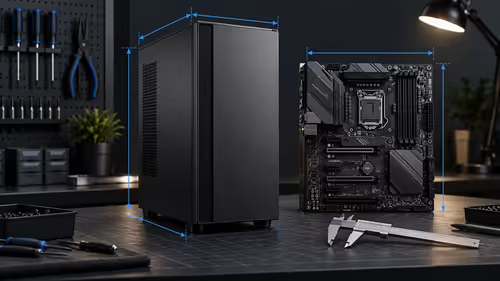
A single PC setup is clean. Less cable management, less desk space, and less complexity. A dual PC setup means another tower, another monitor (or KVM switch), and a web of cables. If you value a minimalist setup, a capture card is the clear winner. For a hassle-free, powerful single-box solution, exploring our range of pre-built PC deals can give you a great starting point.
The Verdict: Which is Right for Your SA Stream?
So, after comparing capture card vs streaming PC power consumption and other factors, what's the verdict?
- Choose a Capture Card if: You're starting out, on a budget, or concerned about electricity costs. For 90% of streamers, a modern gaming PC with a quality capture card is more than powerful enough to produce a high-quality, professional-looking stream without breaking the bank.
- Choose a Dedicated Streaming PC if: You are a professional streamer, an esports competitor, or a content creator who needs absolute maximum gaming performance with no compromises. The flexibility and power are unmatched, but you must be prepared for the higher upfront and running costs.
Ready to Level Up Your Stream?
The capture card vs. streaming PC debate comes down to your budget, goals, and your electricity bill. For the ultimate gaming power in a single, optimised rig, a high-performance PC is unbeatable. Explore our massive range of PC deals and find the perfect machine to conquer your stream.