Strict NAT can remain after perfect router configuration because CGNAT gaming in South Africa may place a second translation layer inside the ISP network. Your router can open its own ports, but it cannot create an inbound mapping on equipment controlled upstream. Diagnose the address path first; changing routers before that test can spend Rand without changing NAT type.
Quick Answer
Compare the WAN IPv4 address shown by your router with the public IPv4 address reported to the internet. A mismatch, especially a WAN address from private or shared space, can indicate CGNAT or another upstream NAT. Ask the ISP whether the specific service uses CGNAT and whether public IPv4 is available. R0 configuration changes cannot remove an ISP-controlled layer.
🌐 What CGNAT Changes for a Game Session
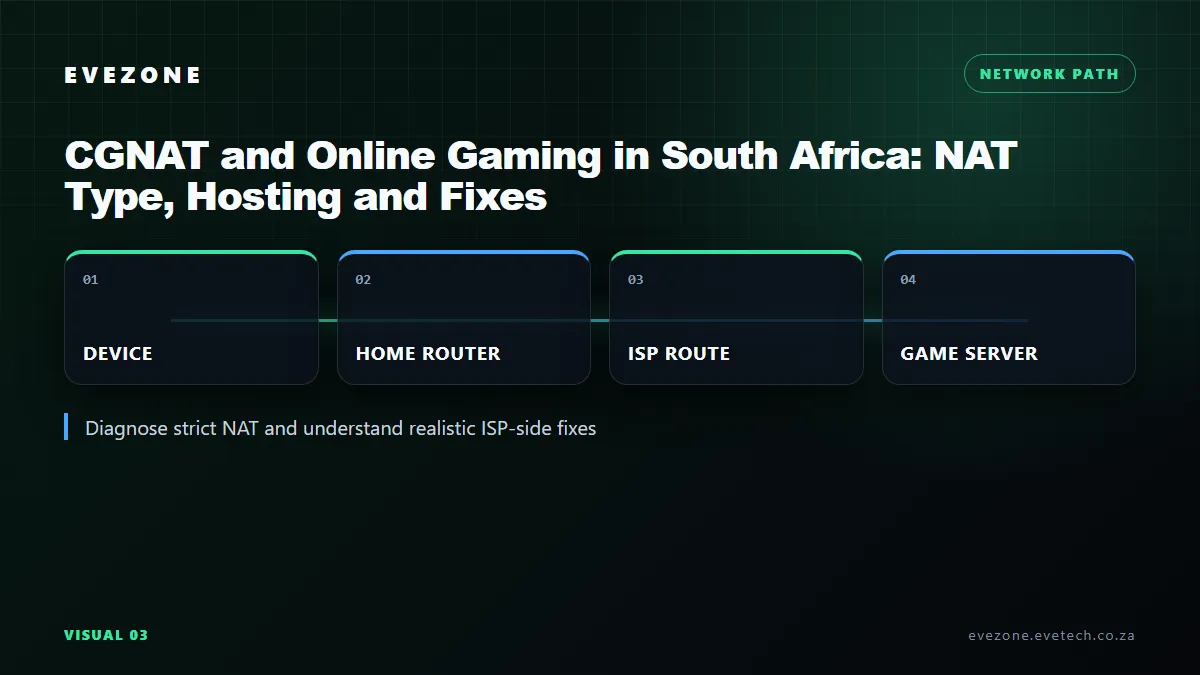
Normal home NAT translates private device addresses to one address on the router's WAN side. Carrier-grade NAT adds another translation stage so multiple subscribers share public IPv4 capacity. Outbound connections usually work because traffic creates a mapping on the way out. Unrequested inbound traffic has no subscriber mapping unless the provider's system and application traversal method create one.
The IETF's NAT444 assessment found failures in peer-to-peer gaming and Xbox test cases. That does not mean every game fails behind CGNAT. Dedicated-server games generally rely on outbound sessions, while peer hosting, direct invites and services that expect inbound reachability are more exposed.
Your platform may label the result Open, Moderate or Strict NAT. Those labels are product-specific summaries, not a precise map of every translation rule. A Strict result plus failed hosting is stronger evidence than the label alone.
🔎 Confirm the Address Path
Log into the router and record its WAN IPv4 address. Then use a reputable public-IP check from a device behind that router. If the two addresses match, CGNAT is less likely, though another configuration issue may remain. If they differ, trace whether the router sits behind an ISP device in router mode before blaming carrier NAT.
A double-NAT home setup often happens when an ISP router and a personal router both perform routing. Bridge mode or access-point mode can remove that local duplication. CGNAT is different because the second translator is outside your home. Use wired networking hardware for the diagnostic connection so weak Wi-Fi does not confuse latency and packet-loss observations.
🎯 Match the Fix to the Symptom
Enable UPnP only if you accept its local-network trust model and the game platform recommends it. UPnP can request a mapping on your home router; it cannot force a mapping through the provider's CGN. Manual forwarding has the same boundary. Do not expose a device through DMZ as a blind first step.
If hosting or direct inbound connections matter, ask the ISP a precise question: "Can this service receive a public IPv4 address with inbound connections?" Availability can vary by package and access network. A static address is not always necessary; a dynamic public address can still provide reachability, while a static-looking arrangement can itself be translated.
Native IPv6 can restore end-to-end addressing, but only when the ISP, router, firewall, platform and game all support it. IPv6 also requires firewall rules; public addressing does not mean every inbound packet should be permitted.
Readers comparing equipment should start with fibre router options, but a new router should be bought for features, capacity or Wi-Fi coverage, not as a promised CGNAT escape.
⚡ Separate NAT, Latency and Bandwidth
CGNAT is mainly an addressing and reachability issue. It does not automatically explain high ping, jitter or packet loss. A faster package can provide more bandwidth without changing the route to a game server or the provider's public-address policy.
Test ping to the router, then to an ISP-side destination, then to the game region where possible. Run the same test over Ethernet at quiet and busy times. If latency spikes only when the line is saturated, investigate queueing and bufferbloat. If loss starts on Wi-Fi, fix the local radio link. If all local hops are stable but the game route is not, gather timestamps and traces for the ISP.
The broader networking selection can help with a weak local link, but it cannot shorten international distance or rewrite upstream policy.
Repeat the same platform test after any ISP-side change. A new public address may alter hosting while leaving ordinary matchmaking unchanged. Record both outcomes so a successful NAT fix is not mistaken for a latency fix, or vice versa.
Mobile and fixed-wireless services deserve the same address comparison, but their policies can differ from fibre even under one provider name. Quote the access product and network when contacting support. A response that applies to one fibre operator should not be assumed to cover a different last-mile network or mobile APN.
🛡️ Host More Safely Once Reachability Works
Open only the ports required by the application, keep firmware current and remove rules when they are no longer needed. Prefer authenticated game services over exposing general remote administration. Never disable the entire firewall simply to chase an Open NAT badge.
Document the working state: WAN address type, router mode, platform NAT result, enabled mappings and ISP response. If the connection changes later, that record shows whether the public address, local topology or software behaviour changed.
Frequently Asked Questions
How do I recognise CGNAT at home?
Compare router WAN IPv4 with the public IPv4 visible online. A mismatch can indicate CGNAT, an ISP gateway or a second home router.
Will port forwarding work behind CGNAT?
A home rule only controls the home router. It cannot guarantee an inbound mapping through the ISP's carrier translator.
Does CGNAT always make ping higher?
No. It changes address sharing and reachability. Physical distance, routing, congestion and local Wi-Fi usually explain latency variation.
Can a public IPv4 improve NAT type?
It can remove the carrier translation barrier, but the router firewall, game ports and platform services must still be configured correctly.
Is IPv6 a complete CGNAT fix for gaming?
Only for applications that use it end to end. The game, platform, ISP and home network all need working IPv6 support.
Should I buy a new gaming router for Strict NAT?
Not until the address path is known. No home router can independently remove CGNAT operated by an ISP.
Ready to solve the right NAT layer?
Record both IP addresses, remove local double NAT, and ask your provider a specific public-IPv4 question before changing otherwise capable network hardware.