A home office NAS should be selected around the work that must continue after a device failure, not simply around a capacity label. NAS storage in South Africa needs to account for the number of users, the size of active files, realistic fibre upload and the practical question of how a recovery will be handled locally.
Quick Answer
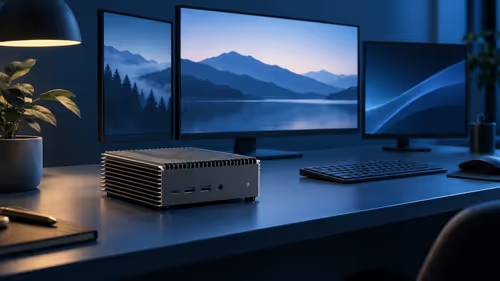
Choose a NAS around the number of users, current data, retention and restore needs. South African teams should also weigh fibre upload, local warranty handling and offsite copy costs, because local sharing and remote recovery use different links. The R8,499 diskless UGREEN NASync DXP2800 combines an Intel 12th Gen N-Series quad-core CPU, 8GB DDR5 and 2.5GbE networking; compatible SSDs or HDDs are a separate selection.
👥 Define who needs access and why
Start by listing each user, device and folder. A sole proprietor may need a laptop backup, a document archive and a photo library. A small team may need named accounts, a shared active-project area and a restricted financial folder. These are access decisions before they are hardware decisions.
Give each person only the folders needed for their normal work. Test a new account from a second device to confirm that access is correct. Broad administrator sharing can appear convenient until an accidental deletion or unwanted change affects the entire team.
The NAS category is useful when comparing the role an enclosure will play. A device choice becomes clearer after the user map and folder map exist.
📦 Calculate usable capacity from retention
Measure current documents, media, workstation backups and project folders separately. Then estimate growth over three years and decide how long previous versions must remain available. Video and image work may arrive in large bursts, while documents need less space but can be equally important to recover.
Raw drive labels are not the usable result. Formatting and the chosen protection layout reduce the space available for files. A two-drive mirror can preserve availability after one drive problem, but it does not produce the combined capacity of both drives for normal storage. Leave a buffer for new imports and maintenance rather than designing around a permanently full volume.
The hard drive category is most useful after that calculation. Choose compatible media around the required usable capacity, not the biggest number that fits a first budget.
🌐 Treat local speed and fibre access separately
The DXP2800 has a 2.5GbE LAN port. That can help large transfers between a wired computer and NAS when the switch, client adapter and cabling support the same level. It does not change the limits of an internet service when files are accessed from elsewhere.
For South African teams, fibre upload deserves a real test before an offsite workflow is promised. A fast download package does not ensure an equally fast upload. Send or restore one representative file using the actual connection, note the time, and decide whether the planned schedule is workable. The wired networking category helps map the local side of the path.
🛡️ Build a recovery route outside the NAS
Drive protection can help when one drive fails, but it cannot replace an independent copy. Keep another encrypted copy away from the enclosure and decide who checks it. A scheduled job should be followed by a restore test: recover a document, a project folder and an ordinary photo to another location, then open them.
Recovery speed is part of the plan. A backup that is technically present but cannot return an urgent file in the needed time may not suit a working team. Record the location, update routine and access details so that recovery does not depend on one person's memory.
🧾 Consider ownership after purchase
The DXP2800 is diskless and supports up to 80TB, so its final capability depends on the compatible SSD or HDD storage installed. It also has USB-C 10Gbps and HDMI 4K output, though those features should follow the main storage and recovery plan rather than replace it.
Keep invoices, drive details and a simple network diagram together. This is useful for local warranty handling and for diagnosing a future problem. Place the NAS where airflow is clear, cables are secure and the sound of active drives will not disrupt focused work.
The diskless NAS storage category gives a route to compare the enclosure side after the data, user and recovery requirements are clear.
🌍 Plan remote recovery around the upload you actually have
Local sharing and offsite recovery are different workloads. A 2.5GbE path can make a large copy between two wired devices much quicker, but it does not change the upload speed supplied by an internet connection. Before choosing an offsite routine, copy a known 10GB test archive and time the upload during a normal working period. Divide the result by the file size to obtain a practical estimate rather than relying on a package headline.
For a small South African team, that test also helps set expectations after a drive failure. If the remote copy would take days to restore, keep the local NAS share organised and make an additional offline copy of the most important folders. Give each user a named account, limit write access where it is not needed, and test a restore to a spare folder. The strongest setup is not the one with the most features; it is the one whose recovery sequence has been rehearsed.
Put the restore order on paper
Write the order in which shared folders should return after an incident. Start with current work and irreplaceable records, then add archive material after the essential services are working. Assign one person to check permissions and another to open restored files. This avoids a long remote recovery becoming an unplanned scramble over which data matters first.
Frequently Asked Questions
How many users can a small-office NAS support?
Choose around the actual users, their folder access and the work they perform. Test shared access with the intended devices rather than relying on a broad assumption.
Does 2.5GbE improve remote access over fibre?
It can improve a compatible local wired route. Remote performance is still governed by the internet connection, including its upload capability.
Are drives included with the UGREEN NASync DXP2800?
No. It is a diskless enclosure, so compatible SSD or HDD storage must be added before files can be stored.
Why is an offsite copy necessary if drives are protected?
Drive protection addresses a limited hardware failure. It does not create an independent recovery route for deletion, corruption or a problem affecting the whole enclosure.
Ready to build office storage around real users, real files and recoverable copies?
Explore diskless NAS systems, compatible hard drives and wired networking for a practical local plan.