You've just dropped thousands of Rands on a shiny new graphics card, expecting buttery-smooth frames in Warzone. But instead, you're hit with frustrating stutters, especially in a hectic gunfight. What gives? Your powerful GPU might be sitting idle, waiting for its partner to catch up. Welcome to the world of the CPU bottleneck, a common performance thief that holds your entire rig back from its true potential. This guide explains everything.
What Is a CPU Bottleneck, Really?
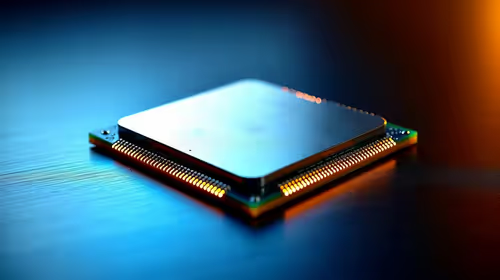
Think of your PC as a production line. Your CPU (Central Processing Unit) is the worker that prepares tasks (game data, physics, AI), and your GPU (Graphics Processing Unit) is the worker that turns those tasks into the beautiful images you see on screen.
A CPU bottleneck happens when your CPU can't prepare these tasks fast enough for your powerful GPU. Your GPU finishes its job and is left waiting for the next instruction. It's like having the world's fastest painter waiting for someone to slowly hand them brushes. The result? Lower frame rates, stuttering, and a feeling that your expensive hardware isn't performing as it should. ⚡
How to Spot a CPU Bottleneck in Your Rig 🕵️
Guessing isn't good enough; you need data. The easiest way to diagnose a processor bottleneck is to monitor your component usage while gaming.
- Fire Up Your Game: Launch a game where you experience performance issues.
- Open Task Manager: Press
Ctrl + Shift + Escand go to the "Performance" tab. Keep it open on a second monitor if you have one. - Check the Numbers: Play for a few minutes in a demanding area. Look at your CPU and GPU usage percentages.
If you see your CPU usage hitting 90-100% while your GPU usage is sitting much lower (e.g., 60-70%), you've almost certainly found a CPU bottleneck. It's clear evidence your processor can't keep up. If this is you, it might be time to start browsing for a worthy upgrade among the latest CPU processors available online.
Quick Performance Check
For more detailed, in-game stats, use a tool like MSI Afterburner with the RivaTuner Statistics Server overlay. It shows you CPU and GPU usage, temperatures, and frame times right on your screen, making it easy to spot a bottleneck in real-time.
Common Causes of a Processor Bottleneck
A bottleneck isn't always about having an "old" CPU. The cause is often about balance and how you use your system.
Mismatched Components
This is the classic scenario. You've paired a brand-new, top-tier graphics card like an NVIDIA GeForce RTX 4070 with a five-year-old mid-range processor. The GPU has immense power, but the older CPU architecture, slower clock speeds, and fewer cores simply can't feed it data fast enough. Your PC's performance will be limited by its weakest link.
Gaming at Lower Resolutions
This might sound counter-intuitive, but gaming at 1080p is more CPU-intensive than at 1440p or 4K. Why? At lower resolutions, your GPU can render frames incredibly quickly. This puts immense pressure on the CPU to prepare the next frame in time. When you increase the resolution, the GPU has to work harder on each frame (rendering more pixels), which gives the CPU more breathing room.
Fixing a CPU Bottleneck: Your Action Plan 🚀
So you've confirmed a bottleneck. Don't panic! You have a few options, from free software tweaks to the ultimate hardware solution.
Software Tweaks (The Free Fixes)
Before you open your wallet, try these first:
- Close Background Apps: Make sure browsers, Discord, and other apps aren't eating up CPU cycles while you game.
- Adjust In-Game Settings: Lower settings that are notoriously CPU-heavy. These often include "object detail," "crowd density," "physics," and "shadow quality."
- Increase Resolution: If your monitor and GPU support it, try running the game at a higher resolution (e.g., 1440p instead of 1080p). This shifts more load onto the GPU, potentially balancing your system.
Hardware Upgrades (The Real Solution)
While software tweaks can help, the most effective way to fix a significant CPU bottleneck is to upgrade your processor. A modern CPU will provide the instructions-per-clock (IPC) improvements and core counts needed to keep pace with today's powerful graphics cards.
For gamers, a modern Intel Core processor often delivers incredible single-core performance, which is crucial for hitting high frame rates. On the other hand, the latest AMD Ryzen CPUs are performance powerhouses, offering a fantastic balance of high core counts for multi-tasking and raw gaming speed. Choosing the right one ensures your GPU can finally stretch its legs and deliver the performance you paid for.
Ready to Uncap Your FPS? A balanced PC is a happy PC. Stop letting an old processor hold back your gaming experience and explore our massive range of CPUs. Shop now at Evetech for performance that leaves lag in the dust.