Is there anything more frustrating? Your Wi-Fi still feels sluggish… especially in the lounge or braai room. You bought a mesh network to kill those dead zones, but streaming still buffers and your game latency spikes.
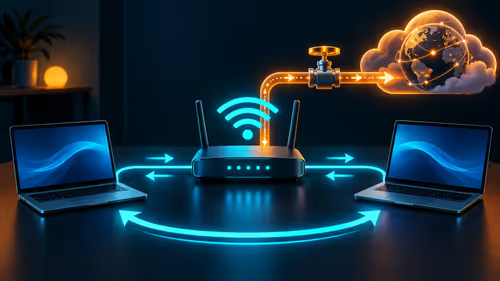
The culprit is often a congested network “backhaul”—the invisible data highway connecting your mesh nodes. The good news? A system with a dedicated backhaul boosts mesh network speed instantly, and understanding how is the first step.
Understanding the "Invisible Highway" of Your Mesh Network
Think of your home Wi-Fi network like a highway system. Your devices (phone, PC, console) are the cars, and the mesh nodes are the on-ramps. The backhaul is the main highway connecting all these on-ramps back to the main router.
In many standard mesh systems, all the traffic—data from your PC to the node, and data from that node back to the router—uses the same lanes. When things get busy, you get a traffic jam. This is why even with a strong signal, your speed can plummet. It’s a huge improvement over basic wireless range extenders, but there's a better way.
How a Dedicated Backhaul Boosts Mesh Performance 🚀
So, what’s the fix? A dedicated wireless backhaul.
This is a game-changing feature found in tri-band or quad-band mesh systems. It creates an exclusive, private lane on your Wi-Fi highway used only for communication between the mesh nodes. This lane, typically a high-frequency 5 GHz or 6 GHz band, is completely separate from the bands your devices use.
The result is dramatic:
- No More Sharing: Your devices get the full bandwidth of the 2.4 GHz and other 5 GHz bands.
- Lower Latency: With a clear path, data packets from your gaming rig reach the router faster, crucial for competitive online play.
- Consistent Speed: Your 100Mbps fibre connection actually feels like 100Mbps, even at the far end of the house.
Essentially, a dedicated backhaul boosts mesh network speed by eliminating the primary source of internal network congestion. It ensures the system's foundation is rock-solid.
Check The Specs Before You Buy
When shopping for a new mesh system, look for the term "Tri-Band" or "Quad-Band". This is the clearest indicator of a dedicated backhaul. A "Dual-Band" mesh system will almost always share its backhaul, limiting its peak performance under load.
Is a System with a Dedicated Backhaul Right for You?
Not everyone needs this level of performance, but you'll feel the difference if you tick these boxes:
- You have a large or multi-storey home with concrete walls.
- You have more than 15 connected devices (phones, laptops, smart TVs, security cameras).
- You pay for a fast fibre line (100Mbps or more) and want to use all of it.
- You're a serious gamer or frequently stream in 4K.
Upgrading your home network is a holistic process. While powerful wireless routers form the core, ensuring your PC has one of the latest wireless adapters is also key to taking full advantage of the speed and stability a high-performance mesh network provides. ✨
If lag spikes, buffering wheels, and inconsistent speeds are holding you back, investigating a mesh solution with this technology is your next logical step.
Ready for Full-Speed Wi-Fi Everywhere?
Stop letting a congested network throttle your fun. A mesh system with a dedicated backhaul is the key to unlocking consistent, high-speed internet in every corner of your home. Explore our full range of wireless networking gear at Evetech and leave lag in the dust.