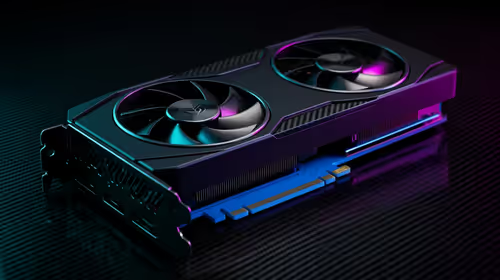
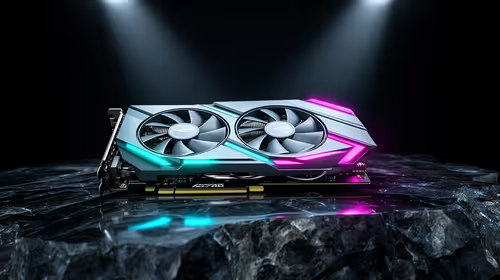
Staring at your FPS counter, wishing you could squeeze more performance out of your rig without forking out thousands of ZAR for a new GPU? You're not alone. For South African gamers, the battle between NVIDIA's DLSS and AMD's FSR is the key to unlocking higher frame rates. This guide breaks down the DLSS vs FSR South Africa debate, helping you choose the smart-scaling tech that will give you the competitive edge. 🚀
What Are DLSS and FSR Anyway?
Before we dive deep, let's get the basics straight. Both DLSS (Deep Learning Super Sampling) and FSR (FidelityFX Super Resolution) are clever upscaling technologies.
Imagine this: your graphics card renders a game at a lower resolution (like 1080p), which is much easier and faster. Then, the upscaling tech uses advanced algorithms—or even AI—to stretch that image up to your monitor's native resolution (like 1440p or 4K), filling in the missing details to make it look sharp and clean.
The result? You get a massive performance boost... sometimes doubling your frames per second (FPS) with minimal impact on visual quality. It's like getting a free hardware upgrade through software.
Breaking Down DLSS: NVIDIA's AI Powerhouse ✨
NVIDIA's DLSS is the veteran in this space. It uses the power of artificial intelligence and dedicated Tensor Core hardware found exclusively on NVIDIA GeForce RTX graphics cards to work its magic.
How It Works
DLSS is trained on super-high-quality, offline-rendered images of games. This AI model then intelligently reconstructs the image on your PC in real-time. Because of this deep learning approach, DLSS often produces an image that is incredibly sharp, sometimes even better than the native resolution, by reducing shimmering and improving anti-aliasing.
The latest version, DLSS 3, introduces "Frame Generation," which uses AI to create entirely new frames between existing ones, providing a monumental performance uplift.
The Catch? You need an NVIDIA RTX 20-series card or newer to use DLSS, and an RTX 40-series for Frame Generation.
Understanding FSR: AMD's Open-Source Challenger 🔧
AMD took a different path with FSR. Instead of relying on dedicated AI hardware, FSR is an open-source spatial upscaler. This is its greatest strength.
How It Works
FSR uses a cutting-edge algorithm to upscale the image based on the data within the frame itself. It doesn't need a neural network or special cores. This "open" approach means it works on a massive range of hardware, not just the latest and greatest. You can run FSR on modern AMD Radeon graphics cards, older AMD cards, and even NVIDIA's cards (including the GTX series).
While the first version of FSR was good, the latest iterations (FSR 2 and 3) have dramatically closed the quality gap with DLSS. FSR 3 even includes its own version of frame generation, called "Fluid Motion Frames," which is also open-source.
The Catch? While incredibly flexible, the image quality from FSR can sometimes be a little "softer" than DLSS in a side-by-side comparison, though most gamers would struggle to notice in the heat of battle.
The DLSS vs FSR South Africa Showdown: Key Differences
So, when you're building a PC in South Africa, which one should you prioritise? The DLSS vs FSR choice often comes down to these three factors:
- Image Quality: Generally, DLSS holds a slight edge in producing the cleanest, most stable image thanks to its AI training. However, FSR 3 is extremely competitive, and the difference is often only noticeable in direct, zoomed-in comparisons.
- Performance: Both technologies offer huge FPS gains. The exact amount varies by game, your hardware, and the quality preset you choose (e.g., Quality, Balanced, Performance). Neither has a consistent performance lead over the other across all titles.
- Hardware Compatibility: FSR is the undisputed champion here. Its ability to run on almost any modern-ish GPU makes it an amazing tool for everyone, especially those upgrading an older system on a budget. DLSS is a premium feature, locked to the NVIDIA RTX ecosystem.
Check The Game List! 🤔
Before you finalise your GPU purchase based on one technology, always check the official support lists for your must-play games. A game like Alan Wake 2 might heavily favour DLSS features, while Starfield has excellent FSR support. Knowing this beforehand can save you from disappointment and help you find the best graphics card deals for your specific needs.
Which Upscaler is Right for Your Next PC Build?
There's no single "winner" in the DLSS vs FSR South Africa debate. The right choice depends entirely on you.
- For the "No Compromise" Builder: If you're buying a high-end RTX 4070, 4080, or 4090, you're investing in the DLSS 3 ecosystem. The quality and performance from features like Frame Generation and Ray Reconstruction are undeniable and a core part of the value proposition.
- For the "Smart Value" Builder: If you're building a mid-range PC, an AMD Radeon card paired with FSR offers incredible performance-per-Rand. You get a powerful GPU and access to an upscaler that will keep you gaming at high frame rates for years to come.
- For the "Savvy Upgrader": If you're holding onto an older but still capable card like a GTX 1660 or an RX 580, FSR is a gift. It can breathe new life into your hardware, letting you enjoy modern games at playable frame rates without needing a full system overall.
Ultimately, both technologies are fantastic for gamers. They allow us to push visual settings higher and achieve smoother gameplay, making PC gaming more accessible and impressive than ever.
Ready to Boost Your FPS?
The DLSS vs FSR debate is complex, but the real winner is the South African gamer. You now have incredible tools to maximise your performance. Explore our massive range of graphics card deals and find the perfect GPU to conquer your favourite games.