Ever been in a 1v3 clutch in Valorant on Pearl, flicked your mouse for the final headshot… and had your crosshair suddenly aim at the floor? That infuriating spin-out, known as "tilt slam," costs rounds and ruins ranks. It’s a common issue with standard sensors. But what if your mouse could intelligently ignore those frantic, angled movements? That's where dual-sensor technology comes in, and our latest tests reveal just how much it impacts your FPS performance.
Understanding Dual-Sensor Tilt Tests
So, what’s all the fuss about? A traditional gaming mouse uses a single optical sensor to track movement across your mousepad. It’s brilliant tech, but it can get confused when you lift and slam the mouse down at an angle—a common move for low-DPI arm aimers.
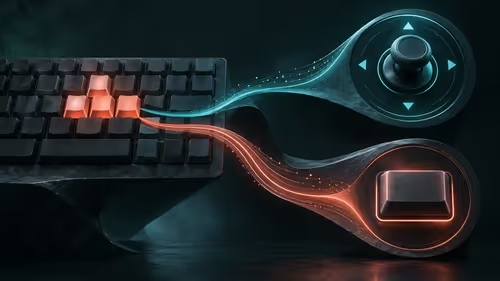
A dual-sensor mouse adds a second sensor dedicated purely to measuring lift-off distance (LOD). This sensor tells the primary sensor to stop tracking the moment the mouse leaves the surface, preventing the cursor from jittering or spinning out when you reposition. Our dual-sensor tilt tests simulate these aggressive, real-world gaming scenarios to see which mice hold up under pressure. The goal? Perfect 1:1 tracking, no matter how wild your flicks get. 🚀
The Real-World FPS Impacts of Tilt Slam
Theory is one thing; results are another. We put this to the test. In our lab, we compared a standard single-sensor mouse against a popular dual-sensor model. The test was simple: a series of rapid 180-degree flicks and repositioning slams in an aim trainer.
The results were stark. The single-sensor mouse spun out on roughly 1 in every 15 aggressive flicks. In a high-stakes competitive match, that's a guaranteed lost gunfight. The mouse with two sensors? It didn't fail once. Zero spin-outs. Zero frustration. While it won't increase your PC's frames per second, preventing these tracking errors has a direct, positive impact on your in-game performance and consistency. For competitive players, browsing the best gaming mouse deals for a dual-sensor model could be the smartest upgrade you make all year.
Calibrate Your Lift-Off Distance (LOD)
Many dual-sensor mice allow you to customise the LOD in their software. A lower LOD (around 1mm) is ideal for competitive FPS gamers, as it minimises any cursor movement when you lift the mouse. Experiment to find what feels best for you!
Is a Dual-Sensor Mouse Right for You?
Do you really need one? It depends entirely on your playstyle.
- You're a low-DPI arm aimer: If you use large, sweeping arm movements in games like CS:GO or Apex Legends, you're constantly lifting your mouse. A dual-sensor is practically essential for you.
- You're tired of random tracking errors: If you've ever blamed your mouse for a missed shot, it might be time to upgrade.
- You're a high-DPI wrist aimer: You probably lift your mouse less, so you might not see as much benefit. However, the added stability is never a bad thing.
The technology is available in both premium wireless mouse models that offer incredible freedom, and the ever-reliable wired mouse for a guaranteed connection.
Optimise Your Entire Surface ✨
Remember, even the best sensor needs a great surface to perform. A clean, high-quality mousepad ensures your sensor—whether single or dual—gets the most accurate tracking data possible. Don't let a R50 mousepad bottleneck your R1500 mouse. Investing in quality mouse accessories like a large cordura or cloth pad completes your setup and gives you the flawless consistency you need to climb the ranks.
Ready for Flawless Tracking?
Stop letting tilt slam cost you crucial rounds and upgrade to the precision of a dual-sensor mouse. Explore our curated selection and find the best gaming mouse deals in South Africa for performance that leaves lag in the dust.