


PCIe 5.0 vs PCIe 4.0 for Cinematic Story Games in SA
PCIe 5.0 and PCIe 4.0 differ most in lane support, compatibility, and upgrade value for cinematic story games. SA buyers should match the choice to their actual hardware and games.
Read moreIn the fdm vs resin for miniatures debate, resin Saturn-class machines resolve detail to tens of microns that FDM cannot match, while A1 Mini at R5,499 prints terrain faster with no chemical handling. Both types are locally stocked for SA hobbyists.
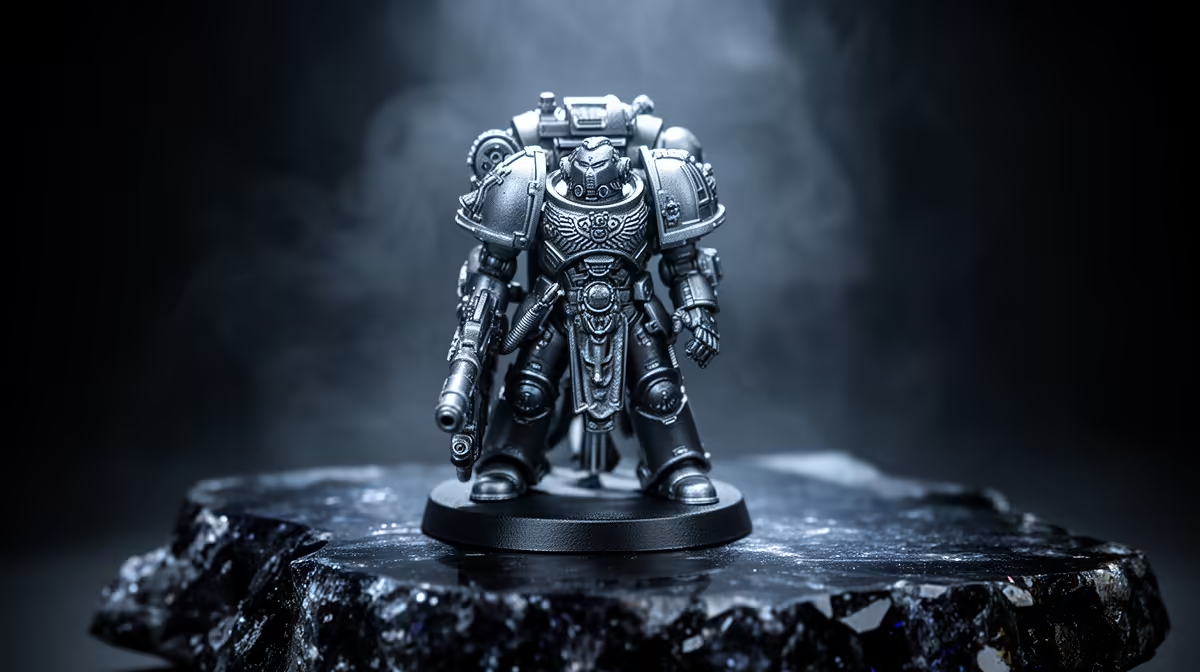
Painting a Space Marine squad and a ruined Imperial city are two different printing jobs, and pretending one machine does both well is how SA hobbyists end up disappointed. The FDM vs resin for miniatures choice splits along a clean line: resin chases crisp character detail, FDM chases cheap bulk terrain. Get that split right and you spend less, waste less filament and resin, and finish more of your army.
For 28mm heroes, faces and fine weapons, a resin Saturn-class printer wins outright because it resolves layers down to tens of microns. For terrain, bases and bulk rank-and-file, an FDM machine like the Bambu A1 Mini at around R5,499 prints faster and cheaper with no resin or alcohol to manage. Many SA painters end up owning one of each.
Resin printing (MSLA) cures a vat of liquid photopolymer one whole layer at a time using a masking LCD. Because the entire layer flashes at once, print time barely changes whether you print one mini or fill the plate, and the achievable detail is tied to the screen's pixel size rather than a moving nozzle. That is why a resin Marine shows clean pauldron trim and readable facial features.
FDM (fused deposition modelling) drags a heated nozzle across a path, laying molten filament in lines. Detail is limited by nozzle diameter and the visible layer lines on curved surfaces, but the trade-off is generous: filament is cheap per gram, parts are tough enough to survive a game night in a backpack, and there are no fumes or wash-and-cure steps. Evetech stocks both families, and browsing the full 3D printer line-up makes the price gap between an entry FDM unit and a resin rig obvious at a glance.
If your hobby is heroes, named characters, busts or anything where the paint job is the point, resin is not a luxury, it is the correct tool. Skin folds, chainmail links, gem facets and crisp edges come off the plate ready to prime. A Saturn-class machine with a large plate also lets you batch a full squad in one overnight run.
At the 28mm scale standard for tabletop wargaming, you are working with features measured in fractions of a millimetre: individual eyelashes, the texture of a cloak, fine filigree on a sword guard. FDM at 100 to 200 microns layer height leaves visible stepping on curved surfaces at that scale. Entry resin machines at 50-micron XY resolution already outperform entry FDM significantly. Current 8K and 12K machines push pixel pitch into the 19 to 24-micron range, which resolves detail at 28mm that would have required professional equipment just a few years ago.
Resin demands respect. You work in gloves, you keep a wash station and a UV cure setup, and you ventilate the room. Uncured resin is an irritant, so this suits a hobbyist with a dedicated bench or a well-aired garage rather than a bedroom corner. Factor in the running cost of isopropyl alcohol and replacement FEP film when you budget.
Ruined walls, barricades, cargo containers, modular dungeon tiles and movement trays are where FDM shines. These pieces are large, get handled hard, and do not need micron detail. An A1 Mini chews through a table's worth of scenery for the price of a few coffees in filament, and tough PLA survives being knocked off the table mid-game.
There is no wash, no cure, no chemical disposal. You slice, you print, you snip the part off the plate. For a parent printing with kids, a club printing shared terrain, or anyone short on ventilated space, FDM is the lower-stress entry point. The difference in surface smoothness matters far less on a wall than on a face, and a well-primed FDM terrain piece looks completely convincing on the table.
For large batches of rank-and-file infantry that will be viewed from playing distance rather than under a brush, the case for FDM is stronger than people admit. Slow speeds and fine nozzles at 0.4mm improve results, and printing soldiers at tabletop distance removes the criticism. Where FDM falls short is the close-up: hold the model in your hand and compare a resin hero face to an FDM one and the gap is obvious.
An FDM starter like the A1 Mini lands around R5,499, and filament is widely available locally in ZAR, so ongoing cost stays predictable. A resin setup costs more once you add the printer, wash-and-cure gear, resin and consumables, but it pays back in detail you simply cannot get any other way. If your group already pools resources, a sensible split is one resin printer for characters and one FDM for terrain shared across the club.
When you are kitting out the bench, the consumables and add-ons matter as much as the machine itself, and the hobby accessories that move fastest are a useful gauge of what other SA makers reach for first.
Not really. FDM handles terrain and bulk infantry acceptably but softens fine character detail, while resin nails detail but is slow and fiddly for large terrain pieces. Owning one of each is common once a hobby gets serious.
It can be, with discipline: gloves, good ventilation, and a contained wash-and-cure zone. If you cannot ventilate properly, FDM is the safer indoor choice because it has no liquid resin or alcohol to manage.
Filament is cheap per gram and sold locally in Rand, so a full terrain set costs very little in material. The main outlay is the printer itself, after which scenery is close to the cheapest hobby spend you have.
On rank-and-file troops at tabletop distance, a well-printed and primed FDM mini looks fine, especially with a fine nozzle and slow speeds. The difference shows up on faces and ornate detail, which is exactly where resin earns its place.
Start with FDM if you mostly want terrain and a low-fuss workflow, like the A1 Mini. Move to resin once you know you care enough about character detail to manage the extra handling.
Ready to start your print bench? Compare locally stocked machines on the Evetech 3D printer range and match the technology to whether you print heroes or hold the line with terrain.
Not really. FDM handles terrain and bulk infantry acceptably but softens fine character detail, while resin nails detail but is slow and fiddly for large terrain pieces. Owning one of each is common once a hobby gets serious.
It can be, with discipline: gloves, good ventilation, and a contained wash-and-cure zone. If you cannot ventilate properly, FDM is the safer indoor choice because it has no liquid resin or alcohol to manage.
Filament is cheap per gram and sold locally in Rand, so a full terrain set costs very little in material. The main outlay is the printer itself, after which scenery is close to the cheapest hobby spend you have.
On rank-and-file troops at tabletop distance, a well-printed and primed FDM mini looks fine, especially with a fine nozzle and slow speeds. The difference shows up on faces and ornate detail, which is exactly where resin earns its place.
Start with FDM if you mostly want terrain and a low-fuss workflow, like the A1 Mini. Move to resin once you know you care enough about character detail to manage the extra handling.
PCIe 5.0 and PCIe 4.0 differ most in lane support, compatibility, and upgrade value for cinematic story games. SA buyers should match the choice to their actual hardware and games.
Read more
ATX 3.1 vs ATX 3.0 for streaming on Twitch and YouTube buyers - what changes is mostly about compatibility, budget, upgrade path, and setup fit. SA buyers should check device support and real needs before expecting a clear win from either option.
Read more
OLED vs Mini-LED for video editing in 4k is mainly about fit, features, compatibility, cost, and upgrade path, not one automatic winner. SA buyers should match the choice to the setup.
Read more
The real world difference between IPS and VA for streaming on Twitch and YouTube is colour consistency versus contrast. For SA creators, match the panel to OBS previews, chat visibility, camera work, and long editing sessions after live streams.
Read more
IPS vs OLED for Couch Co-Op Gaming comes down to contrast, motion, burn-in care, refresh needs, desk use, and game type. SA buyers should match the choice to their setup instead of assuming one option always wins.
Read more
FSR 4 and FSR 3.1 affect competitive esports only if they preserve clarity, latency, and stable frame pacing. SA players should compare response feel, motion quality, and support in the specific titles they grind.
Read more
Wi-Fi 7 vs Wi-Fi 6e for cinematic story games comes down to router support, latency goals, device compatibility, and coverage. SA buyers should match the choice to the real network setup.
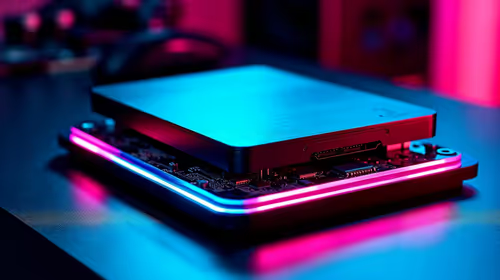
The real world difference between PCIe 5.0 and PCIe 4.0 for MMO and live-service games is usually about loading, patches, and headroom. SA players should weigh NVMe speed, GPU lanes, CPU limits, and platform cost.

Windows 11 gaming laptop dead pixel checks begin with a full-screen colour test. This how to fix dead pixel windows 11 gaming laptop guide helps SA users compare settings, drivers, external screens, and warranty routes.
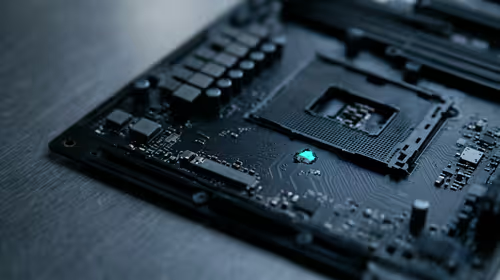
AM5 motherboard stuck pixel fixes in South Africa start with panel, cable, GPU output, and Windows checks. Use a clean test path before blaming the motherboard or replacing screen hardware.

FPS drops blamed on a wireless mouse often point to input, driver, USB, network, or system-load checks. Use a quick SA-friendly troubleshooting flow to isolate software, firmware, thermals, storage, and game settings before replacing hardware.

How to fix fps drops on steam deck starts with power profile, shader cache, storage health, and per-game settings. For South Africa, check charger quality, heat, and download stability before assuming the handheld needs repair. Retest after updates.

How to fix low FPS after an RTX 5080 build upgrade starts with driver cleanup, display settings, thermals, and power mode. For SA gamers, verify GPU usage, PCIe speed, RAM profile, and CPU limits before changing parts.
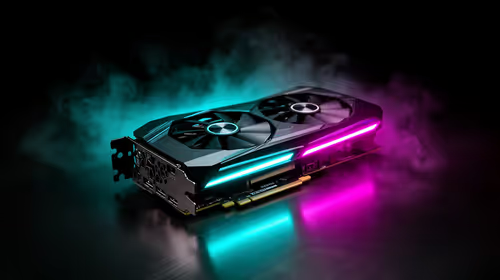
Hollow Knight Silksong at 4K needs a GPU matched to settings, VRAM, CPU balance, and monitor goals. Use this SA guide to compare tiers without treating FPS target or prices as fixed.
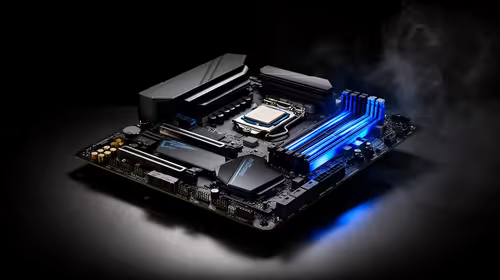
How to fix FPS drops after a Ryzen 9 9950X3D starts with BIOS, chipset, EXPO, power, and GPU driver checks. It helps isolate upgrade stutter on high-end SA gaming rigs before you change hardware, reinstall Windows, or retune cooling.
PCIe 5.0 and PCIe 4.0 differ most in lane support, compatibility, and upgrade value for cinematic story games. SA buyers should match the choice to their actual hardware and games.

FPS drops Windows 11 mechanical keyboard issues can come from USB polling, keyboard utilities, power settings, or overlays. This gaming checklist helps test input-device causes before deeper GPU or CPU troubleshooting.
ATX 3.1 vs ATX 3.0 for streaming on Twitch and YouTube buyers - what changes is mostly about compatibility, budget, upgrade path, and setup fit. SA buyers should check device support and real needs before expecting a clear win from either option.