Quick Answer
Setting up a functional gaming station in a dorm room requires balancing space constraints, noise levels, and budget, especially for SA students working with NSFAS allowances or tight personal budgets. The key is choosing compact, dual-purpose hardware that handles both gaming and academic work without taking over your entire desk or annoying your roommate.
Planning Your Dorm Gaming Setup Around SA Realities
Before buying anything, understand the constraints specific to South African student accommodation. Res rooms at universities like UP, UCT, Wits, UJ, UKZN, and Stellenbosch typically come with a single desk, limited power points, and shared walls, which means noise management matters as much as raw performance.
Loadshedding is a real factor. During Stage 4 or higher, your gaming sessions can be cut off mid-game. A UPS (uninterruptible power supply) rated for at least 600VA can keep a compact gaming PC or a gaming laptop running through a 2-hour slot, giving you time to save progress and shut down safely. Budget UPS units start around R500 to R800, which is worth it compared to losing unsaved work or having your hardware cut out mid-session repeatedly.
Power point scarcity in res rooms means a good surge-protected multi-plug is essential. Some residences limit the appliances you can plug in, so check your res rules before setting up a full tower PC. Many students find a gaming laptop plus a monitor is the easiest setup to stay compliant, since it draws less power than a desktop rig and is portable for moving between lectures and the library.
NSFAS students working with the R5,200 laptop allowance should note that this budget covers a capable mid-range gaming laptop, though it sits at the lower end of what handles modern titles at acceptable settings. Stretching it with a separate keyboard and mouse upgrade can wait until the next semester.
Choosing the Right Display Setup
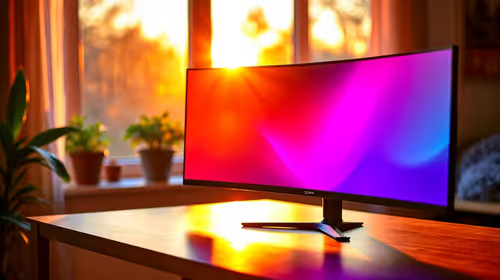
Your monitor is the centrepiece of a dorm gaming setup because it affects both gaming performance and study productivity. For dorm rooms, a 24-inch or 27-inch monitor at 1080p or 1440p resolution is the sweet spot. Going larger creates neck strain at close desk distances and draws more power.
For gaming on SA servers, refresh rate matters more than resolution in fast-paced titles like Apex Legends, Valorant, and CS2. A 144Hz 1080p monitor paired with a mid-range GPU consistently outperforms a 60Hz 1440p monitor in competitive play. The difference in smoothness is immediately noticeable and directly affects your reaction time in game.
If your desk space is very limited, consider a monitor arm. These clamp to the desk edge and free up the monitor stand footprint, giving you room for a keyboard and mouse without the desk feeling cramped. Arms that handle up to 8kg fit most 24-inch and 27-inch panels and start around R400 to R700 at local retailers.
For late-night gaming in a shared room, a monitor with low blue light mode and a brightness ceiling helps keep your roommate from being disturbed. Alternatively, a good pair of headphones with a built-in mic replaces the need for speakers entirely, keeping your audio personal without sacrificing communication in team games.
Peripherals That Work in Tight Spaces
A tenkeyless (TKL) or 75 percent keyboard removes the numpad section, cutting about 30 percent of the footprint versus a full-size board. This extra space matters enormously on a student desk that also needs room for textbooks and a laptop. TKL mechanical keyboards with tactile or linear switches are available from R400 upward and are far more satisfying to use for both gaming and long typing sessions than a membrane keyboard.
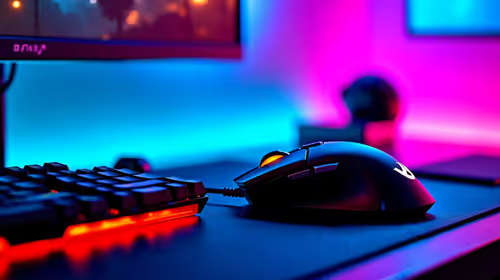
For a mouse, a medium-sized optical gaming mouse with an adjustable DPI setting is all you need. Heavier mice cause fatigue during long sessions. Look for a mouse in the 80g to 100g range. Ambidextrous or right-handed designs with 6 to 8 programmable buttons give you flexibility across different game genres without needing multiple mice.
A headset with a detachable or flip-up mic is ideal for dorm use. It removes the need for a separate desk microphone, which can pick up ambient res noise anyway. Closed-back headphones also reduce sound bleed, so your roommate does not hear every gunshot from your squad game at midnight.
Keeping Your Setup Organised and Quiet
Cable management in a small space is not optional if you want the desk to remain usable for both gaming and study. Velcro cable ties are reusable and cost almost nothing. Routing cables behind the monitor and under the desk using adhesive cable clips keeps the surface clear and reduces the chance of accidentally yanking a peripheral during an intense game.
For noise, if you are running a desktop PC, a case with acoustic foam panels significantly reduces fan noise in a shared room. Mid-tower cases with noise dampening are available in the R1,200 to R2,000 range. Alternatively, running your GPU and CPU fan curves at a slightly higher temperature target, but lower noise profile, through software like MSI Afterburner keeps your PC quieter at the cost of a few degrees Celsius.
If your res has a midnight noise curfew, it is worth knowing that most modern gaming PCs at idle or light gaming load are genuinely quiet. The loud fan spin-up only happens under heavy GPU load, so less demanding titles or single-player games at medium settings are often inaudible at a few metres distance.
Frequently Asked Questions
Can I use a gaming laptop as my only dorm gaming device? Absolutely. A gaming laptop covers both academic work and gaming in one device, which is the most practical choice for res students. Pairing it with a portable monitor and a TKL keyboard gives you an ergonomic dual-screen study setup that folds away when not needed. The trade-off is that gaming laptop GPUs are less powerful per rand than desktop equivalents, but for the convenience they offer in a dorm room the compromise is usually worth it.
What do I do about gaming during loadshedding in res? A small UPS is your best option if loadshedding frequently hits at your campus location. For laptop users, a fully charged battery typically provides 2 to 4 hours depending on the game's intensity. Desktop users without a UPS should save frequently and avoid online competitive modes during scheduled loadshedding windows, since a sudden shutdown mid-match results in a loss and potentially a penalty in ranked queues.
How do I keep my setup cool in a small, hot dorm room? SA summer temperatures in res rooms without air conditioning can push ambient temperatures above 30 degrees Celsius, which affects PC thermals. Position your PC or laptop with clearance on all ventilation sides. A small desk fan aimed at the PC intake area can drop component temperatures by 5 to 8 degrees Celsius. Avoid placing the system in a closed compartment or against a wall that blocks exhaust airflow.
Is it worth bringing a full desktop PC to res? For students in their own room or who have confirmed their res allows it, a compact desktop build outperforms an equivalently priced laptop for gaming. The challenge is transport during holidays and the power consumption rules some residences enforce. If you are confident your res allows it and you have a stable power setup including a UPS, a desktop provides better gaming performance per rand and is easier to upgrade over time.
Ready to Find Your Perfect Match? Find the best gaming PC deals at Evetech and build a dorm-ready setup that handles both gaming sessions and exam season.