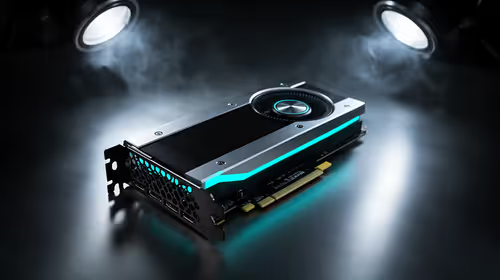
Ever pushed your graphics card to its limits, only for the framerate to tank in a chaotic firefight? That bottleneck you're feeling... it's often your GPU's memory struggling to keep up. But a new memory standard is about to change everything. This is GDDR7 explained, and it’s the secret sauce behind why future cards like the hypothetical RTX 5060 Infinity 2 OC will be so incredibly fast, delivering the smooth, high-resolution gameplay we all crave.
What is GDDR7 and Why Does It Matter for Gaming?
Think of your GPU's memory (VRAM) as a multi-lane highway. The GPU core is the city, and the game data (textures, models, shaders) are the cars. GDDR6, the current standard, is a fast and wide highway, but it has its limits. GDDR7 is like upgrading that highway to have more lanes, a much higher speed limit, and smarter traffic control.
In technical terms, GDDR7 (Graphics Double Data Rate 7) is the next-generation memory standard designed for graphics cards, AI accelerators, and high-performance computing. Its primary job is to feed the GPU core with data at blistering speeds. For us gamers in South Africa, this translates directly to:
- Higher Resolutions: Smoother 4K and even 8K gaming becomes more achievable.
- Better Ray Tracing: Complex lighting and reflections can be rendered faster.
- Higher Framerates: Less stuttering and a more responsive feel in competitive titles.
The leap from GDDR6 to GDDR7 is significant, promising a massive boost in bandwidth… the total amount of data that can be moved per second. While today's graphics cards are already powerful, GDDR7 will unlock a new level of performance.
GDDR7 Explained: The Key Technical Upgrades 🚀
So, what makes GDDR7 so special? The magic lies in a new signalling method called PAM3 (Pulse Amplitude Modulation with 3 levels). Older standards used NRZ (Non-Return-to-Zero), which could send one bit of data (a 0 or a 1) per cycle. PAM3 is far more efficient, encoding 1.5 bits of data in the same cycle.
It might sound complicated, but the result is simple: more data, moved faster. According to industry specifications, this allows GDDR7 to potentially reach speeds of up to 32 Gbps per pin, a huge jump from the ~18-24 Gbps seen in high-end GDDR6X cards. This core improvement is what will empower GPUs like the rumoured RTX 5060 Infinity 2 OC to handle next-gen game engines without breaking a sweat. For those loyal to Team Green, the future of GeForce graphics cards looks incredibly bright.
Optimise Your Current VRAM 🔧
Is your VRAM maxing out in the latest titles? Lowering texture quality is the single fastest way to reduce VRAM usage and boost FPS. In a game like Alan Wake 2, dropping textures from 'High' to 'Medium' can free up gigabytes of VRAM with only a minor visual trade-off, giving you a much smoother experience on your current card.
How GDDR7 Will Boost a Future RTX 5060 Infinity 2 OC
Let's imagine a future hero card: the RTX 5060 Infinity 2 OC. A mid-range card like the 5060 is where performance-per-rand really matters. By equipping it with GDDR7, manufacturers can achieve performance that might have previously been reserved for high-end xx70 or xx80 series cards.
The massive memory bandwidth from GDDR7 would allow the RTX 5060 Infinity 2 OC to:
- Excel at 1440p: Run the latest AAA titles at 1440p with high settings and ray tracing enabled, maintaining high and stable framerates.
- Power Through AI Tasks: Technologies like DLSS will run even more efficiently, generating high-quality frames with less performance overhead.
- Offer Better Value: Instead of using a wider, more expensive memory bus (like 256-bit), a manufacturer could use a narrower 128-bit bus with ultra-fast GDDR7 and still achieve incredible bandwidth. This keeps costs down, which is great news for our wallets.
Custom models from partners like MSI are likely to push the envelope even further, using the thermal headroom of their advanced coolers to deliver factory-overclocked GDDR7 memory for extra performance. Exploring the current lineup of MSI graphics cards gives you a good idea of the quality and innovation we can expect.
When Can We Expect GDDR7 in South Africa? ✨
Patience, padawan. While the GDDR7 specification is finalised, it takes time for the technology to make its way from the factory floor into the graphics cards we can actually buy. Most industry experts predict we'll start seeing the first GDDR7-equipped GPUs in late 2024 or early 2025.
Until then, the current generation of GPUs offers fantastic performance for the price. Both NVIDIA's RTX 40 series and AMD's RX 7000 series are mature platforms with excellent driver support and wide availability. Whether you're looking at the green team or the impressive value offered by the latest Radeon graphics cards, there has never been a better time to build a powerful PC.
The arrival of GDDR7 will be a huge step forward, and understanding what it is helps you see where the future of PC gaming is headed. It's all about faster, more efficient, and more immersive experiences.
Ready for a Framerate Upgrade?
The next generation is exciting, but today's GPUs offer incredible performance for your ZAR. Explore our massive range of graphics cards and find the perfect GPU to dominate your favourite games today.