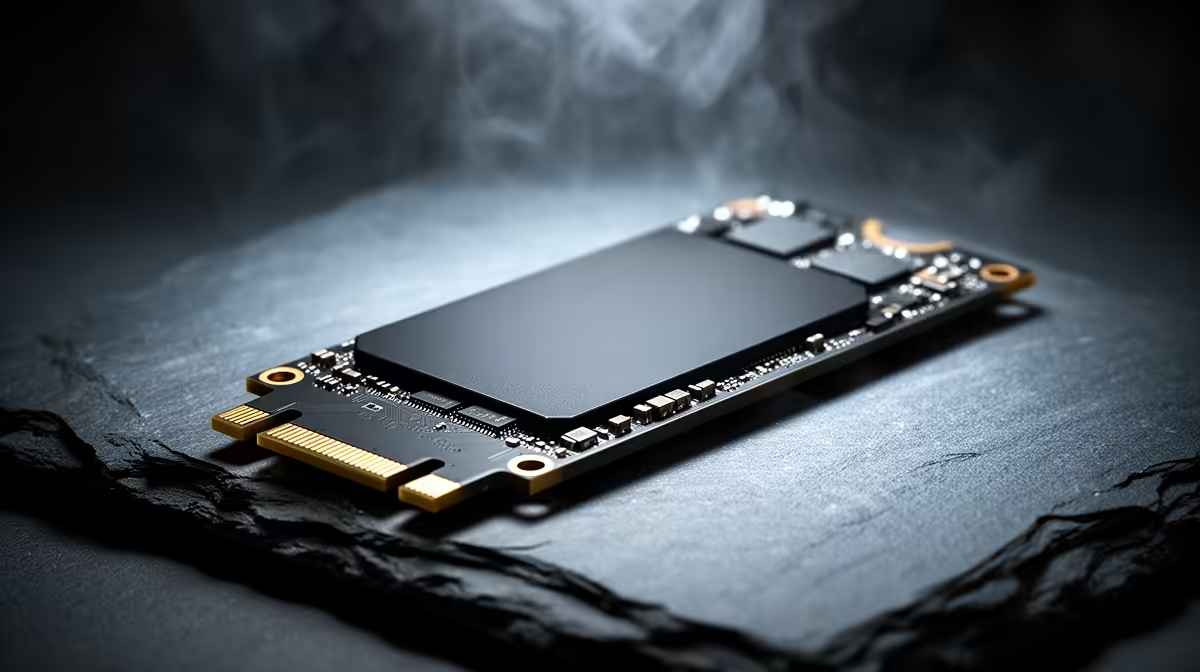
When a local model loads, it reads gigabytes from your drive into memory before it answers a single prompt. That is the one moment storage speed shows up, and it is where the Gen5 NVMe pitch lives. The honest question is not which drive has the bigger number on the box, but whether shaving a few seconds off model loading is worth the premium for the way you actually work.
Quick Answer
Gen5 NVMe roughly doubles sequential read speed, hitting around 14,000 MB/s against Gen4's 7,000 MB/s ceiling, which can halve model load time: a 40GB model loads in about 6 seconds on Gen5 versus 11 on Gen4. But once a model is resident in RAM or VRAM, storage speed plays no further role in inference. Gen4 is the value pick; Gen5 only pays off if you hot-swap models all day.
What faster storage does and does not do
Storage matters in exactly one phase: loading the model file from the SSD into DRAM or VRAM. After that, every token is generated from memory, and the drive sits idle. So the entire benefit of a faster SSD is compressed into those few seconds at load time. Inference speed, the thing you feel most, is set by the GPU, memory bandwidth, and the model itself, not by your SSD.
That reframes the whole decision. You are not buying speed for the work; you are buying a shorter wait before the work starts.
The real numbers on model loading
The gap looks dramatic on paper and modest in practice. A 70B model quantised to roughly 4-bit, about 40GB on disk, loads in around 11 seconds on a Gen4 drive and about 6 seconds on Gen5, a saving of roughly 5 seconds. Scale up to a very large 405B-class model near 230GB and Gen5 can save 20 to 30 seconds per load. The percentage looks like a big win; the wall-clock saving for a single load is small.
Why the gap shrinks in the real world
Loading a model is not a clean sequential read. Inference engines parse metadata, memory-map files, and allocate buffers, and that overhead bottlenecks before the drive's raw throughput does. In other words, you rarely get the full 14,000 MB/s during an actual model load, so the practical difference between Gen4 and Gen5 is smaller than the spec sheet suggests.
Who should pay for Gen5
The deciding factor is how often you reload. If you load a model once in the morning and use it for hours, Gen5 saves you about five seconds for the whole day, which is not worth the premium. Buy a quality Gen4 drive and forget about it.
If instead you run an agent framework or a coding workflow that swaps models dozens of times a day, those few seconds compound into real, cumulative wall-clock time, and Gen5 starts to earn its keep. Frequent model switching is the one workflow where the upgrade genuinely pays.
The thermal and power cost of Gen5
Gen5 drives run meaningfully hotter than their Gen4 counterparts. Most Gen5 drives require an active cooling heatsink or at minimum a large passive one to sustain full throughput, and without it the drive will throttle under sustained sequential reads, which is exactly the workload model loading creates. This matters in a small form-factor build or a case with limited airflow: a Gen5 drive that throttles during a model load can end up slower than a well-cooled Gen4. Factor the heatsink into the cost comparison and the premium widens further.
Power draw is also higher. Gen5 drives pull roughly 25 to 30 percent more wattage under peak load than equivalent Gen4 drives. For a desktop that runs inference continuously, that difference shows up in electricity costs and heat output over months.
SA pricing and the practical maths
At current local pricing, a quality Gen4 4TB NVMe typically runs 30 to 45 percent cheaper than a comparable Gen5 4TB drive. That saving can go toward more GPU VRAM or additional system RAM, both of which make a larger practical difference to model performance than shaving seconds off load time. The maths strongly favours Gen4 unless your workload is specifically the frequent-reload pattern.
For SA builders the currency exposure matters too. Gen5 drives are still imported with limited local competition, so their Rand pricing reflects the premium tier without the volume that would soften it. A Gen4 drive from an established brand has deep stock, competitive pricing, and a known track record locally, which makes it the low-risk choice for a build that needs to work reliably rather than hit a headline benchmark.
Capacity often beats raw speed
For most local-AI users, a large Gen4 drive is the smarter buy than a smaller Gen5 one. A 4TB Gen4 NVMe holds many large model files without juggling storage, and that capacity headroom helps your day-to-day far more than a marginal load-time saving. You can size a build around exactly this trade-off in the AI and creator PC range, and the best-selling complete builds give a clear picture of which storage tiers pair with serious GPUs in real local builds.
Frequently Asked Questions
Does a Gen5 SSD make local LLM inference faster?
No. Storage speed only affects how quickly a model loads from disk into memory. Once the model is resident in RAM or VRAM, the SSD is no longer involved and inference speed depends on the GPU and memory bandwidth, not the drive.
Do Gen5 drives run hot enough to be a problem?
Yes, for some builds. Most Gen5 drives will throttle their throughput without an adequate heatsink, which can actually make them slower than a cooled Gen4 drive during a sustained model load. Check the drive's thermal requirements before committing to it in a compact case.
How much faster does Gen5 load a model?
For a typical 40GB model, Gen5 loads in roughly 6 seconds versus about 11 on Gen4, saving around 5 seconds. Larger models save more in absolute terms, but the per-load saving stays modest for single loads.
Should I buy Gen4 or Gen5 for an AI workstation?
Gen4 for most people. It is the value sweet spot and the load-time difference is small unless you swap models many times a day. Choose Gen5 only for heavy agent or coding workflows that reload models constantly.
Is capacity or speed more important for local models?
Capacity, for most users. Model files are large, so a roomy 4TB Gen4 drive that holds your whole library is usually more useful day to day than a faster but smaller Gen5 drive.
Spec the storage to the way you work, not the box art. Browse the AI workstation range at Evetech and pick the NVMe tier that fits how often you actually reload models.