Tired of staring at loading screens while your mates are already dropping into the action? We've all been there. The secret to obliterating those waits lies in understanding two things: Gen5 SSDs and PCIe lanes. This technology isn't just a small step up… it's a massive leap forward. Ready to learn how the digital highway inside your PC determines your storage speed and how you can get in the fast lane? 🚀
Demystifying PCIe Lanes and Your SSD's Speed
Before we talk about the blistering performance of Gen5 SSDs, we need to understand their foundation: Peripheral Component Interconnect Express, or PCIe. Think of your computer's motherboard as a city, and PCIe lanes are the highways connecting different parts, like your graphics card and storage drives, to the CPU (the city centre).
Each "lane" is a data connection. The more lanes a device can use, the more data it can send and receive at once.
- PCIe x4: Four lanes, like a standard town road.
- PCIe x16: Sixteen lanes, like a massive multi-lane highway.
Modern NVMe SSDs typically use four PCIe lanes (x4). The generation of those lanes (e.g., PCIe 4.0 vs PCIe 5.0) determines the speed limit on that highway. Each new generation roughly doubles the bandwidth, paving the way for faster components across the board, especially in the world of SSDs.
Gen5 SSDs: A New Era of Performance
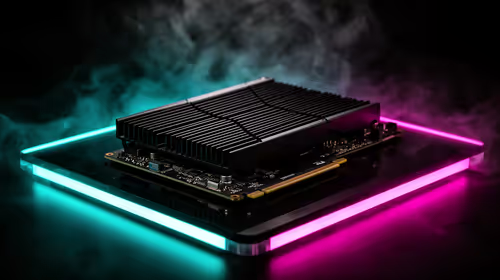
So, what makes a Gen5 SSD so special? It’s simple: they are built to use the incredible speed limit of the PCIe 5.0 highway. While a fast PCIe 4.0 SSD might top out around 7,000 MB/s, Gen5 drives are already pushing past 12,000 MB/s and beyond.
What does that speed mean for you?
- Instant Loading: Games that support DirectStorage technology can load assets almost instantaneously.
- Seamless Content Creation: Editing 8K video or working with massive project files becomes buttery smooth, with no stuttering.
- Rapid File Transfers: Moving huge files takes seconds, not minutes.
This is the next frontier of performance, and innovative brands like Klevv South Africa are at the forefront, developing storage that can keep up with the most demanding tasks.
Gen4 vs. Gen5: What’s the Right Choice for You?
Here’s the big question: do you need to rush out and get a Gen5 SSD today? For most South African gamers, the honest answer is… probably not yet. ✨
While the performance of Gen5 SSDs is incredible, the real-world gaming benefits are still emerging as developers adapt. Right now, a high-quality Gen4 drive offers the absolute best bang for your buck, delivering phenomenal speed that will make any PC feel incredibly responsive. For example, a top-tier drive like the Klevv CRAS C925G 1TB Gen4 NVMe SSD offers incredible performance that smashes older SATA SSDs and is more than enough for today's biggest titles.
So, who should consider a Gen5 SSD?
- The Future-Proofer: Someone building a top-of-the-line rig who wants the absolute best, no compromises.
- The Professional: Video editors, 3D artists, and data scientists whose livelihoods depend on shaving minutes or even hours off processing times.
Compatibility Check! 🔧
Before you even think about buying a Gen5 SSD, you must confirm that both your CPU (e.g., AMD Ryzen 7000 series or Intel 12th-Gen and newer) and your motherboard (e.g., X670, B650, Z790) explicitly support PCIe 5.0 for M.2 storage. Without that support, your super-fast drive will just run at slower Gen4 speeds.
Ultimately, understanding Gen5 SSDs and PCIe lanes is about knowing your options. The future is ridiculously fast, but today's value is undeniably with Gen4.
Ready to Obliterate Loading Times?
Whether you're future-proofing with the latest Gen5 tech or grabbing a fantastic value Gen4 drive, the right SSD will transform your PC experience. Explore our massive range of SSDs and find the perfect speed upgrade for your rig.