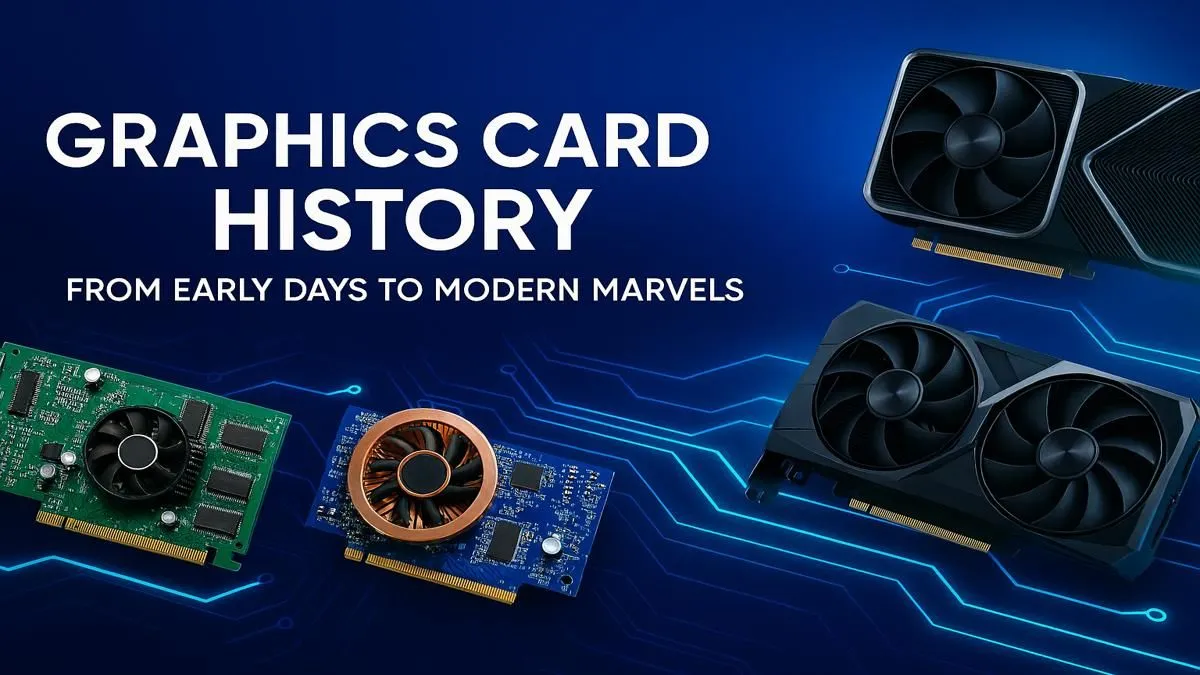
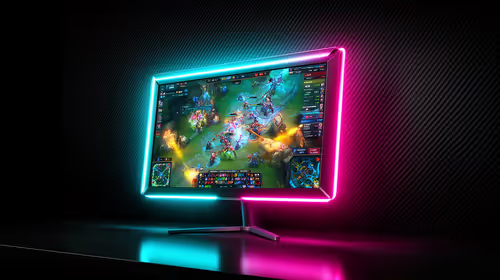
Ever paused in the neon-drenched streets of Night City and just... stared? The way light reflects off wet pavement, the subtle shimmer of a character's eyes—it’s easy to forget it’s all just code and silicon. For many South African gamers, our journey started with chunky pixels and 8-bit sprites. This incredible leap forward is thanks to one component, and its story is the graphics card history itself. 🚀
The Early Days: When Pixels Were King
Before 3D worlds, there was the humble 2D plane. Early PCs in the 80s used simple display adapters like CGA and EGA, capable of showing only a handful of colours. For gamers, this meant side-scrollers and text adventures. The job of the "graphics card" was basic: take data from the CPU and put coloured pixels on the screen.
The real shift began with the arrival of VGA (Video Graphics Array), which set a standard that paved the way for more complex visuals. But even with these advances, the heavy lifting was still done by the CPU. This fundamental limitation was about to be shattered by the 3D revolution, marking a pivotal chapter in the evolution of graphics cards.
The 3D Explosion: How Polygons Changed Everything 👾
The mid-90s changed gaming forever. Titles like Quake and Tomb Raider introduced players to immersive 3D environments built from polygons. This new approach required specialised hardware to handle the complex calculations. Enter the dedicated 3D accelerator.
While many companies tried, one name became legendary: 3dfx Interactive. Their Voodoo graphics cards were magical, using a proprietary "Glide" API to deliver smooth 3D visuals that were previously unthinkable. This was the moment the graphics card became the single most important component for a gaming PC.
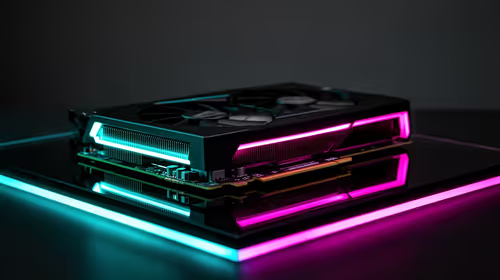
Soon after, a company called NVIDIA released the GeForce 256, marketing it as the world's first "GPU" (Graphics Processing Unit). It integrated transformation, clipping, and lighting calculations directly onto the chip, freeing up the CPU. This innovation laid the groundwork for the lineage of powerful NVIDIA GeForce graphics cards we see today.
The Age of Shaders: Painting with Light and Shadow
The early 2000s kicked off an arms race. The next great leap in the evolution from pixels to photorealism was the introduction of programmable shaders. In simple terms, shaders are small programs that tell the GPU how to handle light, shadow, and colour for every single pixel.
Giving Developers Control
Suddenly, developers weren't limited to fixed lighting models. They could program realistic water reflections, complex bump maps for texture, and dynamic shadows. This era, powered by Microsoft's DirectX 9, gave us visually stunning games like Half-Life 2 and Far Cry. The fierce competition from rivals like AMD Radeon, which acquired ATI, pushed innovation and performance forward at a blistering pace.
Driver Discipline 💡
Your powerful GPU is only as good as its software. Always perform a clean installation of your graphics drivers using a tool like DDU (Display Driver Uninstaller) when upgrading your card. This removes old files that can cause stuttering, crashes, and performance issues, ensuring your new hardware runs perfectly from day one.
Today's Frontier: AI, Ray Tracing, and True Photorealism ✨
Which brings us to the modern era. The graphics card history has culminated in technologies that were once pure science fiction. The two biggest pillars of modern GPUs are:
- Real-Time Ray Tracing: This technique simulates the physical behaviour of light. Instead of faking reflections and shadows, a ray-tracing-capable GPU calculates the path of individual light rays, creating incredibly lifelike and immersive scenes. It's the key ingredient in the journey from pixels to photorealism.
- AI Upscaling: Technologies like NVIDIA's DLSS and AMD's FSR use artificial intelligence to render games at a lower resolution and then intelligently upscale the image to your monitor's native resolution. The result? A massive performance boost with minimal-to-no loss in visual quality. It’s like getting free frames per second.
The power available now is staggering. If you're still running a card from a few generations ago, the performance and feature jump is bigger than ever. If you're feeling that your current setup is struggling with the latest titles, it might be time to check out the best graphics card deals in South Africa.
Ready to Power Your Photorealistic Future?
The history of the graphics card shows just how fast technology moves. Don't get left behind in a world of pixels. Explore our massive range of PC components and find the perfect GPU to bring your games to life.