You’re deep in a boss fight, the last one standing for your squad. Then you hear it… a faint click-click-click from your PC or laptop. It’s a sound that can make any gamer’s blood run cold. That rhythmic, mechanical hard drive clicking noise isn't just an annoyance; it's a death rattle. 💀 It’s the sound of your precious data, your game saves, and your operating system being held hostage by failing hardware. Here's what's happening and your emergency action plan.
Understanding the "Click of Death"
So, what does that dreaded hard drive clicking noise actually mean? Inside your traditional Hard Disk Drive (HDD), a tiny read/write head on an actuator arm floats fractions of a nanometre above a spinning platter to access your data. When you hear that click, it’s the sound of the actuator arm failing to find the data track it’s looking for. It hits its physical stop, resets, and tries again... click.
Think of it like a record player's needle skipping violently across a vinyl. Every click is a failed attempt to read data, and worse, it could be physically scratching the platter's magnetic surface, destroying your information permanently. This is a critical mechanical failure, and time is absolutely not on your side.
Your Immediate Action Plan for a Clicking Hard Drive 🔧
If your PC starts making a hard drive clicking noise, your next few actions are crucial. The goal is to preserve as much data as possible without causing further damage. Forget what you've read on old forums; this is the pro-level advice.
Step 1: Stop Everything & Power Down
Seriously. Stop what you're doing. Don't try to run a virus scan, don't try to copy that one last folder, and definitely don't run any "repair" software. Every second the drive is powered on, the head is potentially scraping across the platters. Shut down your computer gracefully if you can. If it's unresponsive, hold the power button down.
Step 2: Disconnect the Drive
Once the machine is off, unplug it from the wall. If you're comfortable doing so, open the case and physically disconnect the power and data cables from the clicking hard drive. This prevents it from accidentally being powered on again during any troubleshooting.
Step 3: Do Not Attempt DIY "Fixes"
The internet is full of bad advice. Don't be tempted to shake the drive, tap it, or try the infamous "freezer trick." Putting a drive in the freezer is a guaranteed way to destroy it with internal condensation when you take it out. If the data is mission-critical, your only option is to contact a professional data recovery service and prepare for a hefty bill. For most of us, it's time to accept the loss and move on.
SSD vs HDD: The Silent Upgrade
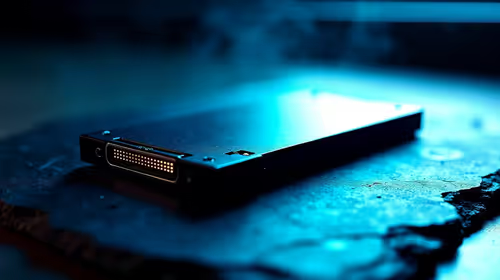
A clicking hard drive is a problem unique to mechanical HDDs. Solid-State Drives (SSDs) have no moving parts, making them silent, dramatically faster, and far more resistant to physical shock. An SSD upgrade is the best long-term fix and preventative measure.
Why Your Hard Drive is Clicking (and What Comes Next)
A clicking hard drive almost always signifies a terminal physical problem. While the outcome is the same, the causes can vary:
- Age & Wear: Like any mechanical device with moving parts, HDDs wear out. The motor can fail, or the actuator arm can lose its precise alignment.
- Physical Shock: This is a big one for laptops. Dropping your device or even a sharp jolt can cause a head crash, where the read/write head slams into the platter.
- Power Issues: Sudden power loss or a surge from load shedding can corrupt the drive's firmware or damage its delicate electronics.
The only real cure for a hard drive clicking noise is replacement. Your focus must shift from "fixing" to "replacing." This is the perfect opportunity to upgrade to an SSD for a massive performance boost. You'll find some of the best gaming laptop deals that come standard with speedy SSDs, making clicks and slow load times a thing of the past. 🚀
Preventing Data Loss Before the Next Click
Losing data to a clicking hard drive is a painful lesson, but one you only need to learn once. The best strategy is a proactive one.
Getting into a good backup routine is non-negotiable. Use a cloud service like Google Drive or OneDrive for important documents, and consider an external hard drive for larger files and system images. A "3-2-1 backup" strategy (3 copies, 2 different media, 1 off-site) is the gold standard.
Better yet, upgrade the source of the problem. If your main machine is still running on an old HDD, consider a new system. Whether you bleed red with one of the new AMD laptops on special or favour the raw performance of the latest Intel-powered laptops, a modern device with an NVMe SSD is your best defence. You don't even have to break the bank; there are plenty of powerful gaming laptops under R20k that offer a huge leap in speed and reliability. 💾
Ready for a Silent, Speedy Upgrade? Don't let a failing drive be the end of your game. Explore our massive range of brand-new, lightning-fast laptops... Shop now at Evetech for performance that leaves lag in the dust.