Staring at your screen, you swear you clicked first. But the killcam tells a different story. Sound familiar? For many South African gamers, that split-second lag isn't just about 'gitting gud'... it might be your monitor. The buzz around high refresh rate gaming monitors is real, but let's cut through the noise. Are they truly worth your hard-earned Rands, or is it just another expensive spec to chase? Let's dive in.
From Lag to Liquid Smooth: What is Refresh Rate?
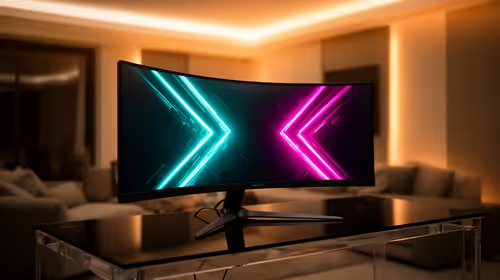
Before we decide if an upgrade is worth it, let's quickly break down the tech. Think of your monitor's refresh rate, measured in Hertz (Hz), as the number of times it updates the image on screen every second. A standard 60Hz monitor refreshes 60 times per second. A high refresh rate gaming monitor, like a 144Hz model, refreshes 144 times per second.
It’s a simple concept with a massive impact:
- 60Hz: The old standard. Fine for office work and slower games.
- 120Hz/144Hz: The sweet spot for most gamers. The jump from 60Hz is immediately noticeable, delivering buttery-smooth motion.
- 240Hz and above: The pro-tier. Aimed at esports athletes where every single frame counts.
More frames per second mean motion looks less blurry, animations are cleaner, and you receive visual information just a little bit faster than your opponent on a 60Hz screen.
The Real-World Advantage: Where High Refresh Rates Shine ✨
So, does it actually make you a better gamer? In certain scenarios, absolutely.
Competitive Shooters (Valorant, CS:GO, Apex Legends)
This is where a high refresh rate gaming monitor provides a clear competitive edge. When an enemy peeks around a corner, your 144Hz monitor shows you their movement milliseconds before a 60Hz screen would. This tiny window can be the difference between landing the first shot and staring at a respawn timer. It reduces input lag and makes tracking fast-moving targets feel incredibly intuitive.
Fast-Paced Action & Racing Games
Even in single-player games like DOOM Eternal or racing sims, the difference is profound. The world feels more solid and connected. Whipping your view around doesn't result in a blurry mess; instead, the environment remains crisp and clear, making the entire experience far more immersive. For anyone who craves that ultra-responsive feel, the upgrade is undeniable.
Before You Buy: Is Your Rig Ready for the Upgrade?
Here’s the crucial reality check: a fast monitor needs a powerful PC to feed it. A 240Hz monitor is wasted if your graphics card can only produce 70 frames per second (FPS). Your GPU and CPU must be capable of consistently pushing frame rates that match or exceed your monitor's refresh rate to see the full benefit.
It’s about building a balanced system. You need to decide what’s more important for your budget and play style: higher resolution (like 4K) for stunning detail, or a higher refresh rate for supreme smoothness. For many competitive gamers, 1080p or 1440p at 144Hz+ is the perfect balance.
Don't Forget This Crucial Step! 🔧
Just bought a new high refresh rate monitor? Don't forget to actually enable it! Windows often defaults to 60Hz. Right-click your desktop > Display settings > Advanced display settings. Under 'Choose a refresh rate', select the highest option available. It's a simple step that many gamers miss, leaving performance on the table!
Smooth Gaming Beyond the Desk 🚀
The quest for smooth, high-refresh-rate gameplay isn't confined to the desktop anymore. We're seeing this premium technology migrate to the exciting world of handheld gaming consoles, which pack serious power into a portable form factor.
Giants like ASUS with their ROG Ally, and new contenders from Lenovo, are packing 120Hz screens into these devices. With established brands like MSI also innovating in the portable space, it's clear that you don't have to be tied to a desk for a premium, fluid gaming experience.
The Verdict: Are They Worth It?
For competitive gamers in South Africa, the answer is a resounding yes. A high refresh rate gaming monitor is one of the most noticeable and impactful upgrades you can make to your setup. For casual players who enjoy immersive single-player titles, it's a fantastic quality-of-life improvement that makes everything feel more responsive.
If your PC is up to the task, moving from 60Hz to 144Hz or higher isn't just an upgrade; it’s like seeing what you've been missing all along.
Ready to See the Difference for Yourself?
A high refresh rate gaming monitor can be one of the most impactful upgrades you make. If you're serious about competitive gaming or just want the smoothest experience possible, it's an investment that pays off every time you play. Explore our massive range of gaming monitors and find the perfect screen to dominate the competition.